
Is methamphetamine a significant workplace hazard?

The Australian Industry Group (AIGroup)  submission to the Australian Government’s Parliamentary Joint Committee on Law Enforcement inquiry into crystal methamphetamine, commonly known as Ice, has been made publicly available.  The submission focuses on the risks to all workplaces, primarily, by imposing non-work statistics onto the workplace, lumping Ice in with other illicit drugs, and relying on anecdotal evidence. This approach is not unique to AiGroup and can also be seen regularly in the mainstream media but such an important Inquiry requires a much higher quality of evidence than anecdotes.

The submission references a recent Australian Crime Commission (ACC) report into Ice saying it:

“… paints a bleak picture for the community and Australian workplaces. This combined with greater ease of access, including in regional areas, places Australian workplaces at risk.

A key requirement for employers seeking to manage safety risks arising from persons attending work affected by Ice is the ability to conduct workplace drug and alcohol testing.” (page 3)

The ACC report refers almost exclusively to the hazards presented to hospital and emergency staff, not by Ice use by staff, and yet is able to link Ice-affected public to the drug testing of workers. Continue reading “Is methamphetamine a significant workplace hazard?”
Mixed messages on OHS and productivity

There is a clear link between the modern take on occupational health and safety (which includes psychosocial health) and productivity. However, there are seriously mixed messages coming from the Productivity Commission (PC) in its current inquiry into Australia’s Workplace Relations Framework.

In Senate Estimates on 3 June 2014 (draft Hansard), the Chair of the Productivity Commission, Peter Harris, and Assistant Commissioner, Ralph Lattimore, briefly discussed OHS.  Harris acknowledged that some of the submissions to the current inquiry discussed OHS matters (page 65) but Lattimore stated:

“….we did say that we would quarantine the inquiry away from workforce health and safety issues unless they were directly related to, say, enterprise bargaining or some feature of the relationship between employers and employees. We were aware of the large amount of regulation in that area, and we were not planning to revisit that.”

Subscribe to SafetyAtWorkBlog to continue reading.
Subscribe Help
Already a member? Log in here

ACTU Congress’ draft OHS policies deserve serious analysis

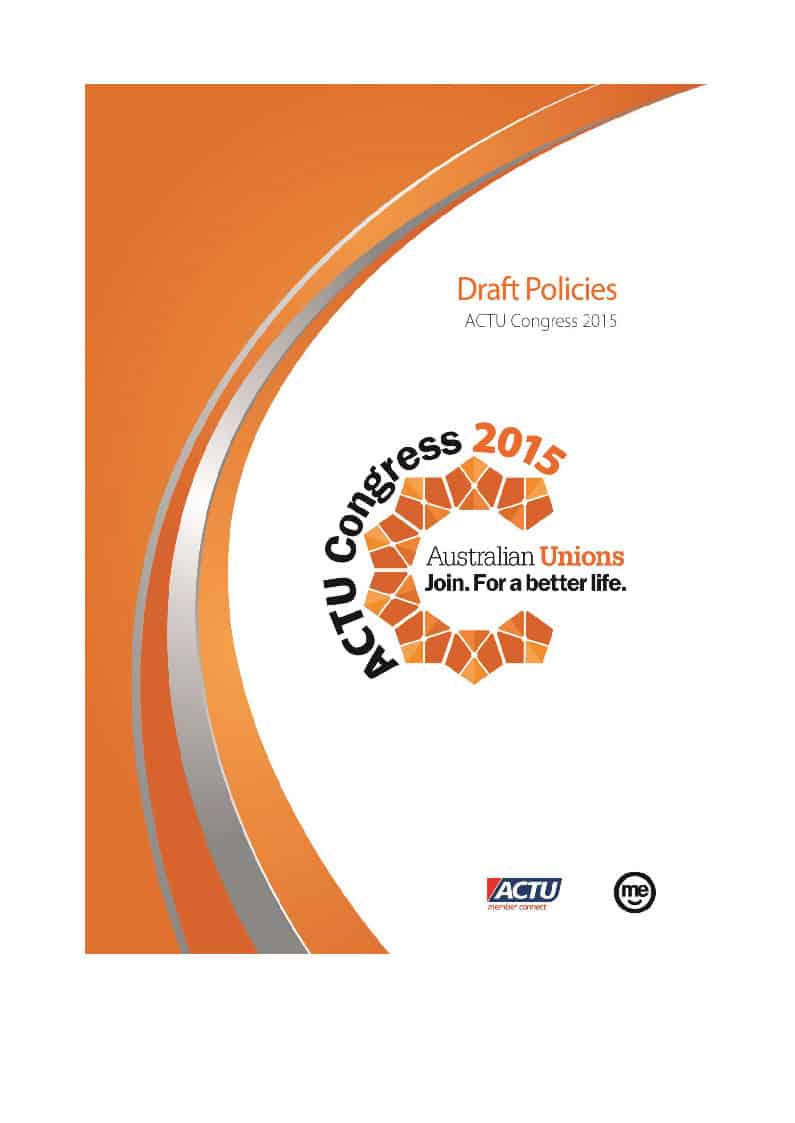
Pages from draft-2015-actu-congress-policies-2015-consolidatedThe Australian Council of Trade Unions (ACTU) commences its 2015 Congress this week.  Each year around 800 trade union delegates meet to discuss changes to policies and to develop or refine strategies. This year the ACTU released its draft policies publicly prior to the Congress.  These policies have a long and strong historical and industrial relations context.  Occupational health and safety (OHS) is an important part of these policies and should spark discussions in the union movement and the OHS profession.

Early in the document, the ACTU states its “bargaining agenda” in which is included

“better work, life and family balance.” (page 7)

Curiously, the ACTU has chosen “better” rather than “safe”.  Better is a more inclusive term but harder to define.  Better for whom?  Better could be better paid or more secure or safer.

Trade unionists often see OHS as being monitored and enforced through the mechanism of the Health and Safety Representatives (HSRs) and would argue that OHS is throughout all the draft policies due to the HSR role but there are more workplaces in Australia without HSRs than with and it is worth considering the policies as independent from the HSR structure, if that is possible..

Subscribe to SafetyAtWorkBlog to continue reading.
Subscribe Help
Already a member? Log in here

Cancer data needs to start a discussion on effective controls

Cover of Cancer Occupational reportThe Cancer Council of Western Australia has released a report (not yet available online)that states:

“The number of occupationally caused cancers compensated each year equates to less than eight per cent of the expected number.” (Executive Summary)

This is an extraordinary statistic but consistent with the history of occupational health and safety (OHS) statistics where the core data originates from compensation figures rather than incident figures.  Cancer has always been a challenge in this area as it can manifest years after exposure or not at all. But this report also provides important data, and a challenge, for OHS professionals and business owners as

“Occupational exposures to carcinogens are estimated to cause over 5,000 new cases of cancer in Australia each year.” (Executive Summary)

The report has an excellent discussion on why such statistics are estimates and the unreliability of previous data in Australia and overseas but there is only a short, but important, discussion about risk and hazard controls – the principle focus for OHS professionals. Continue reading “Cancer data needs to start a discussion on effective controls”

Beyond auditing for due diligence

One of the most significant motivators for changes in safety leadership in the executive circles in Australia has been the obligation to apply due diligence to occupational health and safety (OHS) matters. The obligation has existed for several years now but is still dominated by legal interpretations rather than managerial ones. To support the legal obligations, OHS professionals should look at how they can add value to due diligence.  One way of achieving, and exceeding, compliance of due diligence would be to subject OHS systems and strategies to a peer-review rather than a narrow audit process. Continue reading “Beyond auditing for due diligence”

Important OHS statements in Australia’s Parliament

On the eve of its 2015 Budget, the Australian Parliament was debating an increase in enforcement powers of the Fair Work Building and Construction inspectorate and the resurrection of the Australian Building and Construction Commission (ABCC).  Occupational health and safety (OHS) is rarely mentioned in these debates but not so on 11 May 2015.  Excerpts from yesterday’s safety-related comments are worth noting, particularly as no mainstream media has done so or is likely to..

Senator Cory Bernardi (Liberal Party) attacked a recent video from the Construction, Forestry, Mining and Energy Union (CFMEU) saying that

“For too long the unions have falsely cried safety as a lazy defence for their unlawful and unethical industrial conduct. They have cried wolf so often that they can no longer be believed.”

Subscribe to SafetyAtWorkBlog to continue reading.
Subscribe Help
Already a member? Log in here

Cry of frustration in Industrial Manslaughter Bill

Over the last few months some in Australia’s trade union movement have renewed calls for the introduction of industrial manslaughter laws in various jurisdictions. The issue has appeared both on television and online.

Curiously the Australian Council of Trade Unions (ACTU) seems to have dropped the “industrial manslaughter” terminology it has used in the past. In a 28 April 2015 media release, the ACTU stated:

““Strengthening OHS laws to make negligent companies and individual directors liable sends a clear message to employers that they must ensure people are safe at work.”

and

“Current laws need to be strengthened so that companies and company directors are liable for our safety at work.”

It seems that the charge has been left to the South Australian Greens Parliamentarian,

Subscribe to SafetyAtWorkBlog to continue reading.
Subscribe Help
Already a member? Log in here
Concatenate Web Development
© Designed and developed by Concatenate Aust Pty Ltd