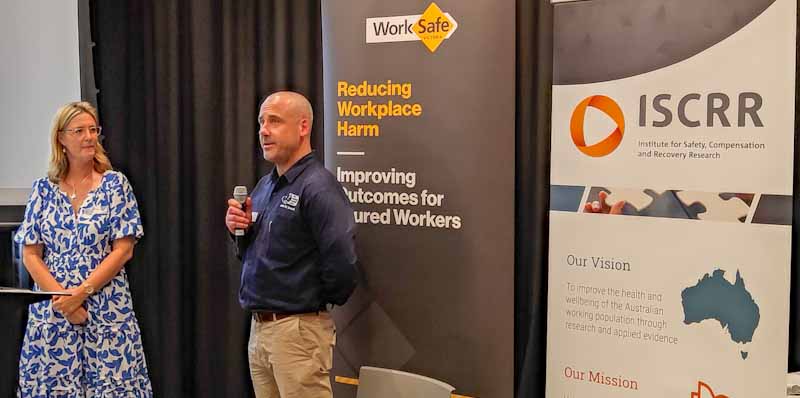
Last week, the Institute for Safety, Compensation and Recovery Research (ISCRR) conducted presentations of its latest research programs. Those projects included:
- Vicarious Trauma
- Evaluating Pilot Programs
- Bitumen Fume Exposure
- Systems Thinking

Last week, the Institute for Safety, Compensation and Recovery Research (ISCRR) conducted presentations of its latest research programs. Those projects included:
Advisory books about how to manage Burnout continue to be published. Another one that, due to the format and publisher, could be influential is Burnout for Dummies by Eva Selhub. Sadly, Selhub consciously downplays the occupational health and safety (OHS) role in preventing Burnout. Her choice sidelines OHS, the organisational context and the employer’s duty of care, but that seems typical for Burnout authors from the United States.
Occupational health and safety (OHS) in healthcare is a unique experience. Patient care and patient safety seem to override the OHS duties for healthcare workers. This is understandable given the culture and purpose with which people work; however, it is short-sighted, especially on the issue of mental health at work.
A new book on burnout (yes, another, and there are even more) was published recently on the issue of preventing burnout for healthcare workers, written by John Halbesleben. This 2nd edition has a slightly revised title to reflect the changing emphasis on mental health at work.
Halbesleben writes that the first edition from 2009 tried to convince readers that burnout was an occupational risk. Since then, that fact is now accepted, and not just because of the coronavirus pandemic. He writes:
Pam Gurner-Hall is no stranger to this blog. Recently she appeared in an article by the Australian Broadcasting Corporation (ABC) about access to information from South Australia’s occupational health and safety (OHS) regulator, SafeWorkSA.
SafeWorkSA has been under considerable scrutiny for the last few years. A “root and branch” review conducted by John Merritt is the latest inquiry. [Note: this article was written before the release of the Merritt report and the Government’s interim response last weekend. More on that report shortly]
Gurner-Hall’s concerns seem more about the government’s response to the inquiry and the application of Legal Professional Privilege (LPP). She is quoted saying:
The primacy of profit to employers is an accepted truth. However, the size of the profit and the pathway to those profits are not absolutes, and it is in this latter context that occupational health and safety (OHS) lives.
Even though profit is a business truth, it is often a word that business representatives seem to fear. They speak of profit through synonyms like “productivity” and “competitiveness”. An example of this timidity or wariness was displayed recently by prominent businessman Michael Angwin in an opinion piece in the Australian Financial Review (paywalled) that contained many other cautious words of business jargon. Angwin misses the harm to workers and others generated by the world as he sees it.
I am always surprised how few people who talk about workplace and safety cultures seem not to have read the great sociologists of culture. Raymond Williams was important when I studied sociology and literature at university in the 1980s. I was reminded of his importance by this article in Catalyst.
As neoliberalism experiences a decline in influence on governments and corporations, it is useful to look at the sociology of culture from the pre-neoliberalism days, even if only dipping into my bookshelves. The Catalyst article opens with this:
“Raymond Williams hasn’t survived the cultural turn intact. Even though he was instrumental in foregrounding the significance of culture in human affairs, his materialist methodology and commitment to socialism jarred against the textualism and cultural relativism of the last three decades. The rise of neoliberalism had an effect as well. It undercut the values of cooperation and solidarity that were key to postwar radical intellectuals like Williams. But a Williams revival is finally underway.”
Consulting firm KPMG has released its annual survey report on the concerns of corporate executives called “Keeping us up at night – The big issues facing business leaders in 2023”. Occupational health and safety (OHS) fails to get a mention. (So much for the attitudinal impact of Industrial Manslaughter laws!) But then neither does “mental health” nor “sexual harassment“.
The KPMG report may accurately reflect executive priorities, but it may also reflect a denial of reality.