Opaque response on construction industry safety code

Model-Health-and-Safety-Management-Plan (2)Victoria’s Construction Compliance Code Unit in the Department of Treasury and Finance has just completed its public comments stage for its model Health and Safety Management Plan (HSMP).  The comments period was extended by a month after initially ending after only one month‘s public consultation on 6 January 2014.  New South Wales and Queensland have mirrored the Victorian construction compliance code so the significance of this OHS submission stage should not be underestimated however the submission process and unusual secrecy is not building the faith and trust in the HSMP that the process needs for it to succeed.

The regular process for submissions to government inquires is for those submissions to be made publicly available, with the permission of the writer.  The CCCU seems to have no plans to follow this protocol which is an enormous shame as the submissions would have provided a window into both the understanding of OHS in the Victorian construction sector, an understanding of the OHS role of the CCCU and an insight into how the CCCU is generally perceived by the Victorian community.

SafetyAtWorkBlog put the following (we think reasonable) questions to the CCCU last week in preparation for the end of the commentary phase:

  • Could you please estimate the number of submissions the CCU has received on the model Health and Safety Management Plan (HSMP) to date?
Subscribe to SafetyAtWorkBlog to continue reading.
Subscribe Help
Already a member? Log in here

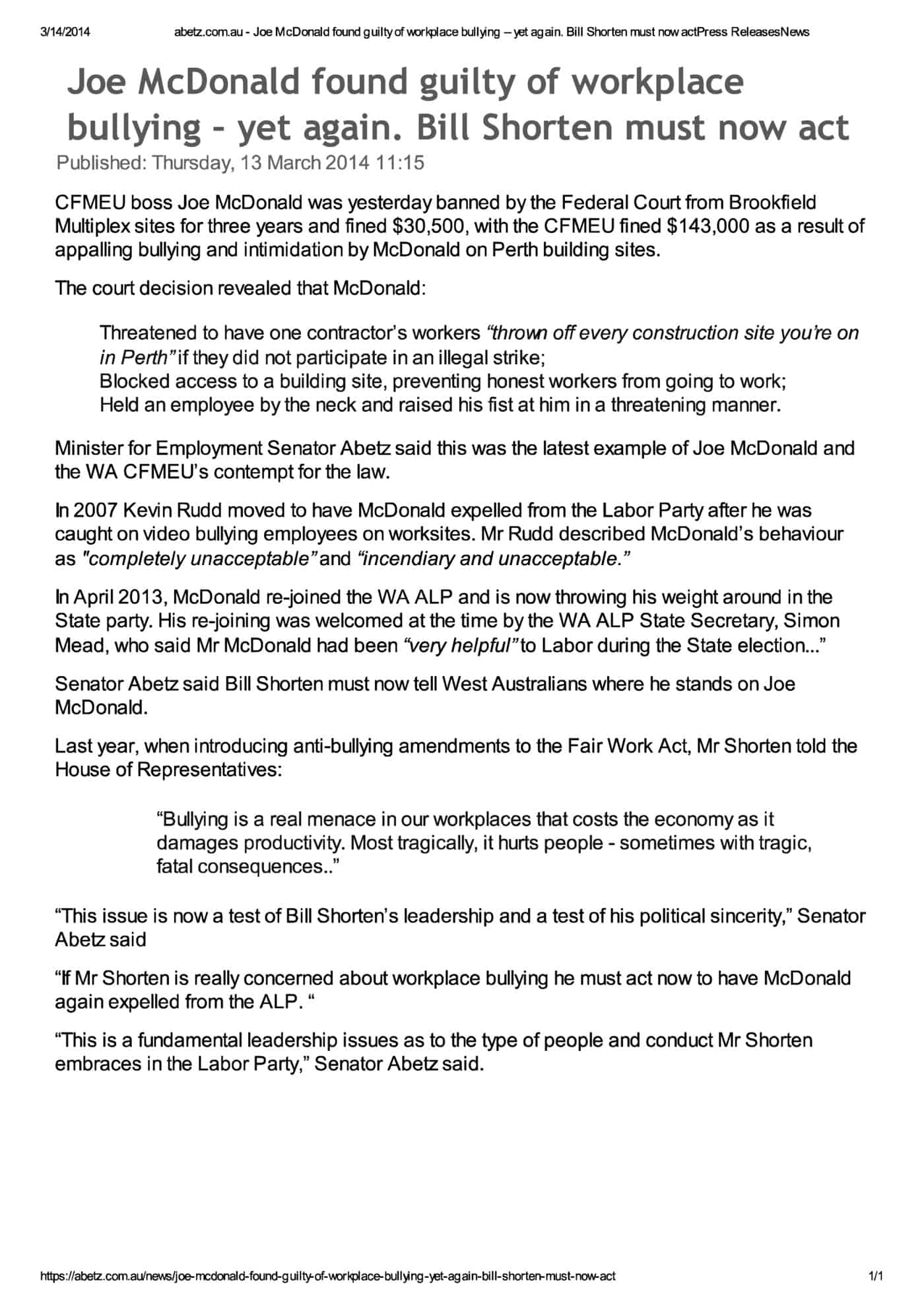
Proposed drug testing – a political tool

On 6 February 2014 the Victorian Premier. Denis Napthine, announced the intention to

“…require construction companies to implement comprehensive drug and alcohol screening measures to ensure the safety of workers to be eligible to tender for Victorian Government construction contracts.”

This is to be part of the occupational health and safety (OHS) obligations of companies under the Implementation Guidelines to the Victorian Code of Practice for the Building and Construction Industry.  Understandably the construction union, particularly, is angry and feels as if it is being singled out.  Both organisations have chosen their words very carefully. Premier Napthine is quoted as saying:

“Reports of illicit drug use and distribution on Victorian construction sites are widespread.”

The CFMEU‘s Victorian Secretary John Setka has stated that

“There is no epidemic of drug taking on construction sites…. Our Health and Safety representatives who look out for workers’ health and safety are not reporting a problem.”

It is unlikely there is an epidemic of drug use but the Premier is talking of drugs AND alcohol.  

Subscribe to SafetyAtWorkBlog to continue reading.
Subscribe Help
Already a member? Log in here

Interesting new appointment at South Australia’s Master Builders

Modern workers rarely stay in jobs longer than six or seven years because they choose to move on or are working on projects that have a short lifespan. Sometimes opportunities arise that can steer people in unpredictable directions, sometimes to positions of influence.  One example of this type of journey could be Ian Markos.

One newspaper recently wrote:

“The recently appointed director of policy for the SA branch of the MBA, Ian Markos, said a “nanny state” approach was stifling job creation. “There’s a raft of laws and regulations. You’ve got employment laws, you’ve got taxation laws, you’ve got environmental laws, you’ve got work health and safety laws, local council regulations. We’re saying enough is enough,” he said.”

Criticism of occupational health and safety (OHS) laws is not surprising from the Master Builders Association but Ian Markos was with South Australia’s OHS regulator, SafeWorkSA, for many years (with a once-only appearance on Gardening Australia) as the Chief Officer, Compliance, Advisory, Legal and Investigations. Continue reading “Interesting new appointment at South Australia’s Master Builders”

Serious questions raised about the effectiveness of OHS enforcement strategies

Richard Johnstone is always worth reading as he writes perceptively about occupational health and safety (OHS) and its enforcement.  The new book from Baywood PublishingSafety or Profit” provides a chapter by Johnstone that argues:

“…that despite the rhetoric of stronger enforcement and more robust prosecution, the dominant ideology of work health and safety enforcement – ambivalence about whether work health and safety offenses are “really criminal” and viewing prosecution as a “last resort” in the enforcement armory – still dominates the approach of Australian work health and safety regulators.” (page 113)

The importance of Johnstone’s chapter is that he reminds us that much of the current OHS debate is circular and limited and fails to question the soft enforcement strategy that has existed since the

Subscribe to SafetyAtWorkBlog to continue reading.
Subscribe Help
Already a member? Log in here

New book provides fresh context to OHS

SafetyAtWorkBlog regularly receives excellent review books from the New York publishing company, BaywoodPublishing.  The latest is entitled Safety or Profit? – International Studies in Governance, Change and the Work Environment.   I have yet to get beyond the introduction to the chapters by Australian academics on precarious workers (Quinlan) and the decriminalisation of OHS (Johnstone) but the introduction is fascinating.

The most fascinating is its discussion of Lord Robens’ Report of the Inquiry into Health and Safety at Work from 1973. The editors, Theo Nichols and David Walters, question the “major advance” many claimed for the Robens report by comparing it reviews 40 years earlier.  Nichols and Walters quote the conservatism that led to Robens seeing criminal law as being “largely irrelevant”, and legal sanctions being “counter to our philosophy”.  However, they do admit that Robens was prophetic on the growth of self-regulation and the duties of care.

Nichols and Walters also remind us that the Robens-inspired Health and Safety At Work Act of 1974 did not recommend the creation of Occupational Health and Safety (OHS) representatives.

Subscribe to SafetyAtWorkBlog to continue reading.
Subscribe Help
Already a member? Log in here

Prediction on accountability and a political kick in the balls

Responsibility highlighted in greenThere will be two areas of occupational health and safety attention in the early months of 2014 in Australia – workplace bullying laws and the Royal Commission into Home Insulation Program.  The labour law firms are gearing up for a “bumper year” as one said prior to Christmas and the business groups are already lobbying/complaining/whingeing about the workplace bullying laws administered by the Fair Work Commission.  However the Royal Commission has the potential for the biggest social and ideological impact so, as the new year begins, I will attempt some predictions of the Royal Commission’s findings based around some of the terms of reference.

Substantial Change

‘the processes by which the Australian Government made decisions about the establishment and implementation of the Program, and the bases of those decisions, including how workplace health and safety and other risks relating to the Program were identified, assessed and managed;’

This paragraph is the one that could have the most long-term effect on governance, due diligence and procurement.  There are many suggestions on these issues in the sphere of project management but trying to keep the discussion in OHS, there are some useful comments on the Government procurement of services.  Australia’s Federal Safety Commission acknowledges that procurement is an important stage in project design.  WorkSafe Victoria’s “handbook for the public sector – health and safety in construction procurement” says

“As procurers, governments can promote better health and safety by requiring projects to include a range of safety measures, such as specifying the safety budget, building layout or the use of certain

Subscribe to SafetyAtWorkBlog to continue reading.
Subscribe Help
Already a member? Log in here

Media coverage on workplace bullying needs more depth and analysis

The Australian media has given workplace bullying the front page, probably because it is a slow news period and there have been no major disasters this Christmas period. However the coverage is of the new rules and opportunities for assistance offered by changes to the Fair Work Act that commence on 1 January 2014, rather than about prevention.

Most of the comments from the business groups in the article by The Age newspaper will be familiar from the last few months. Generally they object to what they see as red tape and increased regulation. Some also believe that workplace bullying should be handled through human resources rather than as an occupational health and safety (OHS) matter.

Red tape and unnecessary bureaucracy is a legitimate concern but one that, in large part, the business sector has allowed to happen. As discussed previously, much of the red tape originates from the risk management strategy of business where, when an issue or hazard cannot be eliminated or it is too difficult to try, insurance or liability protection is obtained. As others have said, too often the risk management of safety is corrupted to become risk management of legal issues. Continue reading “Media coverage on workplace bullying needs more depth and analysis”

Concatenate Web Development
© Designed and developed by Concatenate Aust Pty Ltd