Creating jobs is a waste unless those jobs are safe

Coming out of recession or, at least, a global financial crisis seems to mean that the creation of jobs is the only driver of economic growth.  Governments around the world seem obsessed with employment creation but rarely is the quality of the employment ever considered.

The drive for jobs at the cost of other employment conditions such as safety was illustrated on 11 March 2011 in an article in The Australian newspaper.  New South Wales’ election is only a short while away and, as it is widely considered to be an easy win for the conservative Liberal Party, government policies are already being discussed.

“Industrial relations spokesman Greg Pearce, a former partner at Freehills, said he was aware that concerns about the workplace safety system had emerged in the legal profession.

But the Coalition’s main goal was to minimise uncertainty to encourage job creation.”

The push for jobs is also indicative of short-term political thinking. Continue reading “Creating jobs is a waste unless those jobs are safe”

One person’s red tape is another’s due diligence

Australian business is soon to be required to apply the concept of “due diligence” to occupational health and safety.  One would have expected the agency that is coordinating the changes to provide detailed guidance on what is expected from “due diligence”.  That is not the case and so, inevitably, lawyers have stepped in (some stepped in some time ago).

Part of the due diligence obligation is that it is necessary to “verify… compliance with the business’ safety obligations” and this is unavoidably achieved by audits and subsequent paperwork.  In fact, paperwork is a vital element of support for “evidence-based decision-making”.  So it is with some concern that one sees the New South Wales WorkCover Authority is number three on the NSW Business Chamber’s list of “top 5 red tape offenders”(?), released on 9 March 2011 . Continue reading “One person’s red tape is another’s due diligence”

OHS harmonisation to result in a substantial increase in costs to business

Australian lawyer Andrew Douglas has provided a frank assessment of the OHS harmonisation process instigated by the Australian government to reduce red tape and administrative costs of safety.  In Smart Company on 1 March 2011, Douglas wrote:

“…the Model Act, the regulations and documents that flow from it will dramatically increase state-based businesses legislative compliance, will massively increase the paperwork proving compliance and will inevitably lead to a substantial increase in costs to business in managing safety and OHS.”

Most State governments continue to support the harmonisation process, in almost all its elements, as a positive for business. So what’s the story here?

Andrew Douglas’ opinion needs serious consideration as it is one of the few contrary positions expressed to date. Continue reading “OHS harmonisation to result in a substantial increase in costs to business”

New books – South African nursing and a Canadian perspective

This week two new OHS books came across my desk unbidden.  Both are very good but have very different contexts and both were published by Baywood Publishing Company Inc.

“Who Is Nursing Them? It is Us.” “Neoliberalism, HIV/AIDS, and the Occupational Health and Safety of South African Public Sector Nurses” by Jennifer R Zelnick

Northern Exposure – A Canadian Perspective on Occupational Health and Environment by David Bennett

South Africa is an exotic foreign land to me.  I am aware of the basic political issues of the country for the last 30 years but, in terms of OHS, I know there have been some major mining incidents and that HIV/AIDS is a major occupational and social challenge.  Zelnick’s book illustrates clearly the difficulty of tackling a workplace risk that is also a hot, contentious public health and political issue. Continue reading “New books – South African nursing and a Canadian perspective”

A new safety professional association for Australia

It looks like the safety profession in Australia is to become lively with competition coming from a new starter.  SIWA Limited became a reality this week.  SIWA describes itself as :

“…a new professional association and Australia’s first truly National ‘Member’ Organisation dedicated to providing professional support for, and service to, persons and corporate entities engaged across the Australian Safety and Health industry.”

Those in the safety industry in Australia would perceive some “digs” at the Safety Institute of Australia (SIA) in the quote above and this is not surprising as some the SIWA’s leadership comes from former SIA members in Western Australia.  However, safety professionals should embrace the chance for diversity and choice in their professional membership options. Continue reading “A new safety professional association for Australia”

Business jumps the gun on OHS, unions hope for the best

As the Australian State of New South Wales approaches its March 2011 election day, the lobbying is becoming more fierce.  In fact,  conservation opposition leader, Barry O’Farrell will need to rein in some of his business colleagues if the lobbying becomes too fierce.

It is widely tipped that O’Farrell will win the election and people are already planning for his ascension.  If the business pressure becomes too overt, it may reduce the size of the landslide win that is being predicted.

For example, prior to the Council of Australian Governments meeting organised by the federal (Labor) government, the New South Wales Minerals Council provides an example of the issue they will be running on through to the election.  CEO Dr Nikki Williams has said in a media release this afternoon: Continue reading “Business jumps the gun on OHS, unions hope for the best”

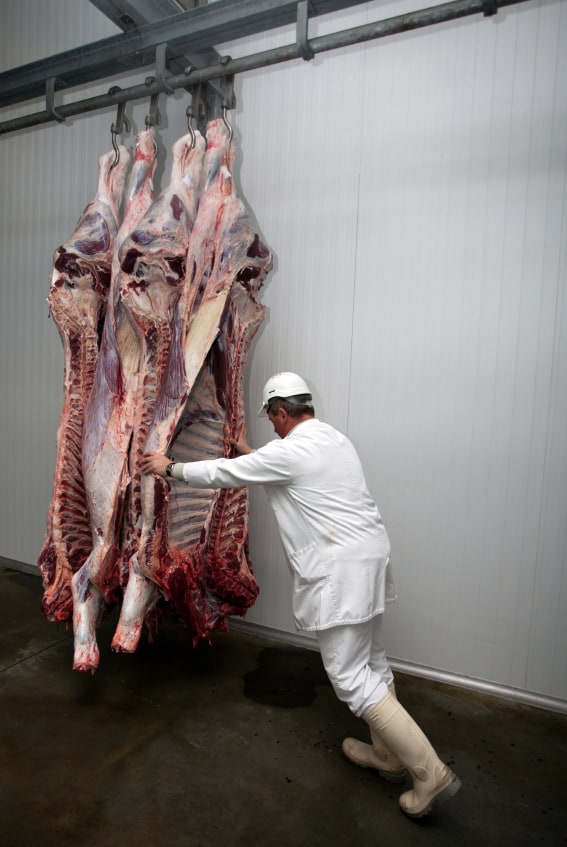
Only animals should die in abattoirs

The Sunday Age of 30 January 2011 ran an article about the status of workplace safety in some of Victoria’s abattoirs.  The article has some similarities to the landmark investigations by Eric Schlosser into work practices and compensation issues related to meatworks in the United States.

The Sunday Age says that

“(Last financial year [2009/2010], there were 355 workers’ compensation claims in Victoria’s meat industry that required at least 10 days off work, or cost more than $580 in treatment, or both – almost one a day. Nationally the industry’s injury and illness rate remains twice as high as that in the construction industry, and four times the average of all workplaces.”

Many would say that meat work is “inherently dangerous” but in the article lawyer Trevor Monti, contests the perception

”Yes, it’s a difficult industry and the work can be hard,” he says. ”But with proper consideration given to the system of work, the risk of injury can be significantly reduced.”

This is a position with which OHS professionals and regulators would agree.

It is significant that, if the comparative figures quoted above by the Sunday Age are accurate, abattoirs do not receive the enforcement attention that the construction industry receives.  Is it that the construction industry is largely unionised and the meat industry much less so?  Is it that abattoirs are rorting the immigration visa system as asserted by the Australian Meat Industry? Continue reading “Only animals should die in abattoirs”

Concatenate Web Development
© Designed and developed by Concatenate Aust Pty Ltd