

Recently The Monthly magazine took a close look at the labour practices of Midfield Meats (paywalled), a major Warrnambool company and meat exporter that had been, yet again, successfully prosecuted by WorkSafe Victoria. There are workplace safety elements to The Monthly’s story that were not as prominent as other issues and there were some questions for companies and governments that have supported Midfield in the past.
Category: Premium

OHS will ease the Work From Home transition
Australian Prime Minister Scott Morrison continues to promise a return to normal but it is impossible to return to a previous point in time without denying the changes that have occurred since then. Morrison speaks of this normality in relation to the COVID-19 pandemic and may offer some understanding of his reticence to act on global warming as climate change will never allow a return to normal.
One of the workplace changes exacerbated by the pandemic is the working from home (WFH) option. Recently businesses are starting to accept this new normal, sometimes backed by research. Many businesses are in a state of (I would argue, permanent) transition. On July 2, 2021, Benjamin Clark offered a useful summary of the WFH state of play for Crikey (possibly paywalled) with some overlap to a November 2020 Harvard Business Review (HBR) article on Working From Anywhere (WFA).
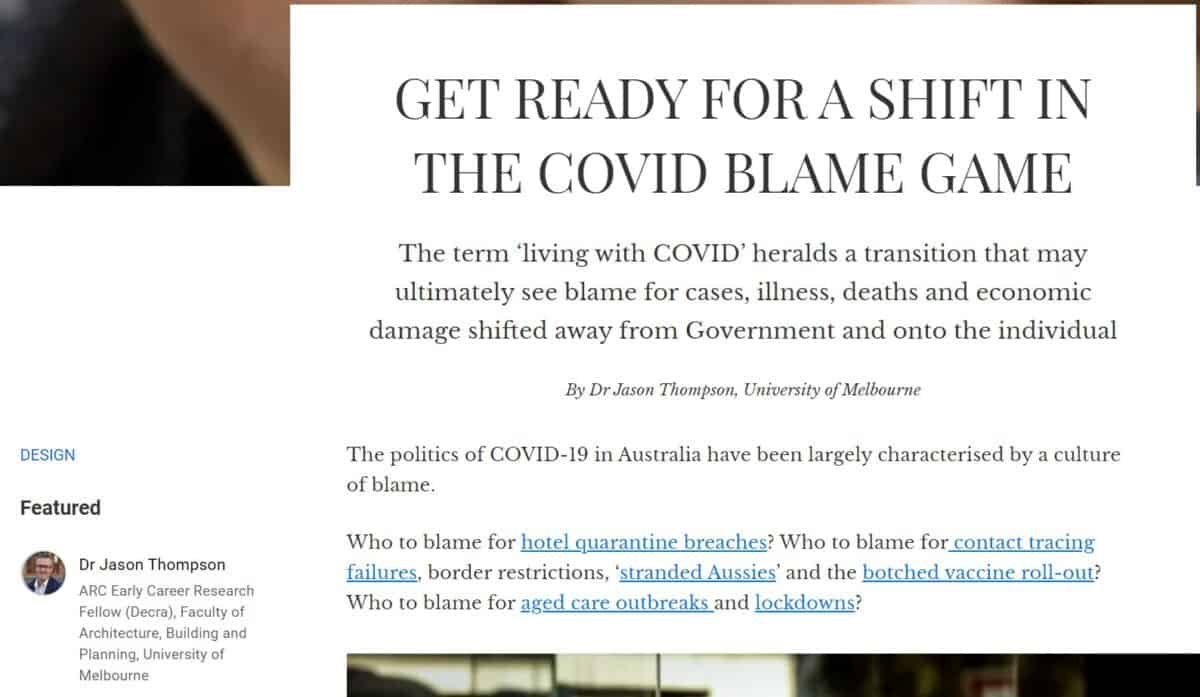
COVID, Blame and Employers
Australia has not had a crisis in public health to the magnitude of COVID-19 for a very long time. It is understandable for people to look at a public health crisis through the reference point of their own experience and profession. There is an overlap between the management of the pandemic and occupational health and safety (OHS), but that overlap should not be inflated.
Jason Thompson wrote an excellent (and recommended) article on COVID-19 and blame for the University of Melbourne titled “Get Ready for a Shift in the COVID Blame Game”. I had the chance to put a few questions to him about the article.

Political attack falls flat
There is an animosity between the Liberal Party in Victoria and some of its sympathetic media and WorkSafe Victoria, particularly aimed at the CEO, Colin Radford. Most of this has been played out in the mainstream media, but recently, in the Public Accounts and Estimates Committee (PAEC) of the Victorian Parliament, the Deputy Chair, Richard Riordan (Liberal), slagged off WorkSafe and Radford over Victoria’s Hotel Quarantine Program. His attack was ineffective and showed a lack of understanding of WorkSafe’s enforcement role and occupational health and safety (OHS) laws.
This performance overshadowed some of the points being made by the Minister for Workplace Safety, Ingrid Stitt (ALP), in the hearing. However, she omitted the upcoming imposition of on-the-spot fines.

Office Noise and Mental Health
Too much weight is given to occupational health and safety (OHS) surveys and research that rely on self-reported data. Such data is subject to social and personal biases. It has its role in the state of knowledge, but its authority and worth is frequently overstated.
A recent research project into the OHS effects of working in open-plan offices removed this level of subjectivity by using a simulated office environment. The researchers’ findings provide a useful context to office design (not a new issue) and work-related mental health, especially when workers are being encouraged to return to the office.

Is Ken Phillips shooting the messenger and missing the real reform target?
Ken Phillips of Self-Employed Australia is continuing his pursuit of Victorian politicians for breaches of the occupational health and safety (OHS) laws after the failure of the State’s Hotel Quarantine Program that led to the deaths of some Victorians from COVID-19. He has supporters in some of the mainstream media and was recently interviewed by Peta Credlin on Sky but perhaps the clearest explanation of his aims is in an interview with George Donikian on The Informer in May 2021. Just recently, Phillips obtained an update from WorkSafe Victoria and has been doing the media rounds again.

Disconnecting is not easy but it is necessary
One of the best ways to maintain one’s own work-related mental health is to adhere to working hours and keep work communication to the hours you are contracted for. This is not rejecting the workload but is establishing boundaries that will offer a more sustainable job, career and mental health.
However, disconnecting is not as easy as that, and there are potential job or career impacts. These were recently discussed in an article in The Guardian written by Elle Hunt.