
 On November 9 2017, the Australian Institute of Health and Welfare (AIHW) released statistical data on work-related injury. This data included statistics from workers compensation but also statistics about hospitalised injuries that were identified as work-related but funded by sources other than workers’ compensation. The report also provides a different perspective on mental health.
Category: depression
What do Weinstein, Spacey and others have to do with OHS?
“Then I went, ‘Oh hang on, I’ve normalised so much of this as part of my industry…. This last three months has really made us all take a long hard look at what we have even let ourselves think is acceptable.” – Sacha Horler

Such a statement is familiar to those working in the field of occupational health and safety (OHS). This normalisation, or habituation, has underpinned much of the discussion of what builds a safety culture – “the way things are done round here”. As a result of revelations and accusations pertaining to Gary Glitter, Rolf Harris, Jimmy Saville, Robert Hughes, Harvey Weinstein, and Kevin Spacey, the entertainment industry around the world has been forced to assess the fundamental ethics on which sections of its industry are based. Continue reading “What do Weinstein, Spacey and others have to do with OHS?”
Discussion of corporate culture includes OHS even when it doesn’t
 The political debate about the dysfunctional culture of Australia’s banking sector has diminished to a discussion, and that discussion continues to bubble along, mostly, in the Australian Financial Review (AFR). The discussion is important for the occupational health and safety (OHS) profession to watch as any change in safety management systems will occur within the corporate or organisational culture.
Two (possibly paywalled) articles appeared this week in the AFR – “
Workplace mental health and wellbeing strategies must consider suicide
 There is an increased blurring between the workplace, work and mental health. In the past, work and life were often split implying that one had little to do with the other except for a salary in return for effort and wellness in preparation for productiveness. This split was always shaky but was convenient for lots of reasons, one of which was the management of occupational health and safety (OHS). However that perceptual split is over, now that mental health has come to the fore in many OHS considerations.
Recently
New approach to mental health of young men needs to expand to include work
Real men and work-related suicide
 Recently Huffington Post Australia posted a video about male suicides called “Men are killing themselves to be real men”. Many of the speakers talked about their experiences at work or with work. The video is highly recommended.
SafetyAtWorkBlog had the opportunity to talk with the Associate Video Editor, Emily Verdouw. Below is an edited transcript.
Research into “gross under-reporting” of illness and injuries
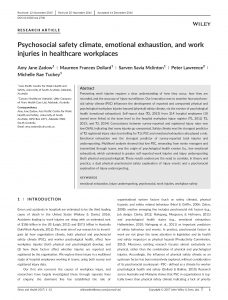 There has been a lot of discussion recently about occupational health and safety (OHS) data. This article is another because the issue is critical for understanding OHS, for planning for the future and managing productivity.
On May 1 2017, the University of South Australia issued a media release about research by Amy Zadow. It opened with the following
“Accidents leading to work injuries cost an estimated $57 billion in Australia and new research from the University of South Australia shows workplaces are unlikely to be adequately addressing injury prevention because management decisions are informed by inaccurate data.”