
The public comment phase of the Victorian Government’s Independent OHS Review into WorkSafe Victoria has concluded and most of the submissions are appearing on the review’s website. Some submissions are extensive, others are simply a whinge. One topic did not get much of a mention in the 40 submissions currently available – on-the-spot fines. The…
Category: research
Workplace suicide reflection
A letter to the Australian & New Zealand Journal of Psychiatry (subscription only) has provided a slightly different perspective on the Australia suicide statistics released earlier this year, and some of the reporting on the statistics. This is an important perspective when considering suicide interventions.
Allison Milner and Andrew Page note that the Australian Bureau of Statistics suicide data only covered the last 10 years which misses out on a comparison from last century which would show the change from 2013 to 2014 to be “less noteworthy”.
On the issue workplace suicides, Milner and Page advocate the integration of prevention strategies into the workplace but also write that
“Workplace suicide prevention activities show promise, but more rigorous evaluation is needed”.
The authors emphasise that
“Perhaps the more important message from the most recent statistics is that suicide among older age males (⩾60 years) and middle-aged males (45–59 years) continue to increase….”
This is an important consideration should your workforce match these demographics.
Milner and Page urge readers to focus on evidence-based approaches to suicide prevention. Such evidence will assist OHS professionals and business owners in considering a worst-case mental health scenario and adjusting these measures to match the mental health profiles of their workplaces and that of their clients.
The research also serves as a caution against immediate commentary on statistics by showing a measured assessment of data. Much of the statistical and academic research reports are murky and complex because the audience is, primarily, academic peers but time and reflection allows for alternate perspectives and, sometimes, plain English translations.
Evidence to support Stand Up, Sit Less, Move More
Office workers need to exercise more. This is one of the simplest occupational health and safety (OHS) statements that can be made. Whether one stands while answering a telephone, walks to a photocopier, have a walking meeting or take the stairs instead of the lift or escalator, you will be healthier by moving. Too often this simple OHS message is confused by sellers of apps, products, furniture and training courses that promise success from a single intervention. The way to avoid this is to look at the research and some recent Australian research into sedentary work is a useful reference in determining workplace safety interventions.
The research “A Cluster RCT to Reduce Office Worker’s Sitting Time: Impact on Activity Outcomes” has been written by a swag of researchers from around Australia and found that a:
“workplace-delivered multicomponent intervention was successful at reducing workplace and overall daily sitting time in both the short- and long- term.”
Great safety book let down by the format
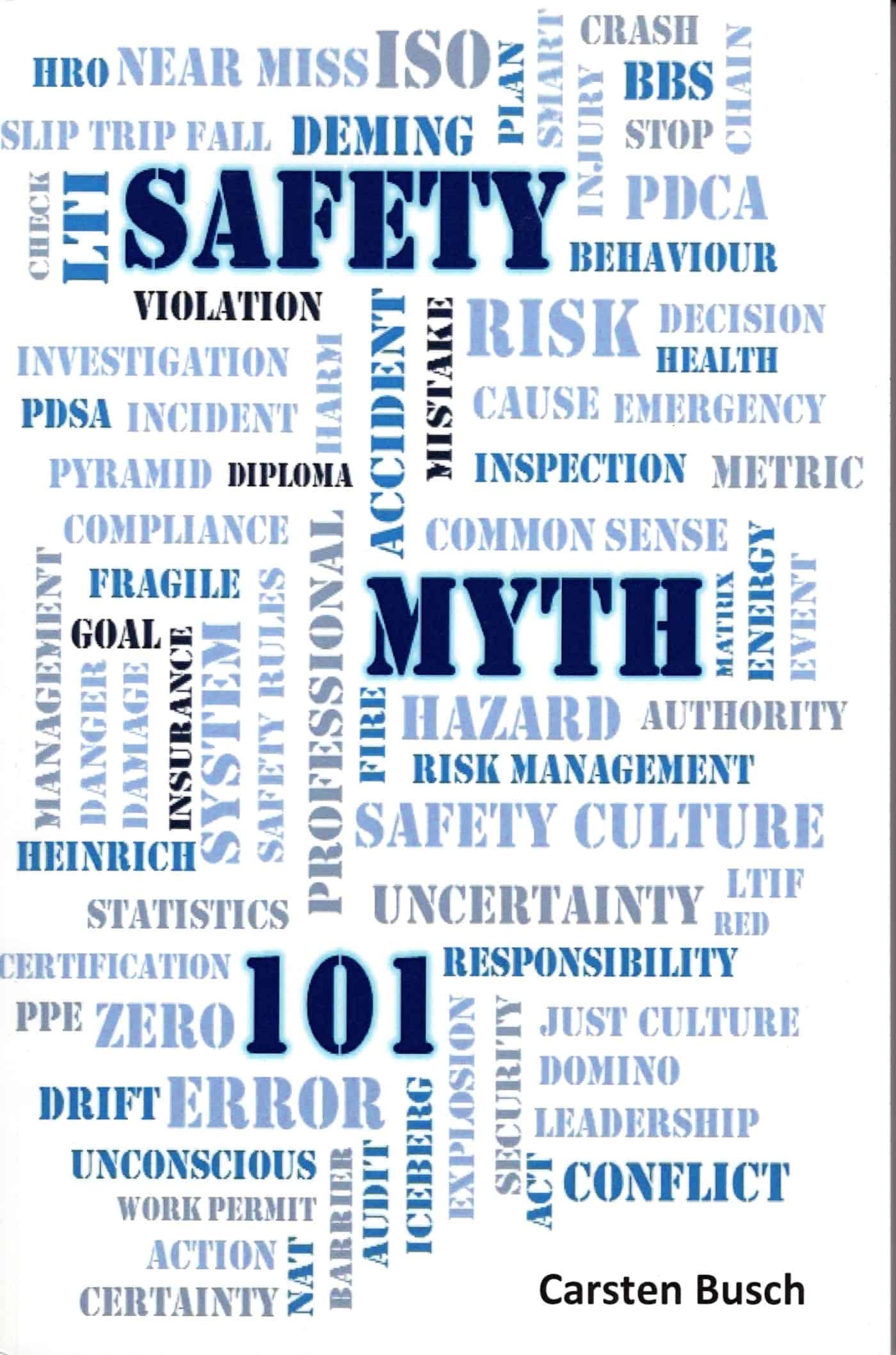 Carsten Busch has self-published “Safety Myth 101” – a book that is one of the most comprehensive discussions on contemporary approaches to occupational health and safety (OHS). But it is also riddled with the problems of many self-published books – the lack of a strong and tough editor, an unattractive presentation and a mess of footnotes, references and endnotes. The content is very good which makes reading this book a frustrating experience.
I can’t help thinking that the book would have been more effective in a more modern online format that would have allowed for word searches, hyperlinks and interaction with readers. In fact, a wiki may have been the best option for Busch’s very valuable content. But what of this valuable content? Continue reading “Great safety book let down by the format”
“We are the safest” – No, only half right
Governments around the world love to be able to claim their State or Country as the safest in the world, when they can. Australia has been plagued by such claims between various States but a report released on July 6 2016 shows that such claims are only half the story.
The Institute for Safety, Compensation and Recovery Research (ISCRR) released its report about “Work-related injury and illness in Australia, 2004 to 2014“. The report makes this extraordinary finding:
“Across Australia, there are twice as many estimated work-related injuries as there are accepted workers compensation claims. This indicates that many injuries do not progress into the nations workers compensation systems” (page 2)
This statement seems to indicate that political statements made on the basis of workers’ compensation data, the major rationale for most of the “we are the safest” statements, are only half right!
Free safety conference was more valuable than many other, more expensive ones
Two ABC radio broadcasts on OHS
Dolly Parton sang about working 9 to 5, asked “what a way to make a living” and asserted that it would drive you crazy if you let it. Many workers would look on a shift of only 9 to 5 as a luxury. ABC Radio in Brisbane played this song as an introduction to a series of radio interviews about workplace safety in which myself and Professor Niki Ellis participated on 9 May 2016.
Curiously the interview, part of their The Juggle series, occurs in the Drive time slot of 4pm to 6pm but the discussion was almost all about occupational health and safety (OHS) in the office environment. If 9 to 5 still exists anywhere, the audience for office safety information was busy. It would have been interesting to talk about OHS and work vehicles. Continue reading “Two ABC radio broadcasts on OHS”