
I travelled to the 21st World Congress on Safety and Health in Singapore as a delegate and a media representative from my home in Australia. Was it worth attending? Yes and no. That may seem a weak answer but I attended in two capacities with two purposes – as an occupational health and safety (OHS) professional and an independent media representative. Both were satisfied a little bit and both could have been better. Here’s a personal report on my professional and media experiences at the World Congress.
Category: research
The OHS profession urged to have a good look at itself
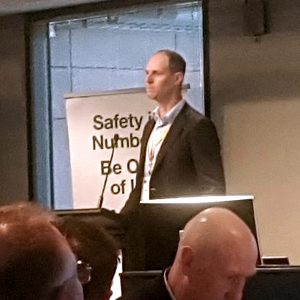 Every safety conference needs a Dave Provan. Provan (pictured right) is researching the occupational health and safety (OHS) profession and discussed this research at a recent conference organised by the Safety Institute of Australia. One of his earliest comments was also the most confronting:
“the safety profession is entirely discretionary”.
Provan’s perspective, shared by thought leaders in Australian OHS deserves further discussion as businesses may be investing in unnecessary people.
Cancer survivors returning to work
 If occupational health and safety (OHS) is to include the “whole-of-life” for workers, companies, products and projects, OHS professionals need to expand their pool of knowledge to meet the demands for an inclusive organisational culture. One recent research paper supports this approach by looking at the return to work of cancer survivors.
Exclusive interview with Hans-Horst Konkolewsky on Vision Zero
 A major theme of the World Congress of Safety and Health 2017 is the extension and strengthening of the Vision Zero concept. One of major advocates of this is Hans-Horst Konkolewsky, of the International Social Security Association. Konkolewsky sees Vision Zero as a “life changer”.
Any safety concept that includes the word “zero” is inflammatory to some sectors of the Australian occupational health and safety (OHS) profession as is evident by some of the tweets received by @SafetyOz over the last few hours. Late on Day One a question from the audience also expressed wariness over the use of the concept. However SafetyAtWorkBlog was able to interview Konkolewsky at the congress over a decade after our first interview, when he was head of EU-OSHA. We outlined the Australian perspective – “Zero Harm” – and his clarification of Vision Zero is important.
Below is audio of the exclusive seven minute interview.
Marnie Williams talks of farm safety, responsibility and a radical future
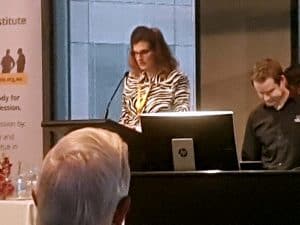 WorkSafe Victoria’s Executive Director, Health and Safety , Marnie Williams, has had a horrid week. Last Saturday, while being ill with a cold, she stood in for the Victorian Industrial Relations Minister at a Migrant Worker Forum, at which she was asked “what you gonna do about it?”. However she continues to make herself available, a crucial element for any leader of a regulatory agency.
Farm Safety
A couple of days later at a safety conference run by the Safety Institute of Australia, SafetyAtWorkBlog accused WorkSafe of not doing enough about the safety of Victorian farmers. Williams rejected the accusation and forecast a new, and surprising, approach for agricultural safety.
Big OHS data needs to digitise the past
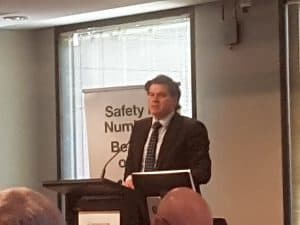 A safety conference in Victoria Australia today heard from Innes Willox of the AIGroup about new challenges in business and occupational health and safety (OHS). As many have mentioned recently big data is a challenge but with important benefits. A major flaw in any of these discussions is an overestimation of data sources and usefulness. Continue reading “Big OHS data needs to digitise the past”
Tassie Coroner releases his safety findings on 7 quad bike deaths
Coincidentally, as an article about quad bike safety was being uploaded to this blog, details of the release of Tasmanian coronial findings were received. The findings were released by Coroner Simon Cooper on August 25 2017 and were not reported widely.
The Coroner investigated seven deaths related to quad bikes but only two occurred on workplaces or as part of performing work – Heather Richardson and Roger Larner. Curiously, WorkSafe Tasmania did not investigate these work-related deaths. Continue reading “Tassie Coroner releases his safety findings on 7 quad bike deaths”