Co-operation may address safety in the work of the future

The investigation of work-related incidents needs to be considered from a broad multidisciplinary perspective.  But occupational health and safety (OHS) itself, applies a much narrower and, some may say, insular perspective.  It hasn’t “played well with others”.  At the recent Comcare conference in Melbourne, Australia, writer Tim Dunlop (pictured right) challenged this type of perception.  He said:

“My point is that it is hard to break out of certain habits of thinking.  Governments pay lip service to the idea that technology will change everything, but then they start talking about jobs and growth as if we were still living in the sixties, where the economy was based on manufacturing, where manufacturing was carried out of factories, employing millions of workers, where the workers were men and where the women stayed at home and looked after the kids.  Those days are gone, and in the future they will be ever more gone.  But the norms of that era I think still informing how we think about the future of work.”

OHS, and some of the safety regulators, may acknowledge the changing future of work
Subscribe to SafetyAtWorkBlog to continue reading.
Subscribe Help
Already a member? Log in here

Emojisuns – ultraviolet risk detection

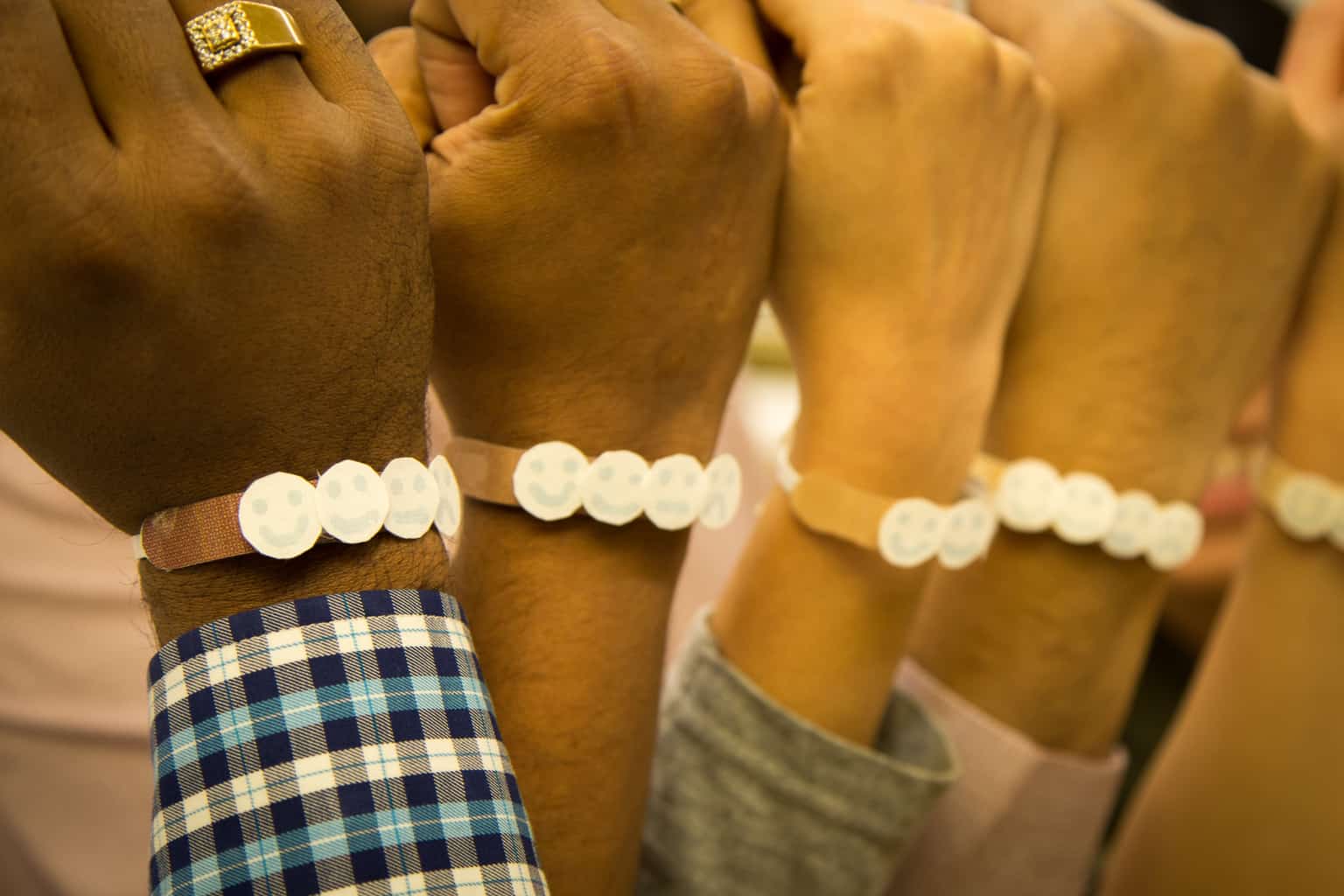
“A new strategy to produce low-cost sensors that allow ultrasensitive detection of ultraviolet radiation (UVR) by the naked-eye is described in Nature Communications this week. The sensors, which are paper-based and wearable, could enable users to manage the impact of UVR on their daily lives.”

The workplace relevance of such a device should be obvious –  far more obvious than the wording of the

Subscribe to SafetyAtWorkBlog to continue reading.
Subscribe Help
Already a member? Log in here

The risks of having an OHS policy

If you ask a lawyer for advice about any issue related to occupational health and safety (OHS) their first piece of advice is likely to be “write a policy”.  There are good legal reasons for advocating a policy, but policies can also create major problems.  Policies are both a reflection of a workplace and the base on which improvements can be created.

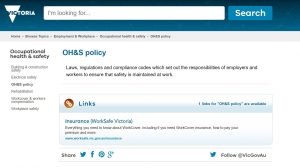
Search for OHS policy guidance from the Victorian Government  and it takes you to a page that describes an OHS policy as

“Laws, regulations and compliance codes which set out the responsibilities of employers and workers to ensure that safety is maintained at work.”

NO it’s not.  The page also directs you to a WorkSafe page about insurance!

WorkSafe Tasmania

Subscribe to SafetyAtWorkBlog to continue reading.
Subscribe Help
Already a member? Log in here

The jury remains out on standing desks but maybe we are asking the wrong questions

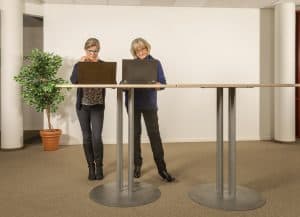
The 20th Congress of the International Ergonomics Association in Florence Italy recently concluded.  Australia’s Professor David Caple attended and brought the latest research into the benefits of sit/stand desks to the September meeting of the Central Safety Group in Melbourne.  Caple said that evidence remains confusing on this increasingly popular piece of office furniture and echoed the modern approach to occupational health and safety (OHS) matters – look at what the work involves and how and where people do it.

Caple explained how large companies are moving away from open-plan offices to those designed around “activity-based work or

Subscribe to SafetyAtWorkBlog to continue reading.
Subscribe Help
Already a member? Log in here

An OHS-based investigation of suicides should identify new control options

Melbourne, Australia – December 28, 2016: Melbourne Metro Train at Ringwood Station

Why is rail-related suicide an occupational health and safety (OHS) issue?

I looked into the issue of rail-related suicide when writing an OHS chapter for the Metro Trains Melbourne’s (MTM) bid for a franchise renewal for running trains on the metropolitan network. Each rail-related suicide, MTM describes these as trespasser suicides, creates major work-related psychological trauma for the train drivers as well as grief for the families of the deceased.  These incidents have secondary impacts on the rail workers who need to clean the trains which are taken out of service after each incident and driven to the nearest biowash, as well as those MTM staff, and emergency service workers, who were required to attend the scene.

There is also massive harm, pain and cost to those whose suicide attempts fail to result in death, and those who will care for those who are now disabled.

Addressing the hazard of rail-related suicides needs a new and broader discussion; one which must involve a broad, enlightened occupational health and safety approach.

Subscribe to SafetyAtWorkBlog to continue reading.
Subscribe Help
Already a member? Log in here

Could your company manage an embarrassing workplace injury?

Every man is aware of his penis and scrotum from a very early age. Male genitals do not feature often in discussions about occupational health and safety (OHS) but there was a workplace incident in the United States around 1970 that gained considerable attention but not really from the OHS perspective.  I have always thought this incident would be a useful case study for discussing how this scenario would be managed today.

In 1991 the journal “Medical Aspects of Human Sexuality” Dr William A Morton Jr. wrote of an unusual medical case.  Basic a worker ripped open his scrotum while using a conveyor belt to masturbate.  He was so embarrassed about the incident, he stapled his scrotum back together and told no one of the incident.  I encourage readers to go to the full article at Snopes.com (some may find the details confronting), where Snopes verified the truth of the story, but the industrial crux of the incident is: Continue reading “Could your company manage an embarrassing workplace injury?”

Concatenate Web Development
© Designed and developed by Concatenate Aust Pty Ltd