More OHS activists needed

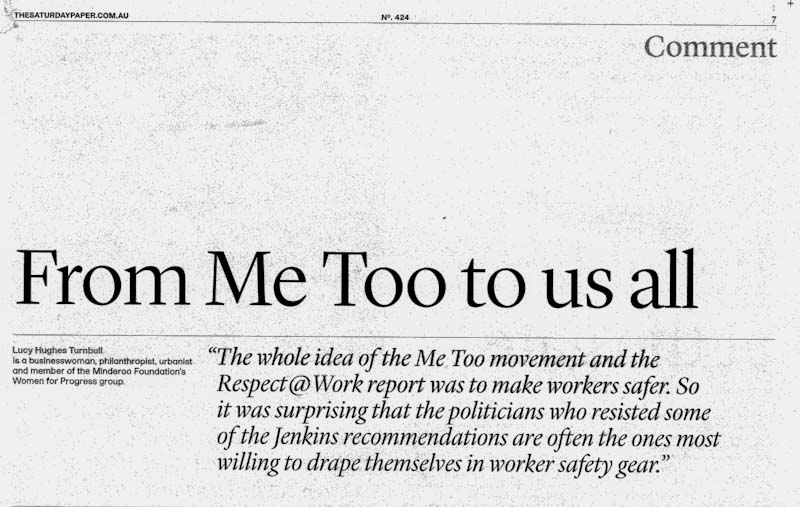
The Australian Government is set to introduce new workplace sexual harassment laws and obligations through Parliament. In The Saturday Paper on November 5 2022 (paywalled), businesswoman Lucy Hughes Turnbull wrote a short article that reminds us of the purpose of the new laws.

“The whole idea of the Me Too movement and the Respect@Work report was to make workers safer. So it was surprising that the politicians who resisted some of the Jenkins recommendations are often the ones most willing to drape themselves in worker safety gear. Protection from abuse and harassment is another key aspect of safety, like guardrails and fire exit signs. Now the legal system recognises it as such.
This latest work safety bill is the best gift the parliament could give to mark the fifth anniversary of the global Me Too movement. Together with more paid parental leave and greater access to more affordable childcare, it has been a great few weeks for women and indeed all Australians.”

links added
Subscribe to SafetyAtWorkBlog to continue reading.
Subscribe Help
Already a member? Log in here

When exemplars are far from

Extensive multinational auditing and consulting firms have been hammered for the last few years over the potential conflict of both auditing and advising the same companies and a toxic workplace culture. Most companies will not be able to afford these consultants’ prices, but the conduct of the large companies, the “corporate leaders”, affects every business by setting the standards. The influence of these large companies over public (and work health and safety) policy should also be noted and is being reviewed by some governments.

Subscribe to SafetyAtWorkBlog to continue reading.
Subscribe Help
Already a member? Log in here

The good and the odd in Oz Minerals’ “Safety Stop”

Oz Minerals Managing Director Andrew Cole is reported in today’s Australian Financial Review (paywalled) saying:

“.. there had also been an ‘‘unacceptable’’ trend in workplace safety during the past three months at the mines, but he was confident the trend had stabilised.”

This is likely to have come from the company’s September 2022 Quarterly Report and webcast released yesterday.

The company’s one-day “stop” for safety consultation is admirable, but some of the discussion reported in other media implies that an older-style attitude to worker safety persists.

Subscribe to SafetyAtWorkBlog to continue reading.
Subscribe Help
Already a member? Log in here

Minister could have spoken stronger on OHS at a business event

Recently Australia’s Minister for Resources, Madeleine King, spoke at an event hosted by the Western Australian Chamber of Commerce and Industry. The speech aimed to reassure the State’s mining sector to not feel threatened by the new Australian Labor Party government. However, her words about sexual harassment were a little odd.

According to the publicly released speech, King said this on the issue of the labour shortage in mining and resources:

Subscribe to SafetyAtWorkBlog to continue reading.
Subscribe Help
Already a member? Log in here

Who is responsible for Burnout? And for preventing it?

I apologise for often referring readers to paywalled content. This restriction can affect the impact and flow of a story, but I want readers to be able to verify the sources of my comments and my information. And I acknowledge that this blog, for many, is an example of the economic reality of paywalled content.

However, there was an article in The Guardian on October 11, 2022, about burnout that is well worth reading (You may be able to get short-term access). Below are some extracts from that article with my thoughts.

The Guardian article “‘I didn’t see how I could ever get back to a normal life’: how burnout broke Britain – and how it can recover” by Gaby Hinsliff,, recounts several cases of burnout and near-burnout that are typical of responses to work-related mental ill-health.

Subscribe to SafetyAtWorkBlog to continue reading.
Subscribe Help
Already a member? Log in here

Pressure on local government over procurement and OHS

On a chilly night in Ballarat, over a hundred people gathered outside the Town Hall, within which the City Council was meeting, to let the Council know that the awarding of millions of dollars of ratepayers’ money to a local company that admitted to breaching occupational health and safety (OHS) laws and that led to the deaths of two local workers was not acceptable.

The event seem coordinated by the local Trades Hall Council, for the usual inflatable rat and fat cat were next to the ute, which was blasting out protest songs. Almost all the speakers were trade unionists, although one was Andy Meddick from the Animal Justice Party. The protest may not have achieved the changes that many speakers called for, but as is the case with these types of events, Council has given some ground with a likely review of the OHS procurement criteria.

Subscribe to SafetyAtWorkBlog to continue reading.
Subscribe Help
Already a member? Log in here

Industrial Manslaughter and marketing

Industrial Manslaughter was always going to generate some workplace safety marketing at some point. In this week’s Australian Financial Review (23 September 2022, page 23, paywalled), Inspectivity paid for a full-page advertorial promoting its data collection and analysis products. It mentioned that its products could help to reduce the risk of being prosecuted for Industrial Manslaughter. But what does this say about one’s customers and their attitude to providing safe and healthy workplaces if the avoidance of personal accountability is the ”hook” for the sale?

Subscribe to SafetyAtWorkBlog to continue reading.
Subscribe Help
Already a member? Log in here
Concatenate Web Development
© Designed and developed by Concatenate Aust Pty Ltd