OHS needs to ride the ESG wave

The current Environmental, Social and Governance (ESG) movement can be seen as the latest iteration of companies and business owners reflecting on the broader purposes of running a business.  An earlier manifestation of this reflection was Corporate Social Responsibility (CSR).  ESG and CSR are similar perspectives from different times but with a fundamental continuity.

Occupational health and safety (OHS) is integral to CSR/ESG/Sustainability considerations but is often overlooked or considered as a business add-on, a situation that has been allowed to persist by the OHS profession, Regulators and others over many decades.


Subscribe to SafetyAtWorkBlog to continue reading.
Subscribe Help
Already a member? Log in here

Where does OHS fit?

Any assessment of ethics in relation to occupational health and safety (OHS) is worthwhile and so the release of a chapter on ethics by the Australian Institute of Health and Safety (AIHS) generated some excitement. That excitement diminished somewhat as this Chapter of the Body of Knowledge (BoK) dealt with ethics in a very narrow context – “Ethics and Professional Practice“.

Subscribe to SafetyAtWorkBlog to continue reading.
Subscribe Help
Already a member? Log in here

Most-read OHS articles in 2019

This past week most media have been reflecting on the last twelve months or the decade. There are two ways of applying this practice to the SafetyAtWorkBlog – statistics and most-read. Let’s look at statistics first.

This year the SafetyAtWorkBlog posted 225 articles, not including this one, with an average word count of 1,030 words – the equivalent of a 230,000 word book on occupational health and safety (OHS). For those Annual subscribers that equates to just over $1.00 per article which I think is a pretty good return.

Continue reading “Most-read OHS articles in 2019”

Don’t be a fish; be a frog.

“Don’t be a fish; be a frog. Swim in the water and jump when you hit ground.”

Kim Young-ha

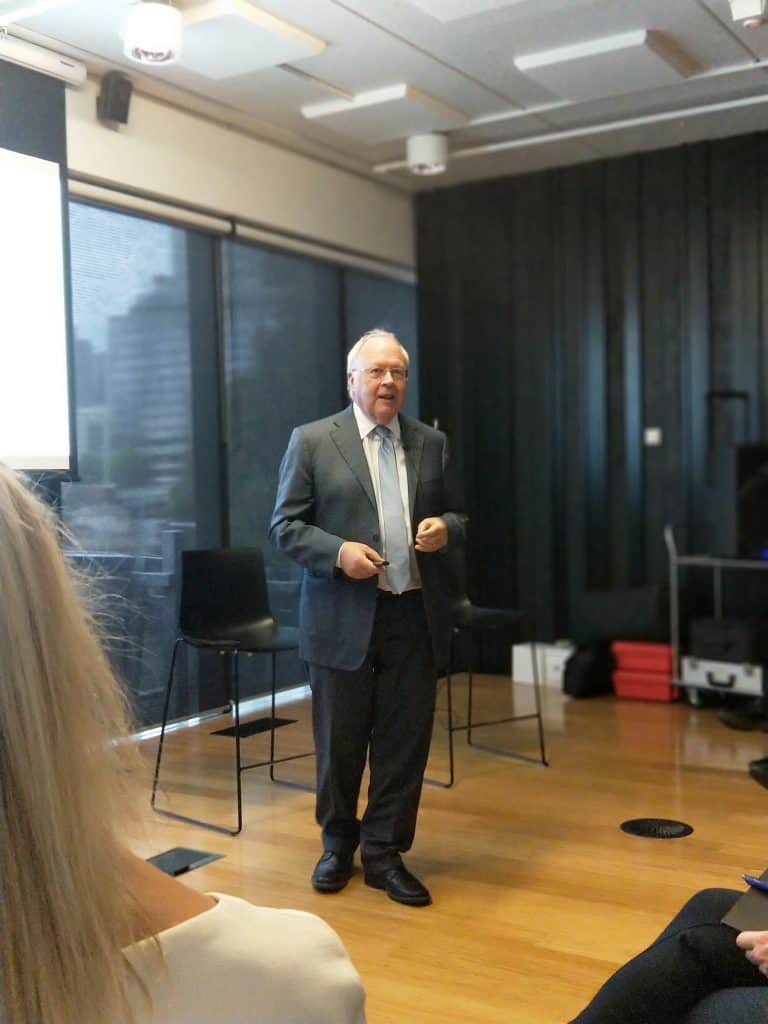
This aphorism seems apt for the safety culture journey that is occurring at Melbourne Water under the tutelage of Professor Patrick Hudson (pictured right). Melbourne Water is attempting to become a “generative organisation” in line with Hudson’s Safety Culture Maturity model and hosted a public event with Hudson in early November 2019. This provided an opportunity to hear how the model has evolved, particularly in its applications.

Subscribe to SafetyAtWorkBlog to continue reading.
Subscribe Help
Already a member? Log in here

New book on a neglected area of OHS research

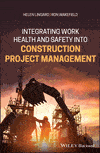
Helen Lingard and Ron Wakefield have published one of the few books to look at how occupational health and safety (OHS) is structured and managed in government-funded infrastructure projects in Australia. Their new book, “Integrating Health and Safety into Construction Project Management” is the culmination of over a decade’s research into this area. The book is both a summary of that research and a launching pad for designing OHS into future infrastructure projects.

Subscribe to SafetyAtWorkBlog to continue reading.
Subscribe Help
Already a member? Log in here

Look closely at the camel rather than the straw

There are strong parallels between the National Inquiry into Sexual Harassment in Australian Workplaces and others addressing workplace issues, such as the Victorian Royal Commission into Mental and the Productivity Commission’s mental health inquiry, but there is also a connection to the Royal Commission into Banking and Financial Services which has focused the minds of some of Australia’s corporation s and leaders into examining their own workplace cultures and, for some, to reassess the role and application of capitalism.

This is going to become even more of a critical activity as the National Sexual Harassment Inquiry completes its report prior to its release in the first month or two of 2020.

Cultural analysis, and change, is often best undertaken first in a microcosm or specific social context. The experiences of sexual harassment of rural women in Australia is one such context, a context examined in detail by Dr Skye Saunders in her book “Whispers from the Bush“.

Subscribe to SafetyAtWorkBlog to continue reading.
Subscribe Help
Already a member? Log in here

Communicating about OHS in New Zealand

Safety conferences rarely generate media interest unless the relevant occupational health and safety (OHS) Minister is speaking or there has been a recent workplace death or safety scandal. At the recent SafetyConnect conference held by the NSCA Foundation in Melbourne, SafetyAtWorkBlog was able to chat with the Editor of New Zealand’s SafeGuard magazine, Peter Bateman. Peter has been editing the magazine and writing about workplace health and safety for a long time and, as an outsider to the OHS profession, he has some useful perspectives on how to communicate about safe and healthy workplaces.

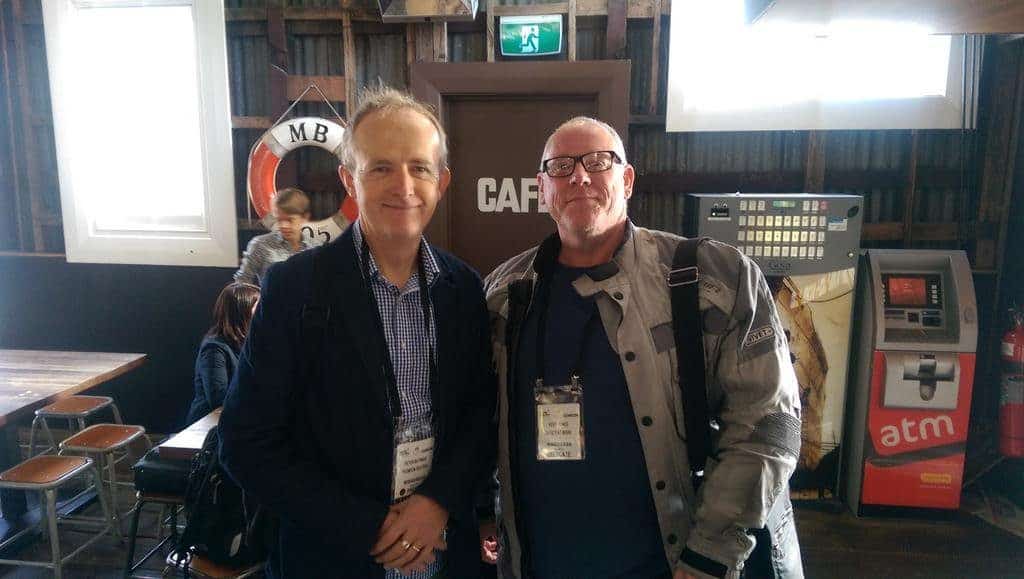
Peter Bateman and Kevin Jones in 2015

SAWB: Peter, great to see you at the Safety Connect conference in Melbourne, hosted by the National Safety Council of Australia Foundation.  So, day one, thanks for coming over from New Zealand.  You’ve been coming to safety conferences for a long time.  How important are safety conferences to your magazine given that Safeguard runs its own conferences as well?

PB: We’ve had the opportunity, through growing the credibility of the Safeguard brand through the magazine, that’s given us I think the trust and the credibility with readers so that when we launched the awards actually, the first event we launched way back in 2005 and then the main conference a couple of years later.  And they were small, but they were successful in their own way and we’ve just been fortunate to grow them year on year, so New Zealand Workplace Health and Safety Awards have been going for 15 years and the main Safeguard National Health and Safety Conference for almost as long.  Then from that we’ve managed to create some more specialist one-day conferences as well.

SAWB: I think I’ve seen a LegalSafe one.

PB: LegalSafe, which is more on the compliance side for those people who want more compliance side even though that’s not my particular area of interest.  But I recognise that a lot of people are very focused on compliance and fair enough.  Then more recently we’ve developed HealthyWork which started off as a way of bringing together traditional occupational health interests with the emerging wellbeing side but has really gone more into the wellbeing and psychosocial stuff as we’ve progressed. And in the last couple of years we’ve launched SafeSkills for H&S reps.

Subscribe to SafetyAtWorkBlog to continue reading.
Subscribe Help
Already a member? Log in here
Concatenate Web Development
© Designed and developed by Concatenate Aust Pty Ltd