Any OHS strategy needs to generate spillovers

Reading Safe Work Australia’s latest ten-year strategy forced me to think creatively.

SWA’s discussion of Persistent Challenges suggests controls that are almost all at the Administrative Control level – education, awareness, knowledge, training, understanding, support, communication and more.  This is after admitting that:

“Injury and fatality rates have fallen significantly over the last decade. However, progress has slowed.”

Page 5

How can we increase the use of the Hierarchy of Controls (HoC) in determining safety-related policy? How can we get organisations to progress up the control hierarchy to show others that it is possible to prevent all of the incidents that everyone agrees are preventable? (Refer to WorkSafe Victoria’s Colin Radford for a recent example of this belief:

“Every workplace incident, every injury, every illness, every death is entirely unequivocally preventable.”)

Subscribe to SafetyAtWorkBlog to continue reading.
Subscribe Help
Already a member? Log in here

Odd OHS comments from the Master Builders

Every year the Australian government releases a budget explaining what it plans to do over the next 12 months or longer. Business groups and trade unions often release documents submitted to the government, although whether the government requests this is unclear. Recently the Master Builders of Australia (MBA) sent through its submission (not yet publicly available). It has some interesting comments on the responsibility for occupational health and safety (OHS) and responsibility.

Subscribe to SafetyAtWorkBlog to continue reading.
Subscribe Help
Already a member? Log in here

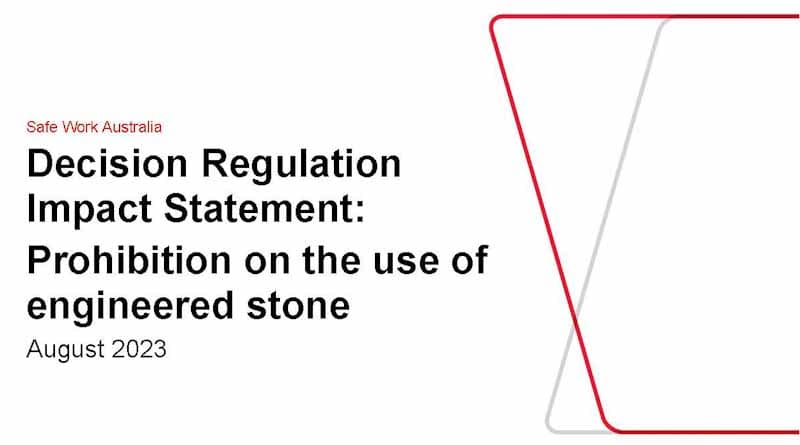
Engineered stone and deadly silica risks seem here to stay

So Australia did not ban the importation of engineered stone. The Heads of Workplace Safety Authorities (HWSA) have issued a Communique and a joint media release outlining their decision. It’s a political slap in the face to the trade unions who went hard on the ban.

Many organisations supported the call to ban the importation and use of engineered stone due to the unacceptable risk associated with cutting the product. Many were strident in need for the ban. Even the Federal Minister for Workplace Relations, Tony Burke, was talking tough on the morning of the critical meeting of the Heads of Workplace Safety Authorities. So what went wrong?

Subscribe to SafetyAtWorkBlog to continue reading.
Subscribe Help
Already a member? Log in here

Silicosis campaign is about safety but is also about politics

The calls for banning engineered stone‘s importation are curious and likely to be acted on later this week.

Politicians, unions and some OHS associations have undertaken a risk assessment and determined that elimination is the most effective harm prevention strategy. Previous risk assessments of silicosis have been reported on in this blog for some time without banning the material. The risks have not changed even with increased inspection and enforcement. So what has changed? Politics.

Subscribe to SafetyAtWorkBlog to continue reading.
Subscribe Help
Already a member? Log in here

Legal Professional Privilege is the OHS equivalent of the Non-Disclosure Agreement

Pam Gurner-Hall is no stranger to this blog. Recently she appeared in an article by the Australian Broadcasting Corporation (ABC) about access to information from South Australia’s occupational health and safety (OHS) regulator, SafeWorkSA.

SafeWorkSA has been under considerable scrutiny for the last few years. A “root and branch” review conducted by John Merritt is the latest inquiry. [Note: this article was written before the release of the Merritt report and the Government’s interim response last weekend. More on that report shortly]

Gurner-Hall’s concerns seem more about the government’s response to the inquiry and the application of Legal Professional Privilege (LPP). She is quoted saying:

Subscribe to SafetyAtWorkBlog to continue reading.
Subscribe Help
Already a member? Log in here

OHS legal changes you might have missed

If you needed confirmation that the mainstream media is disinterested in occupational health and safety (OHS) unless there is a disaster or the incident can be narrowly categorised as sexual harassment, bullying or suicide, last week, the Australian Parliament passed important amendments to the Model Work Health and Safety laws. It seems OHS cannot compete with sexual harassment laws (I’m okay with that) or Industrial Relations (or Australia’s wins in the World Cup).

On December 1 2022, Workplace Relations Minister Tony Burke‘s Second Reading Speech included the removal of insurance policies that could pay for financial penalties awarded against OHS breaches and a pledge to put Industrial manslaughter back on the national agenda.

Subscribe to SafetyAtWorkBlog to continue reading.
Subscribe Help
Already a member? Log in here

You don’t have to talk about OHS to talk about OHS

On November 16 2022, Tony Burke, Minister for Employment and Workplace Relations, spoke at the National Press Club in Canberra. Although his portfolio has occupational health and safety (OHS), workplace health and safety was mentioned only once in passing. In this instance, that’s okay because he is trying to pass a major piece of industrial relations (IR) law. But some of his speech raised issues related to work or how businesses are managed, which do have important OHS contexts.

Subscribe to SafetyAtWorkBlog to continue reading.
Subscribe Help
Already a member? Log in here
Concatenate Web Development
© Designed and developed by Concatenate Aust Pty Ltd