

Occupational health and safety (OHS) has a habit of discovering a useful idea and then asking it to explain everything. (We are desperate for silver bullets.) Systems thinking seems to be the latest candidate. It offers a valuable way to examine how work is organised and how psychosocial harm emerges, but enthusiasm is beginning to blur an important boundary. Systems thinking is a method of seeing how workplaces operate, but Sociology helps explain what is being seen, who shaped it and why it persists.
Category: sociology
Psychosocial Risk Isn’t Special – Start With Hazard Identification
A LinkedIn colleague said this to me recently in a thread I started:
“I can’t see the logic in not integrating psychosocial hazards into the risk assessment process. The scope and complexity of the org will obvs have an impact but on one hand you’re saying employers have to manage both physical and psychosocial hazards/controls, but not to use the same process. And while we’re at it, that’s HR’s responsibility so it’s not on us. I say engage, embrace and guide the entire leadership team (HR included) in the process. As to why you wouldn’t use the risk assessment process I’m keen to know how you demonstrate you’ve used the hierarchy of control and reduced the risk alarp.” (slight edits)
Here is my response and clarification.

What was Missing from the Bullying and Harassment Conference?
The IAWBH2026 sessions offered a revealing snapshot of how international practitioners are grappling with bullying, harassment and gendered violence at work—and how closely these discussions align with Australia’s psychosocial‑hazard framework. Several presentations landed squarely within the Australian work health and safety (WHS) model, particularly those that treated these issues as structural hazards requiring organisational controls. Sapphire Parsons’ argument that gendered violence demands primary prevention, equitable decision‑making, and action on power imbalances mirrors the prevention‑first duties under Australian safety law.
However, there were also indications of how far the change has to go.
Continue reading “What was Missing from the Bullying and Harassment Conference?”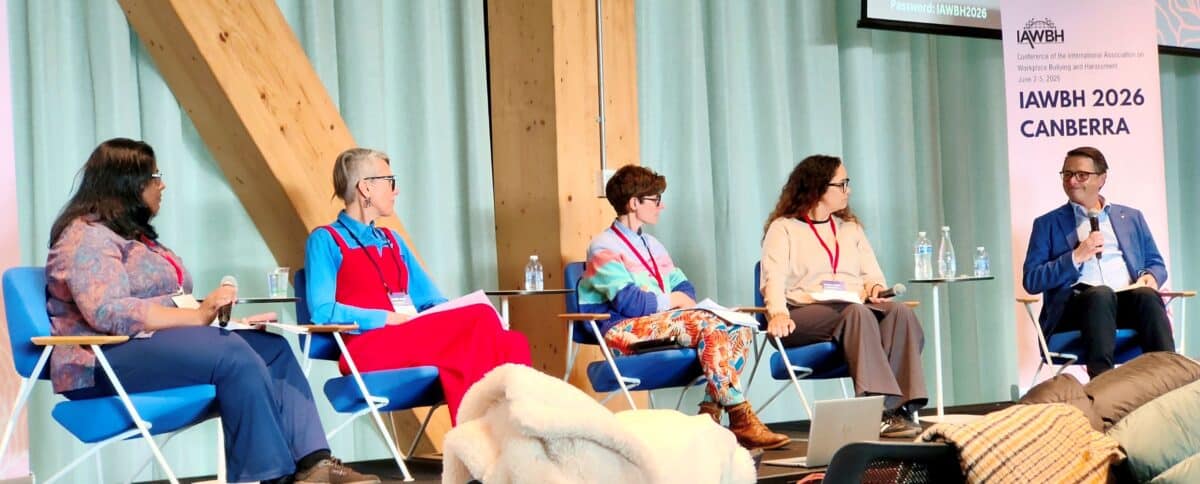
If We Want Change, We Need to Lobby the People Who Call the Shots
I have been trying to challenge some of the speakers at this week’s conference of the International Association on Workplace Bullying and Harassment to think further. In a panel discussion on day one, I asked why party politics is not being discussed. The panellists were gracious in responding and challenged my thinking.

Solving Psychosocial Harm at Work: The Upcoming Global IAWBH Conference in Canberra
Workplace bullying, harassment and other psychosocial risks are no longer fringe issues – they are central to how we think about safety, fairness and dignity at work. One forum that has been shaping this conversation for more than two decades is the International Association on Workplace Bullying and Harassment (IAWBH) and its much‑anticipated biannual conference. This year’s event brings researchers, regulators and practitioners together in Canberra to tackle some of the most difficult problems in working life, with a strong emphasis on practical solutions, especially pertaining to sexual harassment and gender-based violence.
Professor Carlo Caponecchia, who is presenting at the conference, made some time for a couple of questions.
Continue reading “Solving Psychosocial Harm at Work: The Upcoming Global IAWBH Conference in Canberra”
Evidence that the four-day work week provides psychological health benefits
Recently, I bemoaned the lack of evidence on the occupational health and safety (OHS) benefits of a four-day work week. A reader pointed me to the research of sociologist Wen Fan. The most accessible way to her research is through an episode of the “Psych Health and Safety Podcast” from September 2025.

The 1970s Never Ended for Some Employers
For the last few years in Australia, occupational health and safety (OHS) laws have required that the prevention of psychosocial hazards be given the same prominence as the prevention of physical hazards. The most effective recommendation for change is the redesign of work, but very few employers seem to be applying this control. Many employers are still asking (their Human Resources officer) what this psychosocial stuff is all about.
Examining organisational culture at one Australian institution that failed to prevent and may have generated psychological harm in the 1970s provides some context for contemporary OHS struggles.