
The COVID19 pandemic has devastated many countries but it has also created business opportunities. Recently workplace IT company Skedulo released a whitepaper about the new work normal. The document is essentially a marketing strategy but there are some hints about workplace change that may be of interest to occupational health and safety (OHS) advocates and professionals.
Category: stress

The certainty of diagnosis
Occupational health and safety (OHS) is not famous for its certainty. The days of prescriptive compliance to OHS laws are, probably, never to return. But the flexibility offered by modern OHS laws and the pervasiveness of “reasonably practicable” has complicated the management of workplace health safety by increasing that uncertainty.
The attention being given to workplace mental health, over the last 20 years and since work-related stress was identified as a major problem, has highlighted this flexibility/uncertainty. However, some certainty on workplace mental health is accessible if one is prepared to challenge the dominant workplace wellness paradigms.
Work-related mental health remains contentious
This article is about SafeWorkNSW’s recently released Draft Code of Practice for Managing the Risks to Psychological Health, but it is not going to focus on the Code. Instead the focus will be on the supplementary Explanatory Paper because this presents the rationale for the Code’s contents and, in many ways, is a more useful tool for occupational health and safety (OHS) discussions. However, just as the Code has structural and legislative limitations as part of its Purpose, the Explanatory Paper is a support document for submissions on the Draft Code and therefore has its own limitations.
COVID19 and Safety Managers
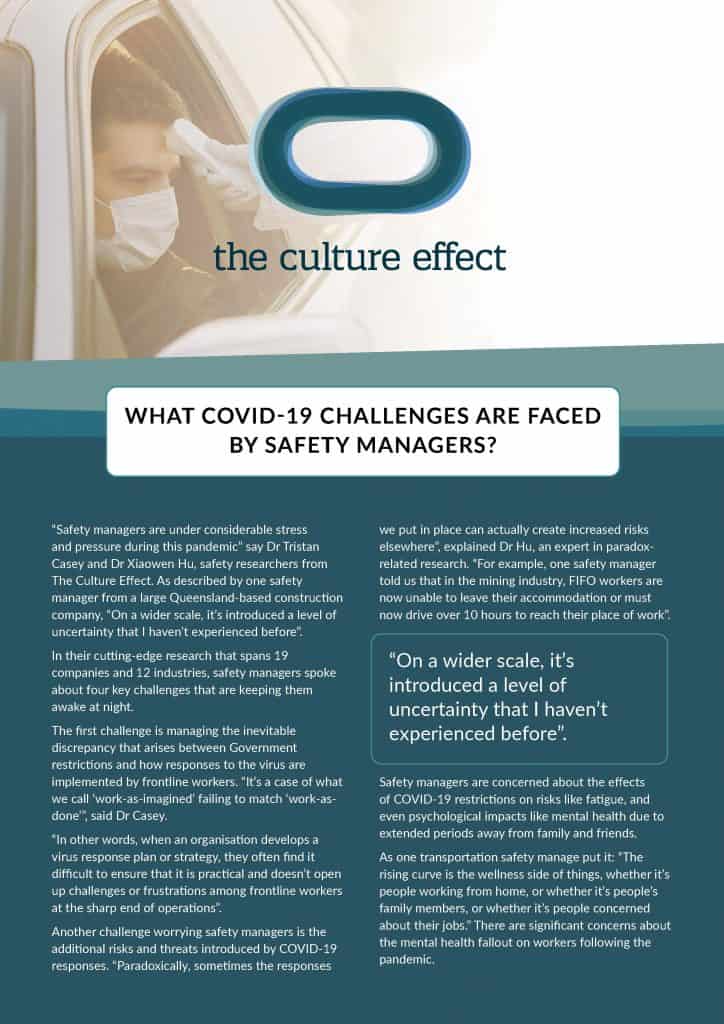
Several weeks ago, researchers from Griffith University and Queensland University of Technology (QUT) commenced a survey about safety managers and COVID19. The research was called “Resilience in a COVID19 World” and aimed at
“Exploring health and safety measures taken by and for ‘essential services’ workers throughout Australia’s COVID-19 crisis, and how their contributions affect personal and organisational resilience.”
Some initial results are in a recent outline published by Dr Tristan Casey & Dr Xiaowen Hu through The Culture Effect consultancy. There were four key challenges but also significant positives.
Tooma on Mental Health – Review
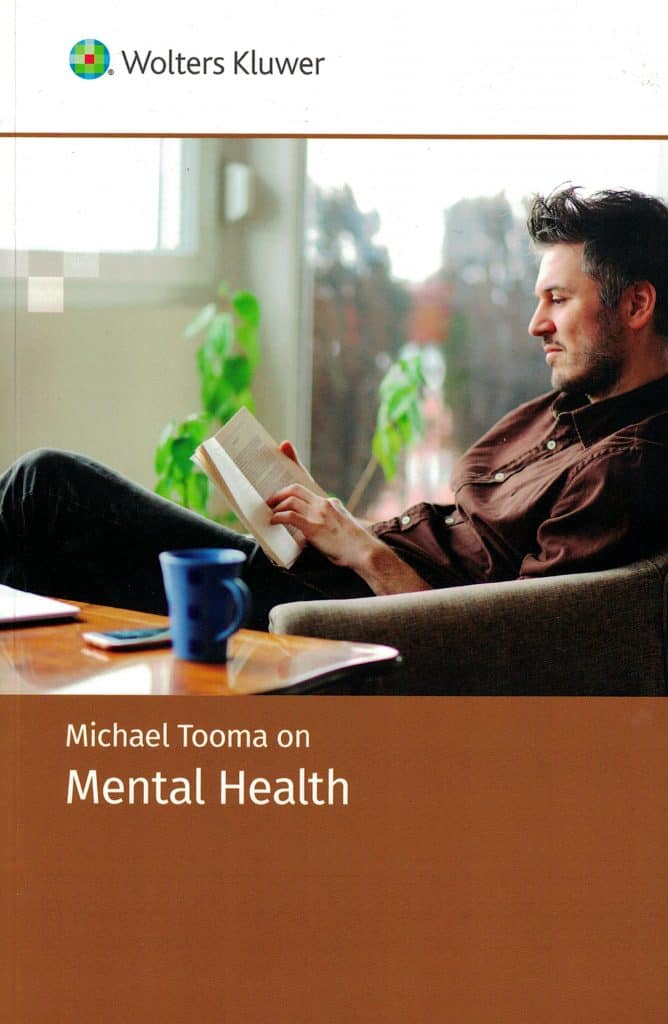
Michael Tooma is probably the most prominent occupational health and safety (OHS) lawyer in Australia. His latest book is, a little pretentiously, called “Michael Tooma on Mental Health“, but it fits with the series of OHS-related publications he has written for Wolters Kluwer. Unusually for a lawyer, there are only two chapters that specifically discuss legislative obligations, and, in many ways, these are the least interesting.
Positive Mental Health
In the Introduction, Tooma goes out of his way to stress the positive benefits of work. He is critical of the current OHS approach to workplace stress writing that we seek a “Goldilocks” application of perfection when this is really subjectively determined by each worker. Tooma challenges this in a major way through the 2012 study by Keller and others:
Running before you can walk on COVID19 and Mental Health
On May 15 2020, the Australian Government released a National Mental Health and Wellbeing Pandemic Response Plan. Mental Health has been on Prime Minister Morrison’s agenda since his election a year ago and the mental health sector is not going to be starved of government funds during his tenure.
Mental ill-health has been talked about throughout the current COVID19 Pandemic and has been forecast to increase due to the economic disruption and the requirements for social isolation. To some extent, the low numbers of COVID19 deaths in Australia has allowed it a “luxury” of addressing mental health, but some of the justifications seem not as strong as claimed and the National Mental Health Plan omits any consideration of occupational health and safety (OHS) other than for those in the health industry; the so-called “frontline workers”.
Work that is meaningful, secure and safe

Occupational health and safety (OHS) is integral to how work and job should be designed in the post-COVID19 world, but you wouldn’t know it from the current discussions in the media. On May 13, 2020, the day after a major economic statement from Treasurer Josh Frydenberg, Jennifer Westacott, Chief Executive of the Business Council of Australia, told ABC Radio that:
“…. there’s some pretty sobering numbers that the Treasurer gave yesterday and fundamentally I think we’ve all got to come back to basics here. This is about people’s lives and so what we have to do, as the kind of leadership dynamic, is to focus on getting people back to work and getting them into secure and meaningful work.
emphasis added
It is not unreasonable to add safety to that “secure and meaningful work”.
OHS fits into this phrase in many ways, but one of particular note is job security and its links to mental health, especially as mental health has been a policy priority repeatedly identified by Prime Minister, Scott Morrison, and others.