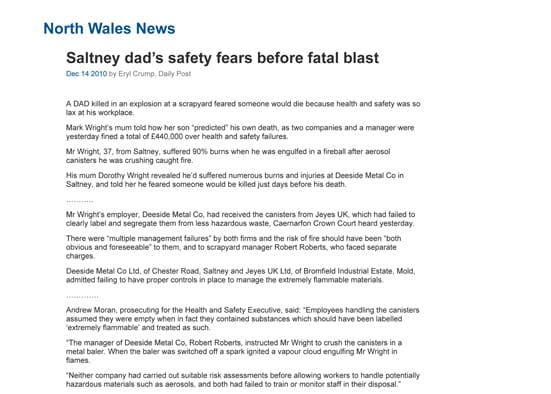
How much significant information do workplace fatalities provide?

Workplace fatalities are terrible, lingering tragedies that generally don’t teach anything new about OHS failures.  I couldn’t find anything new in the frightening detail in the article below (dated 14th December 2010) or in scores of Google searches of industrial/occupational fatalities; though disease fatality epidemiology can be  informative.

If all workplace fatalities in Australia were stopped overnight, most workers wouldn’t notice a single improvement in their own workplace.  They’d still be working in the same cluster of hazards, useless risk assessments and a regular sprinkling of near misses and daily shortcuts.  Despite regulators’ and politicians’ shrieks of dismay at workplace deaths, such fatalities don’t represent the main OHS problem at work.

If any regulator was informed in advance – in some detail – that in a particular industry there would be three fatalities in the next three months (or even intolerable risk) they wouldn’t know how to prevent them.  Example?  Think of the insulation program, which still has some way to go and a few more surprises in store.  Example?  Over the next six months there are likely to be 3-6 quad bike-related fatalities in Australia, mostly as a result of rollovers.

Or think of the value of risk assessments:  example?  Consider the 60,000-80,000 barrels (10,000 tons) of the most dangerous hexachlorobenzene (HCB) waste stockpiled and being repackaged (ultimately, drum to drum) by workers in a primitive work process at Botany Bay Industrial Park, Sydney.  One of the world’s largest stockpiles of such dangerous wastes that no one around the world is prepared to handle.   This is the only place I’ve ever had to wear two layers of protection to inspect. What has the regulator done? Continue reading “How much significant information do workplace fatalities provide?”

West Australian farmer found dead under his quadbike

WorkSafe WA has reported on a quad-bike related death of a 68-year-old man in the evening of 12 December 2010.  Details are scarce as OHS inspectors have only been able to attend the scene this morning.

The WorkSafe media release (soon to be available online) states:

“WorkSafe is investigating the work-related death of a 68-year-old man on a farm at Crooked Brook, near Dardanup south of Bunbury, last night.
The farmer was believed to have left his house to move cows from one paddock to another.  When he did not return, a family member went to look for him and found him under an upturned quad bike.”

Details of the type of terrain, safety features of the quad bike and the type of PPE on site were not available at the time of writing. Continue reading “West Australian farmer found dead under his quadbike”

Powerful OHS stories on YouTube

Yossi Berger recently criticized the award-winning “Homecoming” ads of WorkSafe that have been rebroadcast in the US.  Berger said that the awareness raising ads do not contribute to saving lives.

Workplace Health & Safety Queensland has produced a series of survivor stories that, if the wider working community gets to see them, are an enlightening view of the reality of work-related injuries.  The latest film in the series is “Between a rock and a hard place – The Garry Nichols story” and concerns the impact of a tractor roll-over.

The films benefit enormously from the analysis of contributing factors to the incident.   Continue reading “Powerful OHS stories on YouTube”

Of stunning, short-lived cactus flowers and quad bikes

The smoke from the mine:

It has been a frighteningly bad month in the mining industry internationally.  OHS meetings I attended during this period have been hushed as a result of the New Zealand tragedies.  Discussions about OHS have become more pertinent and more accurate – for the time being.  But this, like stunning but short-lived cactus flowers, will quickly disappear.

Because I’ve had close involvement with the Beaconsfield Gold Mine rockfall that killed Larry Knight, and years earlier with the Esso Longford explosions and fires in Victoria, the CrossCity tunnel fatality in Sydney… and many other tragedies or near misses, such events, like a sudden cramp, re-focus my thinking on current issues.  Another OHS failure that we didn’t stop.

Quad bike safety:

One such issue I’ve been involved in for some time has been the quad bike safety issue. The fatality statistics I have on these machines in Australia show that over the last 10 years 13 people (on average) are killed per year.  130 people, most of whom, the industry will have you believe, were ‘mis-users’ of the machines (see below).  The trend is up not down.

I have just resigned from the TransTasman Quad Bike safety committee created by the regulators last year.   The OHS and quad bike interest group in the community may be interested in some of the difficulties I see with the current work on this issue.

The obvious and useless in practice:

I think a much greater degree of transparency and openness – including a high level public conference – ought to take place.  And neither the regulators nor industry will be interested in that; Continue reading “Of stunning, short-lived cactus flowers and quad bikes”

Queensland safety magazine released

The Queensland Division of the Safety Institute of Australia regularly produces a newsletter/magazine of consistent quality and the November 2010 edition is available online.

This edition includes an article by Warwick Pearse on the Montara oil spill.  Pearse did not have the luxury of access to the final reports or government’s response but he makes sound recommendations.

Kevin Jones

Computer simulations of quad bike risks do not reflect reality

Guest contributor David Robertson discusses the  differences between risk simulations and real risk data in relation to quad bike safety:

“The motion picture blockbuster “Avatar”, for the time we are in the cinema, would have us believe that Sam Worthington can turn into a giant blue man on a faraway planet.  James Cameron used computers to deliver us this illusion. In science (and particularly with safety) we must be able to distinguish between computers that are valuable tools and computers that don’t represent reality.  Dynamic Research, Inc.(DRI) chose 113 actual quad bike (ATV) accidents to simulate in a computer model.

The first table below shows the injuries DRI record as what really happened from all the 113 cases, but represented as approximate normalized injury cost (ANIC)*.   When DRI’s computer runs the same cases, one would expect a similar result.  The results are shown in the second table (ANIC), note the scale on the left has had to be changed (table 2 should be about 10 times taller if the same scale in table 1 was used) because head injuries rose from 360 points to well over 3000. Equally astonishingly is that abdomen injuries have vanished altogether and chest injuries dropped from 266 to a next to nothing (23). Asphyxiation was not even included in the computer model. Continue reading “Computer simulations of quad bike risks do not reflect reality”

Radio National OHS program

On 21 September 2010, Radio Australia’s regular program Australia Talks conducted a live interview concerning occupational safety and health.

For those who have been listening to the show for some time would have been surprised that the program covered much of the same old OHS ground.  Similar statistics, similar questions of what are the most dangerous occupations, similar assumptions and the same misunderstanding that discussions about OHS law are the same as discussions on safety management. Continue reading “Radio National OHS program”

Concatenate Web Development
© Designed and developed by Concatenate Aust Pty Ltd