Suicide prevention needs more than business as usual

That suicide is related to workplace mental health pressures and illnesses is undisputed, but the more independent analysis on the topic, the more complex the causes become. Sometimes, suicide can be a conscious decision, still due to socioeconomic factors but factors that are not necessarily diagnosed or treated with mental health conditions.

[This article discusses suicide risks]

This reality complicates, and should complicate, strategies for the prevention of suicide. Recently, Australia’s National Farmers’ Federation (NFF) submitted its pre-budget wishlist to the government. This submission included action on suicide and mental health but in traditional ways.

Subscribe to SafetyAtWorkBlog to continue reading.
Subscribe Help
Already a member? Log in here

A curious omission from NY Times well-being article in The Age

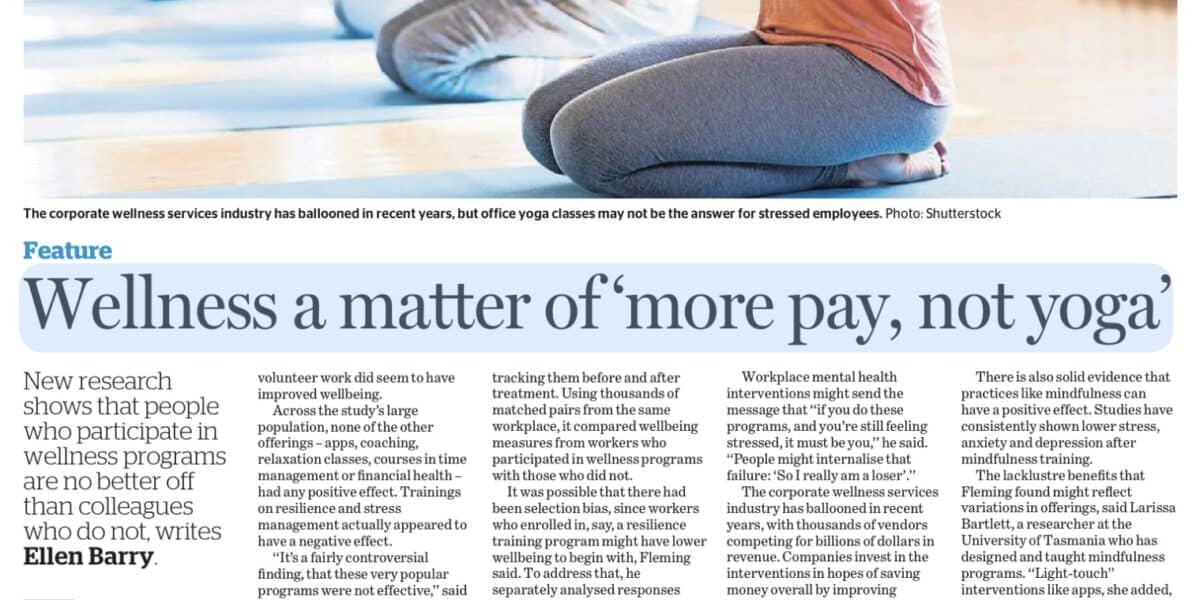
Another article reporting on Dr William Fleming’s workplace wellness research appeared recently in the New York Times, reproduced in some Australian newspapers like The Age (not available online). Newspapers are entitled to edit other newspaper’s articles for many reasons. Most tweaks are legitimate, but, in this case, The Age dropped an entire paragraph, which does not reflect the balance of the full NYTimes article.

Subscribe to SafetyAtWorkBlog to continue reading.
Subscribe Help
Already a member? Log in here

Are wellbeing programs “safe washing” their OHS performance?

First, there was brainwashing, then greenwashing and safewashing. Could the well-being industry be accused of safewashing? Has well-being had its day in the sun?

The first use of safewash to describe presenting occupational health and safety (OHS) information in a diffused truth was in the 2016 research paper by Sharron O’Neill, Jack Flanagan and Kevin Clarke, called “Safewash! Risk attenuation and the (Mis)reporting of corporate safety performance to investors” (abstract/summary available). It has turned up elsewhere since.

Subscribe to SafetyAtWorkBlog to continue reading.
Subscribe Help
Already a member? Log in here

Dr Fleming’s well-being research has generated controversy, as it should

Dr William Fleming’s open-access article called Employee well‐being outcomes from individual‐level “Mental Health Interventions: Cross‐sectional Evidence from the United Kingdom” is receiving a lot of online and mainstream media attention, and rightly so. It is a robust piece of research from a sample of over 46,000 workers in 233 organisations. The article compares:

“…participants and nonparticipants in a range of common individual‐level well‐being interventions, including resilience training, mindfulness and well‐being apps. Across multiple subjective well‐being indicators, participants appear no better off.”

Subscribe to SafetyAtWorkBlog to continue reading.
Subscribe Help
Already a member? Log in here

Is this the end of corporate wellness?

Yesterday, one of my LinkedIn posts reached over 20,000 impressions. The post concerned new research that questioned the effectiveness of corporate wellbeing programs. Some responses were febrile even though they had not read the open-access article! The points raised in the research were not new. Some have been covered in this blog previously, but the New York Times raised the question of the viability of corporate wellness programs in 2020.

Subscribe to SafetyAtWorkBlog to continue reading.
Subscribe Help
Already a member? Log in here

A frustrating but informative book

There are so few occupational health and safety (OHS) books that it is often necessary to look outside the OHS field for answers in the OHS field. One example of such a book is “Work Psychology – The Basics” by Dr Laura Dean and Fran Cousans. The authors could have increased their readership and scope if they had also considered psychosocial issues more closely, but this book is about psychology. Even so, some useful perspectives are offered.

Subscribe to SafetyAtWorkBlog to continue reading.
Subscribe Help
Already a member? Log in here

Moral distress = moral injury = workplace mental ill-health = burnout.

On December 29 2023, The Guardian newspaper’s cover story was about doctors in the United Kingdom’s National Health Service experiencing high rates of “moral distress”. It is common for hospitals and health care services to consider themselves as workplaces with unique hazards rather than suffering similar occupational health and safety (OHS) challenges to all other workplaces. What makes the OHS challenge so significant in the NHS is the size of the challenge rather than its nature or cause.

Subscribe to SafetyAtWorkBlog to continue reading.
Subscribe Help
Already a member? Log in here
Concatenate Web Development
© Designed and developed by Concatenate Aust Pty Ltd