The jury remains out on standing desks but maybe we are asking the wrong questions

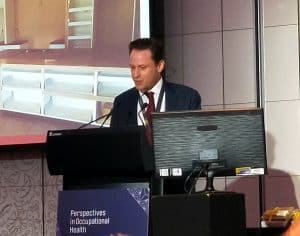
The 20th Congress of the International Ergonomics Association in Florence Italy recently concluded.  Australia’s Professor David Caple attended and brought the latest research into the benefits of sit/stand desks to the September meeting of the Central Safety Group in Melbourne.  Caple said that evidence remains confusing on this increasingly popular piece of office furniture and echoed the modern approach to occupational health and safety (OHS) matters – look at what the work involves and how and where people do it.

Caple explained how large companies are moving away from open-plan offices to those designed around “activity-based work or

Subscribe to SafetyAtWorkBlog to continue reading.
Subscribe Help
Already a member? Log in here

An OHS-based investigation of suicides should identify new control options

Melbourne, Australia – December 28, 2016: Melbourne Metro Train at Ringwood Station

Why is rail-related suicide an occupational health and safety (OHS) issue?

I looked into the issue of rail-related suicide when writing an OHS chapter for the Metro Trains Melbourne’s (MTM) bid for a franchise renewal for running trains on the metropolitan network. Each rail-related suicide, MTM describes these as trespasser suicides, creates major work-related psychological trauma for the train drivers as well as grief for the families of the deceased.  These incidents have secondary impacts on the rail workers who need to clean the trains which are taken out of service after each incident and driven to the nearest biowash, as well as those MTM staff, and emergency service workers, who were required to attend the scene.

There is also massive harm, pain and cost to those whose suicide attempts fail to result in death, and those who will care for those who are now disabled.

Addressing the hazard of rail-related suicides needs a new and broader discussion; one which must involve a broad, enlightened occupational health and safety approach.

Subscribe to SafetyAtWorkBlog to continue reading.
Subscribe Help
Already a member? Log in here

Could your company manage an embarrassing workplace injury?

Every man is aware of his penis and scrotum from a very early age. Male genitals do not feature often in discussions about occupational health and safety (OHS) but there was a workplace incident in the United States around 1970 that gained considerable attention but not really from the OHS perspective.  I have always thought this incident would be a useful case study for discussing how this scenario would be managed today.

In 1991 the journal “Medical Aspects of Human Sexuality” Dr William A Morton Jr. wrote of an unusual medical case.  Basic a worker ripped open his scrotum while using a conveyor belt to masturbate.  He was so embarrassed about the incident, he stapled his scrotum back together and told no one of the incident.  I encourage readers to go to the full article at Snopes.com (some may find the details confronting), where Snopes verified the truth of the story, but the industrial crux of the incident is: Continue reading “Could your company manage an embarrassing workplace injury?”

A possible licence to be safe

The Victorian Parliament continues to consider the Building Amendment (Registration of Building Trades and Other Matters) Bill 2018. According to one interpretation in the unofficial Hansard:

“This bill’s objectives are to deliver better outcomes for domestic building consumers and building practitioners through further improvements to the practitioner registration and disciplinary system, improve compliance with swimming pool and spa barrier standards and implement some recommendations of the Victorian Cladding Taskforce and the Coroners Court.”

There are many aspects to this Bill, one of which is occupational health and safety (OHS).

Subscribe to SafetyAtWorkBlog to continue reading.
Subscribe Help
Already a member? Log in here

A bad day for ACCI at the Senate Inquiry into Industrial Deaths

Jennifer Low, Associate Director of the Australian Chamber of Commerce and Industry addressed the Senate Inquiry into Industrial Deaths in Perth on August 30 2018.  Much of her presentation would be familiar to occupational health and safety professionals as it reflects the ideological position that the ACCI has put to countless inquiries over almost 20 years.  It is fair to say that the ACCI did not have a good day at the Inquiry.

Low’s presentation commenced with a restating of the general commitments to safety and that the ACCI and its members hold the importance of OHS as a “fundamental belief”. This was followed up with

“Our employer network feels strongly that the prevention for workplace incidents, injuries and fatalities is a shared responsibility.” (page 1, emphasis added)

This

Subscribe to SafetyAtWorkBlog to continue reading.
Subscribe Help
Already a member? Log in here

People Risk = OHS for Human Resource professionals

The Governance Institute of Australia hosted a discussion about “Corporate culture and people risk — lessons from the Royal Commission”.  The seminar was worthwhile attending but there was also moments of discomfort.

The reality was that The Royal Commission into Misconduct in the Banking, Superannuation and Financial Services Industry was not discussed in any great detail as it was treated as a ghost hovering behind the discussion but not a scary ghost, almost a ghost of embarrassment.

And it seems that “People Risk” is what the Human Resource (HR) profession calls occupational health and safety (OHS) when it can’t bring itself to say occupational health and safety.

Subscribe to SafetyAtWorkBlog to continue reading.
Subscribe Help
Already a member? Log in here

Solar panel pledge incorporates workplace safety

Victoria’s Premier Daniel Andrews announced a State-supported program to install solar  panels on an estimation of 65,00 homes if his Labor Party is re-elected this November.  This election campaign announcement immediately reminds voters of the last government-sponsored “green” program, the Home Insulation Scheme which, amongst other results, lead to the deaths five workers.

Unsurprisingly,

Subscribe to SafetyAtWorkBlog to continue reading.
Subscribe Help
Already a member? Log in here
Concatenate Web Development
© Designed and developed by Concatenate Aust Pty Ltd