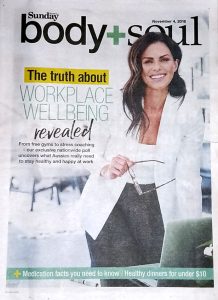
The data for workplace mental health exists, if we demand it

Data about occupational health and safety (OHS) and work-related psychosocial injuries has often been described as being hard to find.  In some ways it is not necessarily hard to find but difficult to access.  An untapped source of data is the records of illness and leave taken that is usually held by the Human Resources (HR) departments, often named “People and Culture”or some variant.  This type of data could be invaluable in determining a workplace psychological profile, if the HR departments would trust OHS professionals more, or release this data in a format that would allow OHS professionals to assess risks while maintaining employees’ privacy.

Beware, Generalisations Ahead

In Australia, employees are usually entitled to ten days’ sick leave, five of which require a medical certificate.  This means that one of the forty-eight expected working weeks may be taken off by workers with no reason provided to the employer other than a call or a text saying “I’m not coming into work today because I am not feeling well.”  Australian slang describes this as “chucking a sickie”.  

Subscribe to SafetyAtWorkBlog to continue reading.
Subscribe Help
Already a member? Log in here

Factbook, short on OHS facts

The Australia Institute has released a “factbook” about The Dimensions of Insecure Work.  It is little more than a snapshot of some of the labour situations in Australia centring on the fact that

“Less than half of employed Australians now hold a “standard” job: that is, a permanent full-time paid job with leave entitlements”

This changed demographic is significant whenever the Government or its departments and agencies take about job and employment figures.  The reliance on full time employment as the core metric should be reviewed and revised but this is likely to change our view of the world through official reports . 

Subscribe to SafetyAtWorkBlog to continue reading.
Subscribe Help
Already a member? Log in here

Preview of Australia’s new work-related psychological injuries guidance

Peta Miller has worked at Safe Work Australia (SWA) for around 17 years.  She leaves there at the end of June.  One of her last public appearances for SWA was the National Health and Safety Conference in Melbourne in May 2018 at which she provided an outline of the new work-related psychological injuries guidance that has been signed-off by SWA but not yet released to the public.

This guide is said to be a large one but not one that requires a re-education on safety and psychological terms.  There is discussion about applying the risk management Hierarchy of Controls to psychosocial hazard identification, the prevention of psychological harm through the design of good work and the identification of psychological hazards without the need to diagnose a medical condition.

Subscribe to SafetyAtWorkBlog to continue reading.
Subscribe Help
Already a member? Log in here

Industrial Manslaughter laws likely for Victoria

With little surprise, at the Australian Labor Party (ALP) Conference in Victoria on 26 May 2018, Premier Daniel Andrews has included the introduction of Industrial Manslaughter laws as a formal part of the campaign for re-election in November 2018.

According to his media release, if re-elected,

“.., employers will face fines of almost $16 million and individuals responsible for negligently causing death will be held to account and face up to 20 years in jail.

A re-elected Andrews Labor Government will make sure all Victorians are safe in our workplaces, with the offence to also apply when an employer’s negligent conduct causes the death of an innocent member of the public..”

There are a lot of steps between an incident and Industrial Manslaughter charges. 

Subscribe to SafetyAtWorkBlog to continue reading.
Subscribe Help
Already a member? Log in here

Fixing the future by planning for the future

The Australian Council of Trade Unions (ACTU) often sets the occupational health and safety (OHS) agenda, as it did on workplace stress and bullying.  On 21 May 2018 the ACTU released a research report entitled “Australia’s insecure work crisis: Fixing it for the future“.  The opening paragraph provides a clear indication of the report’s tone:

“The incidence of non-standard work in Australia is alarming. The fact that our national government and some employer groups seek to deny this reality and refuse to support reforms to better protect workers in insecure non-standard employment is a disgrace.”

There is a lot of useful information in this report but there is also a lot missing, a lot that could affect workplace safety.

Subscribe to SafetyAtWorkBlog to continue reading.
Subscribe Help
Already a member? Log in here

Good data but never enough

The Australian Institute of Health and Welfare (AIHW) released two statistical reports on May 16 2018, one concerns eye injuries and the other, hospitalised injuries.  Some occupational injury data is readily accessible, particularly on eye injuries.

“Eye injuries in Australia 2010–11 to 2014–15” states this about occupational injuries Continue reading “Good data but never enough”

Australian Workplace Safety Bureau

There seems to be a growing community frustration with regulators who hesitate to prosecute breaches of laws, including occupational health and safety (OHS) laws, and about options that sound reasonable, like Enforceable Undertakings, but still let businesses “off the hook”.  The calls for Industrial Manslaughter laws are the most obvious manifestations of the anger and frustration from perceived injustices.

But perhaps there was another way to achieve change in workplace safety, a way that could be based on a model that Australia and other countries already have. Continue reading “Australian Workplace Safety Bureau”

Concatenate Web Development
© Designed and developed by Concatenate Aust Pty Ltd