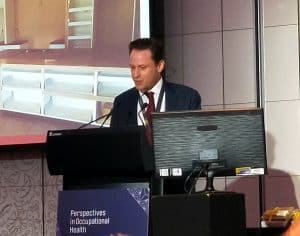
Why hazards are not reported

Each year thousands of people express support for International Workers Memorial Day and the World Day for Safety and Health at Work publicly and through social media.  This is a statement of their commitment to occupational health and safety (OHS) as well as a call to continue action in improving workplace health and safety.  However, this usually does not add to the state of knowledge on OHS.

This year there was a couple of contributions of information that may be useful.  Shine Lawyers released the findings of a recent survey (not yet available online) into why workers do not report workplace incidents. The survey was largely overlooked by the media, perhaps because the full survey results have not been released publicly.

Subscribe to SafetyAtWorkBlog to continue reading.
Subscribe Help
Already a member? Log in here

Notification of mental health incidents

Australia’s entertainment and performing arts sector is gradually attending to the workplace mental health risks that are inherent, or have been shown to be problematic, in their industry. However it continues to operate in isolation rather than facing the reality and magnitude of the problems and the challenges facing lots of industries who have only recently discovered their psychosocial hazards.

The latest edition of Dance Australia magazine contains an interview with Chloe Dallimore,* President of Equity, a division of the Media Entertainment and Arts Alliance (MEAA), which illustrates the willingness to change, but still within limits.  Occupational health and safety (OHS) obligations are hardly mentioned, nor is the role of the OHS regulators.  Perhaps it is time to include mental health as a workplace incident or condition that should be notifiable under law.

Subscribe to SafetyAtWorkBlog to continue reading.
Subscribe Help
Already a member? Log in here

Melbourne’s Worker Memorial ceremony

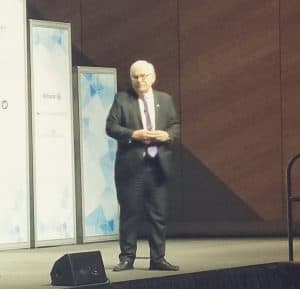
The Melbourne ceremony for International Workers Memorial Day was held on 27 April 2018 and had a good turnout.  The standout “speaker” was Lana Cormie (pictured right), whose husband, Charlie Howkins in a trench collapse in March 2018, a work colleague died later in hospital from injuries from the incident. Victorian Trades Hall’s Luke Hilakari was fired up in his talk about the importance of occupational health and safety (OHS) and the need for Industrial Manslaughter laws.

Cormie’s speech was read out by

Subscribe to SafetyAtWorkBlog to continue reading.
Subscribe Help
Already a member? Log in here

“Just Culture – The Movie” – important case study

I was born outside Liverpool England well over 50 years ago and have lived on the other side of the world ever since.  I love hearing accents from Northern England as it reminds me of my relatives, my roots and, most of all, my Mother.  This meant that I had to watch Sidney Dekker‘s latest 30 minute documentary at least twice so that I paid attention to what was said rather than how.

“Just Culture – The Movie” (accessible through the YouTube share below) tells the story of the transformation from a divisive and unproductive blame culture to a just culture.  It is an important story because it is theory, concept and idea made real, and made real in an industry sector that has a complex organisational culture only partly explained by its funding model.

Subscribe to SafetyAtWorkBlog to continue reading.
Subscribe Help
Already a member? Log in here

Danger Money has been internalised

Late last century I worked in the Victorian Department of Labour as an administrative officer, at a time when award restructuring and “structural efficiency principles” were in full swing.  The existing awards often included a swathe of special allowances for activities like working at heights or picking up roadkill.  These allowances were commonly called “dirt money” or “danger money” and were largely eliminated or incorporated in the base rates of pay through the restructuring of awards.

The concept of “danger money” has disappeared from the formal industrial relations (IR) processes in Australia but is an important one to remember in the context of occupational health and safety (OHS), particularly as there are renewed calls for IR reforms in Australia.

Workers continue to accept high risk activities in response to higher rates of remuneration, as was recently discussed in another SafetyAtWorkBlog article.  Below is one take on “danger money”and the OHS attitudes of trade unions

Subscribe to SafetyAtWorkBlog to continue reading.
Subscribe Help
Already a member? Log in here

USA response on sexual harassment is interesting but can be better

Australia continues to develop various Codes and Guidances for the prevention and management of sexual harassment, particularly in the creative industries.  America’s Screen Actor’s Guild (SAG) released some guidance about its Code of Conduct on April 12 2018. It is educative but Australia can do better.

A positive in SAG’s announcement is that it clearly places sexual harassment under the category of workplace safety which allows for a broad approach to the hazard and one that is supported by legislation and an employer’s duty of care. 

Subscribe to SafetyAtWorkBlog to continue reading.
Subscribe Help
Already a member? Log in here

First WHS Review submission released is hard work but useful

The Minerals Council of Australia (MCA) has released its submission to the Independent Review of Work Health and Safety Laws.  It is a good example of the business-speak that can erode the effectiveness of clear communication, but the submission is still revealing.  Here is an example from its Executive Summary:

“A nationally-consistent, risk-based preventative Work Health and Safety (WHS) regulatory system, supported by industry-specific regulation, would deliver benefits based on greater certainty, consistency and efficiency. It would also help to ensure that compliance challenges do not detract from the practical tasks of identifying, managing and minimising risk and the continuous improvement of safety and health outcomes by companies.” (Page 3)

So, the MCA wants national occupational health and safety (OHS) laws?

Subscribe to SafetyAtWorkBlog to continue reading.
Subscribe Help
Already a member? Log in here
Concatenate Web Development
© Designed and developed by Concatenate Aust Pty Ltd