
OHS solutions promoted but not necessarily delivered

All professions need spokespeople or champions who can provide informative and, hopefully, authoritative commentary on topical matters within and beyond the profession.  Australia’s safety profession has never had such a spokesperson but recently the speakers’ bureau ICMI has packaged a selection of speakers who it thinks could be appropriate. The brief for Work Health Solutions focuses almost entirely on the issues of absenteeism, lost productivity, presenteeism and creating “a more enjoyable, friendly and less threatening environment” but will these speakers provide solutions to illnesses, injuries, amputations and diseases? Can these speakers provide the solutions implied in the program?

From the information on the program’s flyer, several of the speakers seem to be able to present stories about safety-gone-wrong. Theo Venter survived electrocution. Ian Johnson was seriously burned and speaks about the risks of confined spaces. Philip Smallman was a tree surgeon who became a paraplegic after a fall. Helen Fitzroy speaks of the impact of her husband’s workplace fatality.  John Tickell has spoken at several OHS conferences and has at least contributed to a book about OHS but others are tenuous. But ICMI is also promoting speakers who are primarily event hosts or Masters of Ceremonies and at least one of them generated complaints during a WorkSafe Victoria event several years ago for inappropriate comments about women. Continue reading “OHS solutions promoted but not necessarily delivered”

Sex, work, liability and safety

There is a constant tension between occupational health and safety (OHS) and workers compensation. OHS is intended to prevent harm and workers compensation is available for when harm cannot be, or has not been, prevented.  In Australia, these two elements of safety are administered by different organisations under different legislation but it is a distinction that baffles many.   The recent discussion about a sex-related workers compensation claim illustrates this bafflement to some degree.

This time last year Comcare filed an appeal over a Federal Court decision regarding

“A Commonwealth employee is seeking workers’ compensation for injuries sustained after a light fitting was pulled from the wall of a motel during sex, on a business trip.”

(A good summary of most of the legal proceedings is provided by Herbert Geer.)

The case has received wide media attention mostly for the salacious matter of the case, and some political attention, but the purpose of the appeal, according to Comcare, was

“… to seek a High Court ruling on the boundaries between private Continue reading “Sex, work, liability and safety”

Lovely chair that helps greatly but is only part of the solution

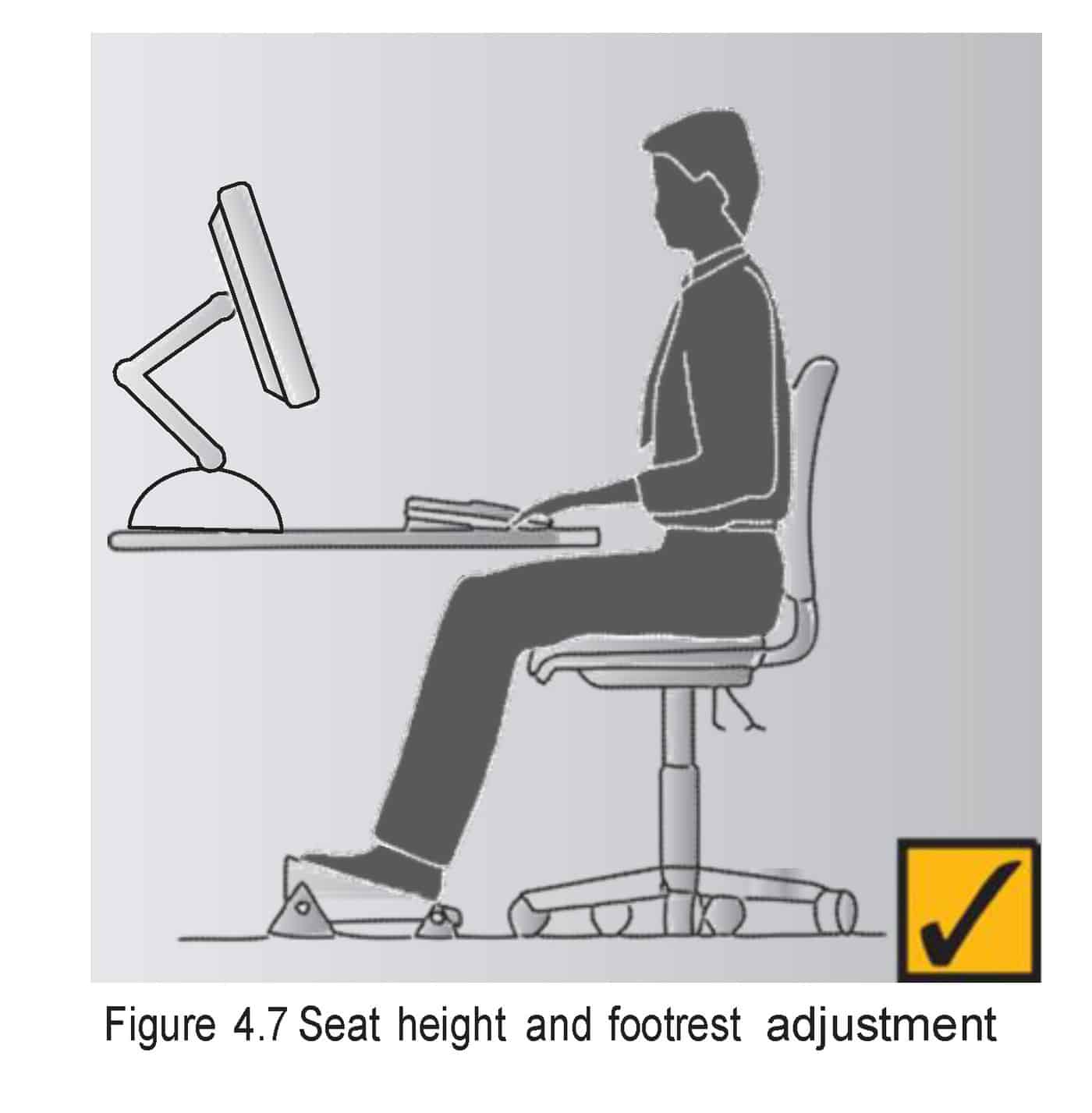
Figure 4A diagram of  safe posture at modern workstations has become iconic but it has also become a symbol of ergonomic misunderstanding.  There are assumptions behind the angular figure about the way modern workers work, the equipment used and the tasks undertaken.

Too often images, such as the one included here, are taken out of context.  The image is used as a shortcut to what is considered the “correct” way to sit.  The context, the risk assessments, the tasks undertaken, the location of the workstation – basically all of the OHS information included in the workplace safety guides is ignored.  People think “the picture has a tick of approval, so why read when the picture says enough”?

This week Steelcase, a one hundred year old company that originally constructed waste paper baskets, launched its Gesture chair.  The marketing of this chair is based on the discovery (?) of nine new postures in the workplace:

Continue reading “Lovely chair that helps greatly but is only part of the solution”

No code of practice for workplace bullying but hope remains

Ha01-037As the 1 January 2014 implementation date for new workplace bullying processes approaches there is an increasing amount of legal, HR, and safety seminars, and newsletters and alerts being produced.  Most reiterate the amendments to Australia’s Fair Work Act but occasionally there is additional information.

In a recent seminar, it was suggested that the draft Code of Practice for the Prevention and Management of Workplace Bullying, developed by Safe Work Australia, is to be released as a guidance note rather than a Code of Practice (see below).  Continue reading “No code of practice for workplace bullying but hope remains”

OHS as an industrial relations tool

Recently Queensland’s Attorney-General Jarrod Bleijie has been asserting that a review of union right-of-entry provisions is needed because unions have been using occupational health and safety (OHS) issues as an excuse for industrial relations (IR) action.  Such assertions have been made for decades in Australia to the extent they have become fact.  Below is an article looking at one of the sources of the Attorney-General’s assertions.

In a media statement dated 5 October 2013, Bleijie stated:

“For too long, we have seen construction unions using safety as an industrial weapon in this State… Quite frankly, their abuses of the current right of entry provisions are designed to bully contractors until they get their way. Sites are being hijacked and workers held to ransom.

“I have personally heard of stories from hard working Queenslanders who have been locked out of their workplace because of militant union activity.

“Earlier this year, a major contractor lost 42 days of work due to illegal strike activity in the first year of their enterprise agreement. This practice will end.”

Some of this statement was quoted in a Sunday Mail article on 6 October 2013 following the minister’s speech at an awards ceremony with the Master Builders. Like most political media statements there is a large amount of hyperbole but this article’s focus will be on the OHS elements of the statement.  Continue reading “OHS as an industrial relations tool”

Hundreds plead with government to save lives while those to blame beg for scrutiny

The article below has been written by Marian Macdonald and is about an event that I recently attended in Sydney about fall protection.

When a plumber perched on the rooftop of a skyscraper clips a safety harness onto the point that anchors him to the building, there’s a one-in-three chance the anchor itself is unsafe. Remarkably, the installers being held to blame are pleading for greater scrutiny of their work from the regulator.

SummitAudienceThe Working At Heights Association (WAHA), which represents fall prevention equipment installers, today sent a call to action submission (not available online)  to the Heads Of Workplace Safety Authorities (HWSA). It follows an industry crisis summit held last month where, with a sea of upstretched hands, hundreds packed into a stifling conference room demanded urgent action from governments. Continue reading “Hundreds plead with government to save lives while those to blame beg for scrutiny”

New political challenges for OHS in Australia

This weekend the Australian people voted for the conservative Liberal Party to be the next Federal government.   Workplace safety has been largely absent from the pre-election campaign but when it has been mentioned it has almost always been couched in terms of productivity.  In the next few years, workplace safety issues must be couched in terms of productivity to have any hope of gaining the ear of the new government and, particularly, the ear of Senator Eric Abetz, the most likely candidate for the ministry of workplace relations.

Workplace Bullying

Recent changes to workplace bullying laws which provide a prominent role of the Fair Work Commission are unlikely to be rolled back but Abetz has promised Continue reading “New political challenges for OHS in Australia”

Concatenate Web Development
© Designed and developed by Concatenate Aust Pty Ltd