Charges laid on swing stage collapse

SafetyAtWorkBlog reported on a scaffolding incident in Queensland in mid-2008.  Charges have now been laid but not manslaughter charges as were called for at the time by the unions.

The workers were fatally injured on 21 June 2008 when the swing stage scaffold they were using to carry out concrete patchwork on the Pegasus high-rise, then under construction at Broadbeach, failed and fell 26 levels to the ground.

According to Workplace Health and Safety Queensland

Allscaff Systems Pty Ltd, which erected the swing stage, is charged with failing to ensure the plant was erected in a way that ensured it was safe when used properly.

Ralph Michael Smith, director of Allscaff Systems Pty Ltd, is charged with failing to ensure the company complied with its obligations under the Act.

Karimbla Construction Services Pty Limited, which built the high-rise, is charged with breaching obligations as a person in control of a workplace and as project manager.

Pryme Constructions Pty Ltd, which undertook the concrete patching, is charged with breaching its obligations to ensure workplace health and safety.

SsfetyAtWorkBlog will be following this case over the next few months.

Not another Australian swine flu website!?

Recently in 2009, the Health Services Australia company launched a new swine flu website.  

The HSA site is run by a private health services company and came to the attention of SafetyAtWorkBlog through a news item by the OHS Commissioner of the Australian Capital Territory.   The ACT OHS Commissioner may not be endorsing the site but the HSA website is described positively.  The Commissioner’s site says

“The site provides information on the risk of flu – pandemic, swine, avian and seasonal varieties – expanding upon information previously published on their avian influenza site.

It also includes the latest health alerts, FAQs, useful links and information on travel health services relating to flu which people may find of benefit.”

For further information on www.fluthreat.com.au SafetyAtWorkBlog followed the trail from fluthreat to HSA which then lead to the site of one of Australia’s largest private health insurers, Medibank Private.  The two companies merged only recentlyon 1 April 2009.

Health Services Australia is listed on the fluthreat site  as the copyright holder but Medibank Private is not mentioned.

The HSA site which includes a prominent link to www.fluthreat.com.au does mention Medibank Private, in a mediarelease link on the home page but more succinctly, but almost in passing, under Governance and Structure:

“Health Services Australia Limited (HSA) and its subsidiaries are owned by Medibank Private Limited (Medibank).”

It seems very odd that the ACT OHS Commissioner should be directing Internet visitors to a privately run influenza information website instead of to the influenza information from authoritative websites such as the Australian Department of Health and Ageing, the ACT Dept of Health, the Federal Government’s dedicated swine flu site – healthemergency, or even the the World Health Organisation.

[SafetyAtWorkBlog has repeatedly tried to contact the ACT OHS Commissioner’s office but gets an answering service each time.  The media spokesperson for HSA Group and Medibank Private has not yet returned calls]

Kevin Jones

Swine Flu and business continuity – video

On the evening of 2 June 2009, the ABC TV show “Lateline Business” ran a short item on the business continuity issues associated with Australia’s swine flu outbreak.  Not much that was said was new but it proposed an interesting scenario for those people who manage aged care facilities where a potentially virulent illness could harm residents who it may be difficult to isolate or quarantine.

Michael Tooma of Australian law firm, Deacons, spoke briefly to remind viewers that health and safety were important legislative obligations that relate to illnesses, such as swine flu.  Interestingly he provided a rule-of-thumb scenario on business continuity.  He asked whether a business could continue to operate with 20% less staff, a 20% reduction in logistics services and 20% less customers, if the swine flu realises its potential.

Most of the speakers spoke from the current position that Australia is suffering from a “mild” case of this virus.  The story would be considerably different if Australia suffered its first swine-flu fatality, as have other nations.  One death and the terminology will change.

A video of the segment is available to view online.

Kevin Jones

Union movement misdirects on OHS

According to an AAP report on 3 June 2009, the ACTU is forecasting action on the matter of workplace deaths.  Although the issues is heartfelt and important, the Australian union movement mostly discusses OHS in relation to its opposition to the Australian Building and Construction Commission.  The AAP report is a good reflection of this.

ACTU secretary Jeff Lawrence states that the rate of workplace fatality is unacceptable but is then quoted as saying

“The high level of deaths and injuries in the construction industry is a national disgrace and yet safety standards have got worse in the period the Australian Building and Construction Commission (ABCC) has operated.”

It has never been the role of the ABCC to regulate workplace safety obligations.  That obligation sits with the State OHS authorities and maybe the Australian Safety & Compensation Council (now Safe Work Australia).The union movement has been instrumental in improving safety on worksites throughout Australia but Jeff Lawrence’s misdirection to the ABCC does a disservice to the efforts of OHS professional and health & safety representatives.

Kevin Jones

Legal opinion on Australia’s model OHS laws

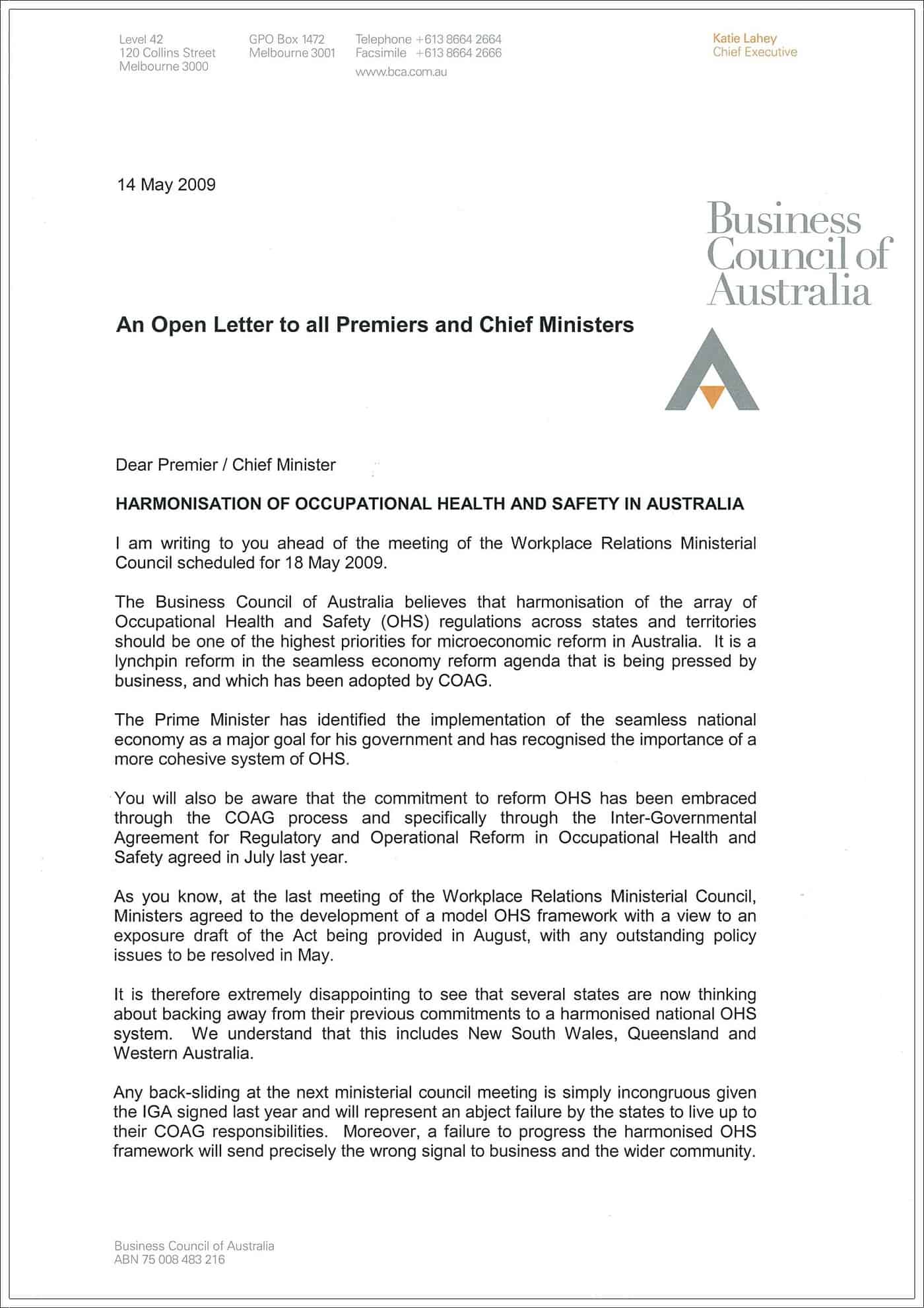
The comments on the Australian Government’s response to the report into Australia’s model OHS laws have been pretty muted.  There were the obligatory compliments from those in favour and the obligatory criticisms from those against but both types of response were in the immediate aftermath of the Workplace Relations Ministers’ Council meeting in mid-May 2009.

Going from the institutional and media quiet, there must be few changes that are expected to have any great impact.  Law firm Blake Dawson released their take on the government’s response.  Here is their advice to employers – pretty much “wait and see”: 

Lessons for employers

  • The decisions made by the WRMC on the proposed national model OHS Act will bring changes to virtually all areas of OHS in all Australian jurisdictions.
  • All employers and other duty holders should carefully review the model OHS Act upon its release and consider whether changes need to be made in advance of the laws being enacted.
  • Particular areas of focus are likely to be:
    • ensuring all duty holders have a clear understanding of the nature and scope oftheir duties and obligations;
    • ensuring that officers of corporations are taking proactive steps to promote health and safety;
    • in respect of some Australian jurisdictions (eg NSW) preparation for the introduction of health and safety representatives and the role that HSRs may play in an organisation;
    • thorough preparation for regulator investigations.

It is strongly recommended that their full “alert” be read for interest.

Kevin Jones

Presenteeism and swine flu

Craig Donaldson interviewed Joydeep Hor, managing partner of Australian law firm Harmers on employment issues related to the swine flu outbreak.  Joydeep rightly points out that HR and OHS processes should not differentiate between swine flu and other workplace illnesses.  Hor briefly discusses the employers duty of care and how to question one’s traditional approaches to the “sniffles” at work.

Of course there is also the much under-enforced obligation of the employee not to put their work colleagues at risk – the major argument against presenteeism.

Kevin Jones

Guarding – last line of defence

Guards around power tools or over moving parts of equipment (e.g. covers over compressor pulleys) are there for seriously good reasons. Injuries and deaths from people getting cut or caught in machinery keep happening all the time.

It’s a common misunderstanding that bits of clothes caught in moving machinery can’t be that dangerous, after all cloth rips doesn’t it? Wrong.

A loose bit of overall sleeve caught in between a pulley and pulley belt is unlikely to rip. It will have an arm or hand mangled in a micro second. Nip points on equipment can catch skin.  A de-gloved hand, where a pinch of skin is caught in machinery and the skin is ripped off the hand is as ugly as it sounds.

Do regular checks of things like angle grinders and moving parts of equipment to make sure the guards originally fitted are still in place and doing the job they have to.  People will remove guards.

Have a policy that when guards are removed to do repair or maintenance work on equipment the guards are refitted as soon as those sort of jobs are done.

Monitor use of power tools in the workshop.  Stop any work being done with power tools when the guard has been removed.

Don’t consider that a guard isn’t necessary if an operator is using some other sort of personal protective gear (e.g. using protective eye gear with a bench grinder that has no fitted shield in front of the grinder wheel).  Treat safety as a thing that works best in layers. Murphy’s Law never rests.  One level of safety protection will always fail at the wrong time.

Do regular checks on all guards on tools and equipment.  Make it a specific check. Include an evaluation of whether equipment that can catch clothes or part of a body is properly guarded.  Modern equipment designers are generally pretty good at making sure guards are fitted where they need to be, older gear is not so well designed.  If it seems entirely possible for a person to get caught by a moving bit of equipment look at having a guard made and fitted: use a specialist to do that.

Readers are at liberty to use this stuff as they see fit, but acknowledgement of the author and the source (i.e. SafetyatWorkBlog) is expected. Contact Kevin Jones first if ya wanna use it. Cheers.

Col Finnie
col@finiohs.com
www.finiohs.com

Concatenate Web Development
© Designed and developed by Concatenate Aust Pty Ltd