‘No Bystanders Rule’​ Bullshit

Guest Post by Dr Rebecca Michalak

About couple of weeks ago, the Australian Financial Review (AFR) featured a piece on a law firm that had introduced a mandatory approach to reporting sexual harassment – referred to as a ‘no bystanders’ rule. 

To be clear upfront, here is my disclaimer – I am not directly commenting on the law firm in question; there isn’t enough information in the articles to make any objective judgements on that front. The references used from the two media pieces are for illustrative purposes only. Call them ‘conversation starters.’

In the AFR piece, the contractual obligation was outlined to involve: 

“…chang(ing) ‘should’ (report) to ‘must’ – so any staff member who experiences, witnesses, or becomes aware of sexual harassment must report it,” 

with the affiliated claim being,

“That shift really reinforces that there is zero tolerance – and there are no confidences to be kept; it needs to be outed – bystanders [staying silent] will no longer be tolerated.

Continue reading “‘No Bystanders Rule’​ Bullshit”

Behind the OHS words in Parliament

On December 11 2020, Senator Deborah O’Neill (ALP) (unsuccessfully) sponsored a motion that, amongst other things, called on the Government to act on the recommendations of the 2018 inquiry in to industrial deaths and the Boland Review, and to introduce Federal industrial manslaughter laws. That last request will probably never occur under a Conservative government, but does not need to for such laws to be introduced across Australia.

It is good that pressure on important occupational health and safety (OHS) matters is maintained, even if the motion was “negatived”. However, perhaps more interesting was a couple of statements that Senator O’Neill’s actions generated, one of which is deconstructed below.

Subscribe to SafetyAtWorkBlog to continue reading.
Subscribe Help
Already a member? Log in here

Federal leadership misses State action

Australia’s Industrial Relations Minister and Attorney-General, Christian Porter, has popped up on occupational health and safety (OHS) issues several times in the last few weeks. It is fair to say that each time he has not really shone, partly due to political ideology and partly due to constitutional structures. Some of these barriers, the Minister can address.

As mentioned recently, several food delivery drivers have died. Minister Porter was asked specifically about one of these deaths, that of Chow Khai Shien, in Parliament by the Australian Labor Party’s Josh Burns. Porter said that he had talked to representatives of the Transport Workers Union about this type of work, but:

“One of the things that we discussed in that meeting was the fact—that is acknowledged, I think, inside the union—that occupational health and safety for those drivers is, not just predominantly, but essentially, a state based responsibility.”

Subscribe to SafetyAtWorkBlog to continue reading.
Subscribe Help
Already a member? Log in here

Gig work changes that could save lives

The New South Wales government is conducting an inquiry into the gig economy, modern versions of precarious work. There has been five deaths of food delivery workers over the last few months and this has increased media attention on the Inquiry and the issues raised.

On November 28 2020, Joellen Riley Munton, Professor of Law at the University of Technology, Sydney spoke on the Australian Broadcasting Corporations’ AM Program. Out of all the recent media discussions on gig work, Munton’s seemed the most targeted on occupational health and safety (OHS).

Subscribe to SafetyAtWorkBlog to continue reading.
Subscribe Help
Already a member? Log in here

Noisy Buggers in the Post-COVID world

Guest Post by Melody Kemp

In my more bizarre moments, I can imagine the cockpit conversation:

‘Hey Bill, there’s the blue and white house. We turn left here’
‘Bob, Copy. Over.’

Of course, it’s nonsense to think that the complexities of aircraft take-offs and landings would depend on visual cues, rather than complex technology, weather and fuel economy.  In fact, it’s the very technology that allows communities to track and identify aircraft and the noise level as they pass overhead.

But I have to admit that, particularly at night, when I see the queue of aircraft waiting to approach, their starboard and port lights blazing into our living room, it’s hard not to go out and shake an impotent fist at the crew.

As I completed this third paragraph, a Jetstar plane flew overhead. I measured the roar at 76DbA, another app told me it was slightly less than 1000 feet above my roof.  As it continues to descend, it passes over the densely populated parts of the city that follow the Brisbane River, including New Farm and Doomben, well known to race goers. What was that old saying about don’t scare the horses?

I work at home. My concentration and the paragraphs I write, come in lumps divided by the passing of planes. Some, like the Flying Doctor prop-jets, make, in objective terms, little noise (around 58dBA), but if one is sensitised to the noise in general, they become yet another psychological hazard. Evidence for aircraft noise exposure being linked to poorer well-being, lower quality of life, and psychological ill health is reflected by the responses to my questions and Facebook comments posted by concerned residents (some are included below)

Continue reading “Noisy Buggers in the Post-COVID world”

The never-ending line between healthy and sick

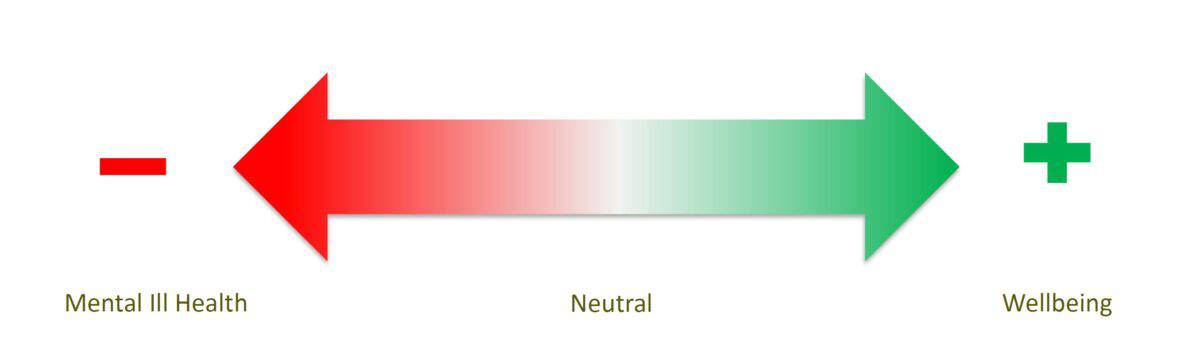
Infographics are increasingly used to summarise sometimes quite complex reports about occupational health and safety (OHS) matters. But often the nuance of the facts being depicted are stripped away in the translation process. There is one graphic that is repeatedly used in the context of mental health that seems to misrepresent reality for the sake of clarity.

Subscribe to SafetyAtWorkBlog to continue reading.
Subscribe Help
Already a member? Log in here

Thanks, but we need more

Statistics are vital to any decisions about occupational health and safety (OHS). Safe Work Australia (SWA) does a great job providing statistical packages based on the data sources it can access. Last week SWA released its 2019 report on “Work-related Traumatic Injury Fatalities” which identified vehicle collisions as, by and large, the most common cause of worker fatalities. This category may be a surprise to many readers but perhaps the most important part of the report is what is omitted.

Subscribe to SafetyAtWorkBlog to continue reading.
Subscribe Help
Already a member? Log in here
Concatenate Web Development
© Designed and developed by Concatenate Aust Pty Ltd