
The first week of media coverage of Victoria’s Royal Commission into Mental Health is very thin on the roles and impacts of workplaces and work activities on people’s mental health, but it is part of the conversation.
The Public Hearings on July 4-5 had Prevention and Early Intervention as their theme. Prevention as occupational health and safety (OHS) people would apply was mostly absent. Prevention, in OHS terms, is usually about the elimination of a risk or hazard whereas the impression from the discussion in the Royal Commission over the last few days is that mental health is something that appears, strikes an individual (with ripples to relatives), is treated and a new psychological normal, a functional/social normal is established. Analysis of the social, occupational and environmental precursors, elements that OHS investigations are obliged to consider, seems missing, at the moment.
According to the Commission’s transcript Chair Penny Armytage said on July 2, 2019:
“We start these hearings with a wide lens. Not in hospitals or clinics, but in our homes, our sporting fields and our workplaces.”

 The trade union movement was instrumental in showing that workplace bullying was a pervasive problem in Australian workplaces. Many Codes of Practice and guidances for workplace bullying and occupational violence were written shortly after the action by the Australian Council of Trade Unions almost two decades ago. But, for some reason, although sexual harassment was mentioned in those early documents, it never received the attention in occupational health and safety (OHS) circles that, in hindsight, it should have.
 Occupational health and safety (OHS) is often about promises. Employees trust their bosses to provide them with a job and the employer promises to provide a workplace that is as safe as possible. There are also contractual policies which formalise OHS relationships between client and contractor. But OHS is more often about those more personal promises and expectations between the boss and the worker.
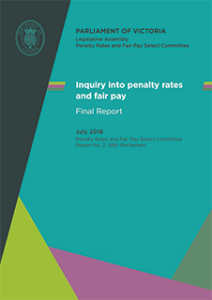 Australia currently has a lot of official inquiries into workplace issues that affect the occupational health and safety (OHS) of workers. It is almost impossible to keep up with them and, as a result, some important voices are being missed, but even if they spoke, there is a strong chance they will not be listened to. The Victorian Government has released the final report of the Inquiry into Penalty Rates and Fair Pay. There are two overt mentions of OHS that don’t seem to go anywhere.