Now there is too much mental health information, and it’s like toothpaste

Australia is experiencing a boom in occupational health and safety (OHS) information about work-related psychological harm, including sexual harassment at work. This level of information is long overdue, but a consequence of this “boom” is that employers can be very confused about which information to use and which source they should trust or even what relates to their specific circumstances, especially after years of denying there is a problem.

Putting on my consultant hat, I would advise any State-based organisation to comply with the OHS guidances issued by that State’s OHS regulator. If a national company, look towards the guidance of Comcare or Safe Work Australia for the national perspective. The challenge is greater for companies that operate in multiple States, but these have been rumoured to be less than 10% of Australian businesses. If multi-State, they should be big enough to have the resources for OHS compliance.

However, some State-based mental initiatives have evolved into a national platform.
Subscribe to SafetyAtWorkBlog to continue reading.
Subscribe Help
Already a member? Log in here

WorkSafe Victoria intends to change the farm safety culture

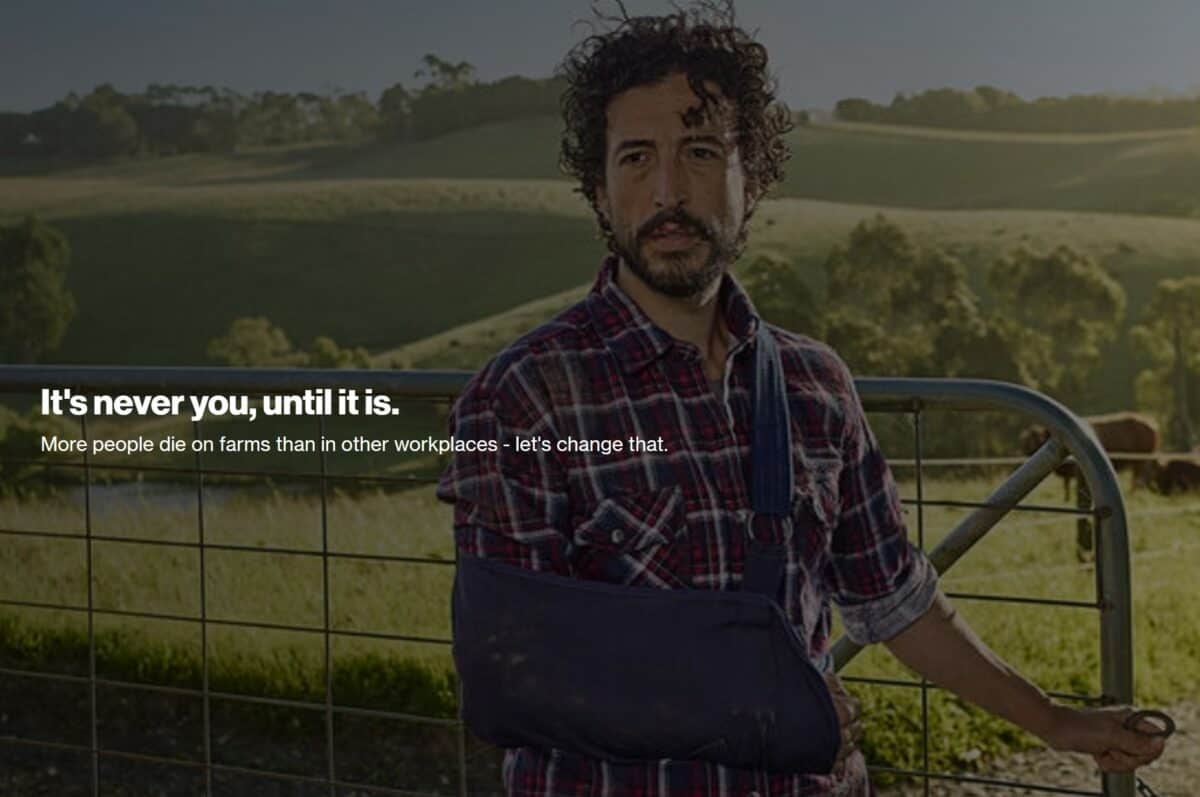
WorkSafe Victoria has launched a new campaign about health and safety on farms. Safety and health in this sector needs constant promotion as high rates of death and serious injury persist. The latest video campaign deserves a broad audience and hopefully is pushed heavily on television in rural areas and through local newspapers (what’s left of them) as these media continue to be major influences.

Farming is one of the hardest industries in which to achieve tangible change in occupational health and safety as discussed only recently on this blog. This latest campaign is fresh and looks good but the message is confusing if, as WorkSafe Victoria claims, the aim is to affect cultural change in the agriculture sector. The video takes a narrow focus on the male farmers implying they are the major cause of injuries. (Gender is a sensitive issue in farming, even though the statistics show older male farmers continue to be at high risk of injury) There is a little bit of “blame the worker” which is contrary to most strategies for cultural change.

Subscribe to SafetyAtWorkBlog to continue reading.
Subscribe Help
Already a member? Log in here

Is WorkSafe jumping the gun?

In mid-February 2021, WorkSafe Victoria issued a media release informing the community that it has charged a contractor following a worker’s death at a residential building site in Ballarat. Informing the community in such an early stage of a prosecution raises the issue of fairness and, according to one prominent occupational health and safety (OHS) lawyer, appears a little “unseemly”.

The revelation of legal action in any area of enforcement is tricky, with each case raising unique combinations of concern. Does the accused know of the prosecution? And before anyone else is told? Is the revelation in the public interest? Does it taint any future hearing or court appearance? Does it affect the chance of a successful prosecution or a successful defence? All of these are valid questions that need asking and answering in each case. Worksafe would surely have considered these matters before the February 2021 media release, but let’s look at the release in a different context.

Subscribe to SafetyAtWorkBlog to continue reading.
Subscribe Help
Already a member? Log in here

Business voices add weight to OHS change

On February 27 2012, The Australian reprinted/tweaked a Harvard Business Review (HBR) article on Burnout. A significant feature of the article is the acknowledgement of organisational factors as contributing to burnout and other workplace mental health hazards. The situation seems to have changed as these types of acknowledgements were harder to draw out of psychological health experts when SafetyAtWorkBlog spoke to some in 2019.

However, there are also clear parallels to Australian research into job stressors that could have helped HBR’s author Dave Lievens add weight to the decades-long research of Michael Leiter and Christina Maslach.

Subscribe to SafetyAtWorkBlog to continue reading.
Subscribe Help
Already a member? Log in here

The PM expects Australian workplaces to be “as safe as possible”

Prime Minister Scott Morrison has set the occupational health and safety (OHS) bar unachievably high for Australian businesses.

Morrison is embroiled in a scandal about an alleged rape in a ministerial office, his knowledge of and response to it, and his government’s duty of care to political employees. Below is his response to this question from a journalist:

JOURNALIST: “What is your message to young women who might want to get into politics and see this and are just horrified by it. What’s your reassurance to them about getting involved in the Liberal party or other parties? “

Subscribe to SafetyAtWorkBlog to continue reading.
Subscribe Help
Already a member? Log in here

Parliamentary culture must change

Australia is in the midst of a murky investigation into an alleged rape that occurred out-of-hours in an office of a Federal Minister in Australia’s Parliament House. The incident has raised discussions and debates about workplace culture, the reporting of crimes, the uniqueness (?) of the parliamentary workplace, the rights of women, the role of the media in reporting the allegations or in being complicit in the workplace culture…….

Prime Minister Scott Morrison has got himself into a pickle about how to respond, how to investigate and what he should have known and what he was expected to do. One of the actions that he and his government could do, and should have done, was to accept, and act on, the findings of the National Inquiry into Sexual Harassment in Australian Workplaces conducted by the Australian Human Rights Commission (AHRC) early last year. The relevance of this report is obvious:

Subscribe to SafetyAtWorkBlog to continue reading.
Subscribe Help
Already a member? Log in here