COVID19 and OHS gets political

Workplace health and safety risks related to COVID19 emerge in Australia and the United Kingdom.

Trade Union Suggestions

On May 5 2020, the Australian Council of Trade Unions released a statement on occupational health and safety (OHS) calling for certain Industrial Relations and OHS changes, including:

  • Paid pandemic leave
  • New regulations on safety and health standards, and
  • Compulsory notifications to Health Departments and OHS Regulators.

SafetyAtWorkBlog has been led to believe that the paid pandemic leave is intended to apply from the time a worker is tested for COVID19 through their isolation while waiting for the test results and the operation of sick leave should the test results be positive.
Subscribe to SafetyAtWorkBlog to continue reading.
Subscribe Help
Already a member? Log in here

What is needed to get us out of this crisis

As parts of the world begin to emerge from the disruption and lockdowns of COVID19 some academics and experts are advising that the future must be built on the past but should not seek to replicate it. Over a dozen prominent, global academics (listed below) have written a discussion paper to be published in the Economic & Labour Relations Review (ELRR) in June 2020 entitled “The COVID-19 pandemic: lessons on building more equal and sustainable societies” which includes discussion on workplace relations and factors affecting mental health at work. These big picture discussions are essential in the development of strategies and policies for the post-COVD19 world and occupational health and safety (OHS) has a legitimate, and some would say unique, voice.


Subscribe to SafetyAtWorkBlog to continue reading.
Subscribe Help
Already a member? Log in here

Shop safety protocols do not go far enough

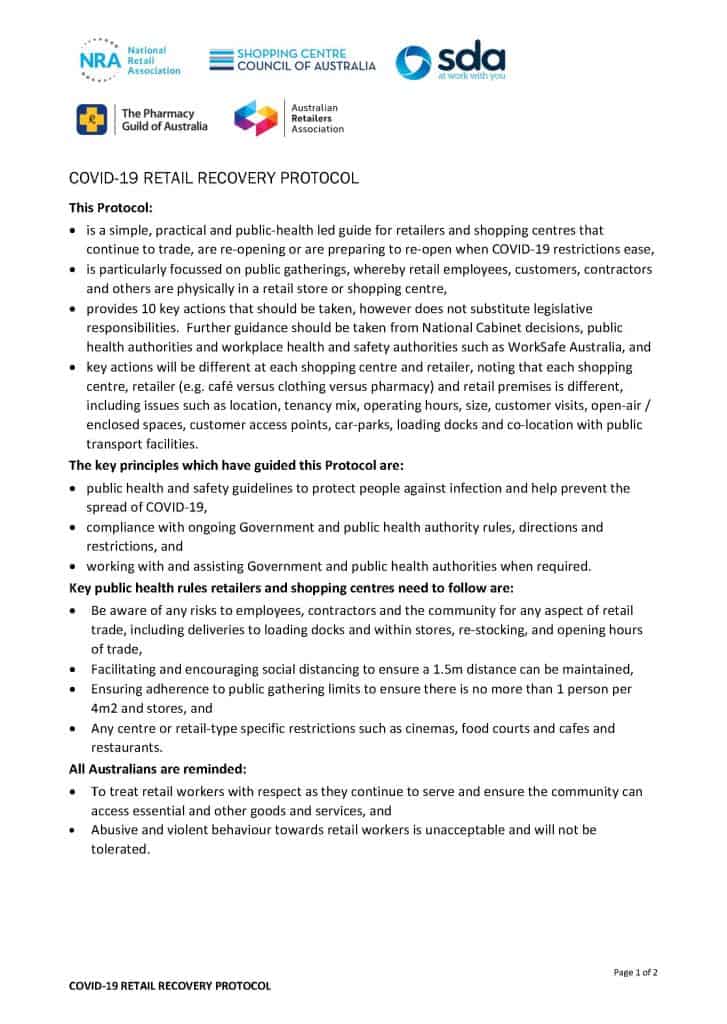
A group of retail associations in Australia has released a very curious COVID-19 Retail Recovery Protocol.

All shops and malls are workplaces and must comply with occupational health and safety (OHS) laws. A small embarrassment in these protocols is that although it acknowledges that further guidance may be available from workplace health and safety authorities, it provides no links to that COVID19 guidance and gets Safe Work Australia’s (SWA) name wrong! It does not inspire confidence and all that was needed was a single hyperlink to the SWA guidance developed specifically for the Retail Industry.

Subscribe to SafetyAtWorkBlog to continue reading.
Subscribe Help
Already a member? Log in here

OHS and Marilyn Hubner

Dr Marilyn Hubner has been a steady presence in Australia’s occupational health and safety (OHS) field. I had the pleasure of spending some time with, and interviewing, her at the World OHS Congress in Singapore a few years ago. Her training work keeps her connected with workers and business owners away from workplace, usually, and allows for a good level of perception on the reality of OHS.

Marilyn says:

Just want to say first up, that humanising OHS is interesting.  Some people think safety is all about humanising, but many others often find themselves thinking numbers and compliance a bit too much.   I’m not your typical safety person.  Most of my work is training related.  Either writing programs, delivering training or evaluating and improving training programs.  Many will see this as outside the safety profession, but I tend to think of myself and my services as a contractor to the profession as well as to organisations.  

How did you get into Health & Safety?

I got into safety in a very common way, through the HSR way.  While working as an educator I was put forward to be the HSR, after the first day of the 5 day training, I knew that this was the way that I could (as everyone wants) ‘save the world’.  After the course I enrolled in the Cert IV, then the Diploma of OHS and then looked for work.  With my defence force and adult education background, safety training and consulting came naturally.

Continue reading “OHS and Marilyn Hubner”

“a COVID safe workplace” – Mark 2

Less than 12 hours after not mentioning Safe Work Australia’s COVID19 occupational health and safety (OHS) guidance, the Minister for Employment, Skills, Small and Family Business, Michaelia Cash, issues a media release, in conjunction with the Minister for Industrial Relations, Christian Porter, saying that

“The Safe Work Australia (SWA) website has been transformed into a centralised information hub, which can be easily searched using a handy content filter to find work health and safety guidance relevant to 23 specific industries.”

Subscribe to SafetyAtWorkBlog to continue reading.
Subscribe Help
Already a member? Log in here

“a COVID safe workplace”

The closest photo I could find related to “teaching your Grandmother to suck eggs

On May 1 2020, Australia’s Employment Minister, Michaelia Cash, spoke on breakfast television to discuss what the government considers to be a “COVID safe workplace”. Her advice to Australian employers was nothing more than understand your business, assess your risks and apply the controls, as if employers did not already know!?

To David Koch on Channel 7’s Sunrise program, Minister Cash said:

“… businesses need to examine what industry am I in; what are the restrictions that are still going to be in place in my particular workplace; and, do I have that action plan, that set of best practice principles ready to go so when I’m given the green light I can open my doors and Australians can come back to me with confidence knowing I have a COVID safe workplace.”

Subscribe to SafetyAtWorkBlog to continue reading.
Subscribe Help
Already a member? Log in here

Quick OHS News – Danger Money, Red Tape and Toilets

Below is some interesting occupational health and safety (OHS) issues that have appeared over the last week that I don’t have the time to explore in the usual depth but are useful.

Danger Money appears

David Marin-Guzman reports that unions are asking for an extra

“$5 an hour to compensate [disability workers] for risks in assisting clients suspected of having coronavirus.”

The reporter’s Twitter account justifiably describes this as “danger money“, an issue forecast as likely by this blog recently. That such an offer is made by the Health Services and United Workers Unions is disappointing but unions can do little else as the employers have the primary OHS responsibilities. What such action also does though is let the employers off lightly from their OHS duties to continuously improve workplace health and safety. The $5 danger money may be cheaper than implementing other risk control options but OHS laws have a process for this type of decision making that has Cost as the last option to be considered. Allowances do not reduce worker safety risks and they can undermine future OHS initiatives.


Subscribe to SafetyAtWorkBlog to continue reading.
Subscribe Help
Already a member? Log in here