Managing safety on a high risk TV program

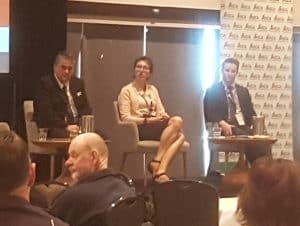
Roger Graham (left) and Todd Sampson talking safety

Todd Sampson has created a niche in Australian television by challenging himself in mental and physical tasks.  His latest program is “Life on the Line“. What is intriguing about this type of TV program is how occupational health and safety (OHS) is managed in a way that does not impede the aim of the show.

SafetyAtWorkBlog spent some time with the safety adviser on the show, Roger Graham, to better understand the demands of advising film and TV productions on workplace safety.  The exclusive interview is below.

Subscribe to SafetyAtWorkBlog to continue reading.
Subscribe Help
Already a member? Log in here

The OHS benefits of a single lunchtime meeting

Being a member of a local safety group provides nuggets of occupational health and safety (OHS) information from speakers and members in a broad range of industries and occupations.  The May 2017 meeting of the Central Safety Group at which Wayne Richards spoke provoked several OHS thoughts about safety, leadership and culture. One was that Transdev…

Subscribe to SafetyAtWorkBlog to continue reading.
Subscribe Help
Already a member? Log in here

How will “independent workplace facilitators” improve OHS?

Every government releases a great deal of information, particularly around budget time and occupational health and safety (OHS) funding often gets missed in the overviews and media discussion.  The Victorian Government’s budget papers (Budget Paper No. 3 – Service Delivery) for 2017 included A$3 million to the Department of Health and Human Services (DHHS) for

“Addressing occupational violence against health workers and workplace bullying” (page 78)

There is no doubt that such funding will help improve OHS but it also seems odd, given some of the recent incidents and riots,  the corrections and prison services received no specific OHS funding. The introduction of “a trial of independent workplace facilitators” is also intriguing.

Continue reading “How will “independent workplace facilitators” improve OHS?”

Real men and work-related suicide

Recently Huffington Post Australia posted a video about male suicides called “Men are killing themselves to be real men”.  Many of the speakers talked about their experiences at work or with work.  The video is highly recommended.

SafetyAtWorkBlog had the opportunity to talk with the Associate Video Editor, Emily Verdouw. Below is an edited transcript.

Subscribe to SafetyAtWorkBlog to continue reading.
Subscribe Help
Already a member? Log in here

Research into “gross under-reporting” of illness and injuries

There has been a lot of discussion recently about occupational health and safety (OHS) data.  This article is another because the issue is critical for understanding OHS, for planning for the future and managing productivity.

On May 1 2017, the University of South Australia issued a media release about research by Amy Zadow.  It opened with the following

“Accidents leading to work injuries cost an estimated $57 billion in Australia and new research from the University of South Australia shows workplaces are unlikely to be adequately addressing injury prevention because management decisions are informed by inaccurate data.”

Subscribe to SafetyAtWorkBlog to continue reading.
Subscribe Help
Already a member? Log in here

Trade unions offer alternative, more accurate(?) workplace death statistics

The Victorian Trades Hall Council (VTHC) indirectly acknowledged the ILO theme for World Day for Safety and Health at Work in its media release for International Workers Memorial Day 2017.  The ILO was calling for more, and better, data on workplace injuries and illnesses.  VTHC questioned the official workplace fatality numbers issued by the government.  It stated:

“A VTHC analysis shows that in 2016-17 over 200 Victorians died as a direct result of Workplace injury or illness, although the government’s official tally for the year is just 26.”

This disparity needs to be discussed across jurisdictions because occupational health and safety (OHS) data has always been incomplete, a fact acknowledged by many government inquiries in Australia for many years.  

Subscribe to SafetyAtWorkBlog to continue reading.
Subscribe Help
Already a member? Log in here

safetyculture clarifies its approach to SWMS

On May 1 2017 safetyculture released an e-book called “Confused about Workplace Safety?” intended to address questions commonly asked of them.  The topic of most interest is their advocacy of Safe Work Method Statements (SWMS), an activity discussed earlier by SafetyAtWorkBlog.

safetyculture states up front that SWMS are for “high risk construction work” as defined by occupational health and safety (OHS) legislation and lists the activities that make up high risk construction work. But then poses a confusing question:

“So why did my principal contractor request that I supply a SWMS for the plastering or turf laying job I just did?”

Subscribe to SafetyAtWorkBlog to continue reading.
Subscribe Help
Already a member? Log in here