New old US research into driving and talking

The New York Times has revealed research on the hazards of driving and using mobile phones that was withheld since 2003.   The newspaper understandably focuses on the intrigue that prevented the report from being released but the content of the report has the potential to substantially change how companies “manage” the hazard of their staff using mobile phones whilst driving. Pages from original

The report, obtained through Freedom of Information and made available on the newspaper’s website, was a  substantial project for the National Highway Traffic Safety Administration and, according to NYTimes:

“The research mirrors other studies about the dangers of multitasking behind the wheel. Research shows that motorists talking on a phone are four times as likely to crash as other drivers, and are as likely to cause an accident as someone with a .08 blood alcohol content.”

The full report is available by clicking on the image in this post.

Kevin Jones

BHP Billiton’s safety record is again in the Australian media

BHP Billiton’s production report has generated some OHS-related interest in the Australian business media on 23 July 2009, but not all.  [SafetyAtWorkBlog has written several pieces about BHP Billiton‘s safety record]

The company’s iron ore production has fallen short of its May 2009 guidance.  Iron ore is the only division where production has dropped.  The Age newspaper reports that the five deaths “forced a production slowdown” and noted the Western Australian government’s review of BHP’s safety management.

Malcolm Maiden’s commentary in the same newspaper mentions the BHP production results but describes the five workplace fatalities as “production glitches”.   He writes

“Production glitches for both companies [BHP Billiton & Rio Tinto] might have been handled better if their iron ore operations were merged, as is now proposed.”

Safety management may have been improved.  Rio Tinto’s OHS performance is considerably better but the description of the fatalities as “production glitches” is cold.

This contrasts considerably with the coverage provided to the BHP results by the Australian Financial Review (AFR) which listed the issue on the  front page  with the headline “Poor safety record hits BHP output” (full article not available online without a subscription).  AFR says

“the safety issues overshadowed better than expected results from BHP’s petroleum and  metallurgical coal units….”

There was no overshadowing according to the writers in The Age.

The AFR article identifies a raft of safety matters that illustrates well the OHS status of BHP Billiton and emphasises just how serious the workplace fatalities are.

  • “Tensions with the WA government [over a variety of issues, including safety] have escalated…”
  • Seven BHP workers died in Australia and South Africa in 2008/09.
  • “Eleven BHP staff… died while on the job in 2008.”
  • On 22 July 2009 WA Minister for Mines & Petroleum, Norman Moore, praised BHP’s efforts to improve safety but said “It is very difficult to understand sometimes why fatalities occur within the safety frameworks that operate in most major mining companies…” said on 22 July 2009

Warren Edney, an analyst with the Royal Bank of Scotland and occasional media commentator, spoke in relation to the safety record of BHP’s Pilbara operations, where five workers died.  He said in the AFR article:

“It’s better than Chinese underground coalmining but that’s not a big tick, is it?… In part you’d say that we’ve undergone this mining boom in WA so you’ve got workers who haven’t had the safety brainwashing that other parts of the workforce may have had over the last 10 years.  Part of it reflects that and part of it may be that people get pressed to do things quicker.” [my emphasis]

It seems odd to compare the safety performance of an open-cut Australian iron ore mine with “Chinese underground coalmining”.  Similarly describing safety education and training as “safety brainwashing” is unusual.  SafetyAtWorkBlog has contacted the Royal Bank of Scotland for clarification of Warren Edney’s comments.

The AFR has almost been leading the Australian media pack on reporting of safety management in 2009,  partly due to the OHS harmonisation regulatory program and its impact on business costs.  This may also be due to some of the concerns about increased union activity on worksites under the new industrial relations legislation.  The AFR should be congratulated for discussing the OHS context of BHP’s iron ore production figures and providing a front page prominence.

Kevin Jones

Behavioural-based safety is no different to traditional safety management

Sometime ago SafetyAtWorkBlog wrote that “engagement” was just a new term for “consultation”.  Rebadging or rebranding occurs in the safety discipline as much as any other but our internet ears pricked up at some recent comments in a  Canadian podcast from Safety Excellence.

Shawn Galloway and Terry of ProACT Safety is discussing traditional approaches to safety management and how they fit into his philosophy of safety excellence.  They say this about behavioural-based safety (BBS):

“[People] come back in with advanced strategies, like behavior-based safety and it’s the same old thing.  Everything on the behavior-based safety list is already covered by a rule or procedure in traditional safety.

A lot of times it’s an admission of failure of their traditional safety program…”

It is refreshing to hear a BBS specialist acknowledge that the role for BBS is to progress safety beyond compliance and that compliance strategies, what Galloway describes as “traditional safety”, are fundamental to a company’s safe operation.

For those enlightened safety professionals who seek a deeper understanding of their discipline thr0ugh alternate perspectives, this particular podcast is very good.

The full podcasts are often worth listening to as they discuss safety culture issues, performance indicators and many more of the current safety management concepts.

Kevin Jones

New approach to risks of nanomaterials

US research scientists have released a new article about assessing the exposure risk of nanomaterial.  Treye Thomas, Tina Bahadori, Nora Savage and Karluss Thomas have published “Moving toward exposure and risk evaluation of nanomaterials: challenges and future directions“.

Pages from Wiley nano 02Refreshingly they take a whole-of-cycle approach to the materials and, even though, the conclusion is that more research is required, that they are approaching the hazard in this fashion is a very positive move.

They say that nanomaterials will only become an acceptable technology if people understand the risks involved with the products.

“The long-term viability of nanomaterials and public acceptance of this new technology will depend on the ability to assess adequately the potential health risks from nanomaterial exposures throughout their lifecycle.”

This openness by manufacturers has not been evident up to now as the commercial application of the technology is early days.

The researchers advocate two elements to further investigation of nanomaterials.

The first is metrology and
developing tools to characterize and measure relevant
attributes of nanomaterials, including particle
size, number, and surface area. The second is lifecycle
analysis of nanomaterials in consumer goods
and their transformation and degradation in products
throughout the lifecycle of materials.

“The first is metrology and developing tools to characterize and measure relevant attributes of nanomaterials, including particle size, number, and surface area.   The second is lifecycle analysis of nanomaterials in consumer goods and their transformation and degradation in products throughout the lifecycle of materials.”

There are several medical articles included on the Wiley Interscience website that may be of relevance but it is heartening to see some interdisciplinary thinking in this field.

Kevin Jones

Swine flu – A very odd catastrophe

Each weekend the readership of one particular swine flu article increases.

It is almost two months since that article was posted and the mood in Australia is remarkably blasé about swine flu even though over that time Australia has experienced its first swine flu deaths.  It seems that for those not directly affected by a swine flu case, the influenza is a non-issue.

This mood is surprising as the initial reports of Australian exposure, when isolation remained a valid option, were alarming, even allowing some leeway for media hype.   Perhaps the alarms were more from the authorities’ response – isolation – than from the infection.  Perhaps one’s expectations were increased from a teenage diet of disaster movies and novels such as Day of the Triffids.

The issue currently has no specific workplace relevance so there are no plans for further SafetyAtWorkBlog articles on the issue.  Still, it feels a very odd catastrophe.

Kevin Jones

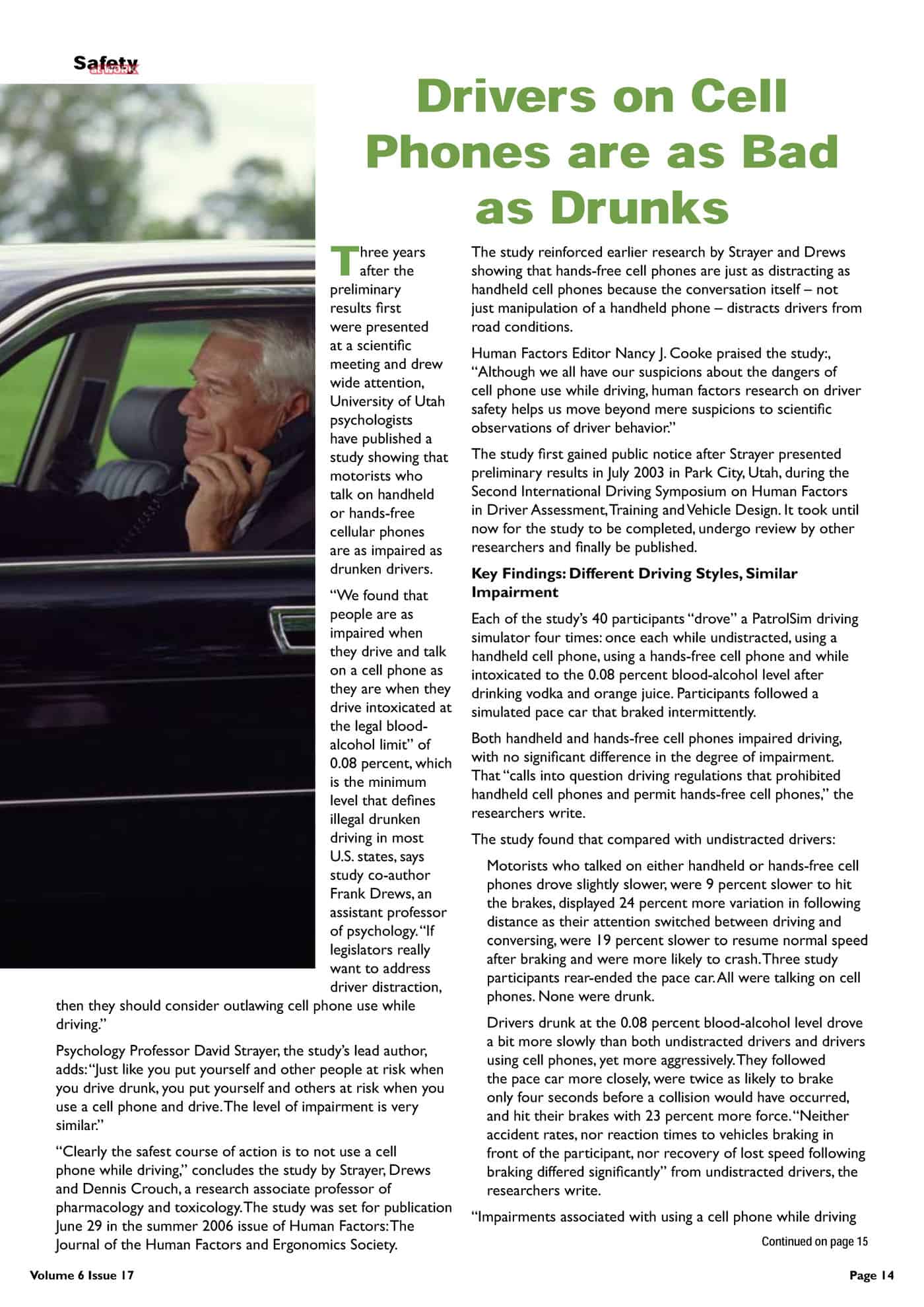
Driving and talking

The issue of driving while using a mobile is a perennial issue for the media but nothing much changes.  The New York Times on 20 July 2009 carried an article on the latest research which confirms  many previous studies that using a mobile phone while driving increases the risk of an accident.

Pages from 6i17 rawNo US State has banned the practice because social use of mobile phones has become so widespread that any ban is impossible to enforce effectively.

In January 2009, SafetyAtWorkBlog reported on the recommendations from WorkSafe Victoria on the matter.  Even in their guide they would say nothing more than

“recommend that hands free calls be kept to a minimum”.

At some point for most workplace hazards, the evidence outweighs the enforcement difficulties and bans ensue.  It has happened to asbestos, it has happened with smoking, but these are decades after dancing around the most effective control measure – elimination.

Pages from 6i02 v4The industrialised world, in particular, has been wrestling with the hazard of phones and driving for well over a decade.  One report from 2002 said
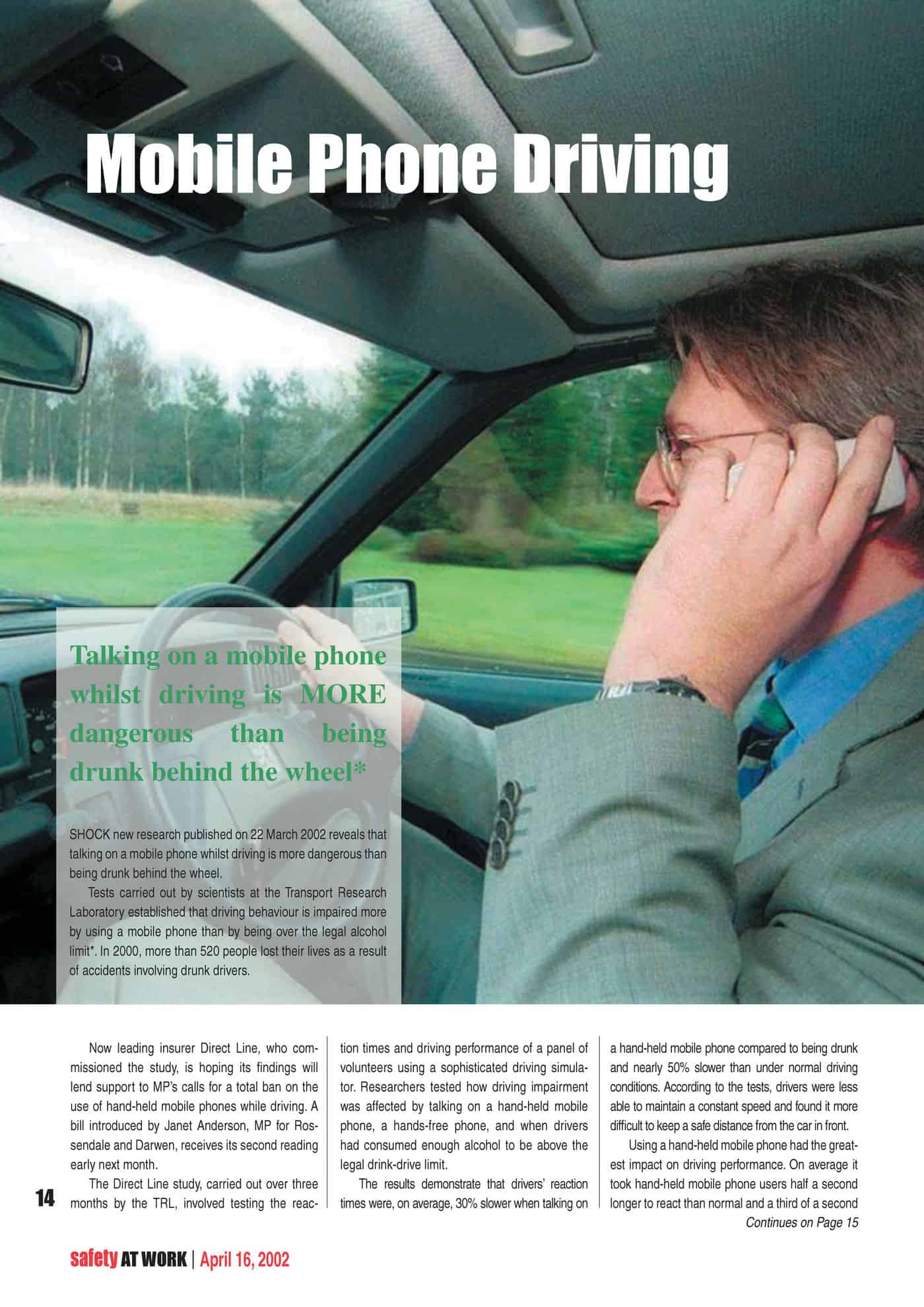
“Tests carried out by scientists at the Transport Research Laboratory established that driving behaviour is impaired more by using a mobile phone than by being over the legal alcohol limit.”

The footnote to this comment said

“Previous research has shown that phone conversations while driving impair performance. It was difficult to quantify the risk of this impairment because the reference was usually made to normal driving without using a phone. “Worse than normal driving” does not necessarily mean dangerous. There was a need therefore to benchmark driving performance while using a mobile phone to a clearly dangerous level of performance. Driving with a blood alcohol level over the legal limit is an established danger.”

There are always conditions set with research findings but these are sensible and valid.

Pages from 3i13According to a 2004 report by the US National Highway Traffic Safety Administration reported by UPI (unable to find a link)

“…estimated 8 percent of all motorists — about 1.2 million drivers — were using cell phones at any given time while driving, up from 6 percent in 2002 and 4 percent in 2000. About 800,000 of those drivers used handsets and not hands-free devices.

  • Handheld cell phone use increased from 5 percent to 8 percent among drivers aged 15 to 24 between 2002 and 2004.
  • Use of cellular-phone handsets increased from 4 percent to 6 percent of female drivers, while the number of men talking on handheld cell phones while driving remained constant at 4 percent.
  • Motorists were more likely to use a cell phone while driving alone, but drivers with children in the vehicle were just as likely to use the phone as those without children in the car.”

For those readers who like dollar figures, the same UPI article stated

“A 2002 study by the Harvard Center for Risk Analysis, part of Harvard University’s School of Public Health, found drivers using cell phones caused 1.5 million accidents annually resulting in 2,600 deaths and 570,000 injuries.

Researchers estimated banning cell phone use in vehicles would cost $43 billion a year in lost economic activity.”

Pages from 2003-119[The only HCRA report on the website is is a 2003 study – Cohen, J.T. and Graham, J.D. A revised economic analysis of restrictions on the use of cell phones while driving. Risk Analysis. 2003; 23(1):5-17.]

A September 2003 report from NIOSH lists a range of driver hazards related to work activities and is worth downloading.  Pages 51-555 deal specifically with phone use.

(If any reader knows of a literature review on this topic, please contact SafetyAtWorkBlog)

This workplace hazard has been around for so long that in the opinion of SafetyAtWorkBlog, when someone is driving a work vehicle 100% of their attention should be on the principal task at hand – driving.

Achieving this realistic aim can be helped by

  • not passing on mobile phone numbers when one knows the person is driving.  The low tech alternative of taking a message works.
  • having employees turn off the phone while driving. (The phone does have an OFF switch)
  • not fitting workplace vehicles with hands-free units.
  • reminding employees of the safe driving policies of the business; and
  • enforcing those policies so that employees know that dangerous acts will not be tolerated or compensated by the company.

Above all, employees must be informed of the risks involved with distraction, must be reassured that employers will support safe actions, and must realise the affect on other drivers and their families from their own mistakes.

Kevin Jones

Aspirational targets are next to useless put politically expedient

Further to the recent blog article on New South Wales WorkCover statistics,  SafetyAtWorkBlog has been provided with a copy of the official Comparative Performance Monitoring (CPM) report that was released in August 2008.  These figures are used to measure performance against the National OHS Strategy 2002-2012.

SafeWorkAustralia has told SafetyAtWorkBlog that the next edition is due in October 2009 (just in time for Safe Work Australia Week – what a coincidence!) after it has been discussed at the next scheduled Workplace Relations Ministers Council amongst other meetings.

Most organisations, including political ones, have key performance indicators for managers and the companies themselves, to measure the likelihood of meeting the target.  This may involve additional remuneration, awards or any other type of recognition.  If the target is not reached, there are repercussions – loss of potential bonus, loss of job….

The National OHS Strategy has no reward for achievement other than a warm, fuzzy feeling.  Nor does it have any penalty except the same warm, fuzzy feeling with perhaps a few less degrees of warmth or duration.

According to the media release from the then-National OHS Council in May 2002, the “indicators of success” are

  • “Workplace parties recognise and incorporate OHS as an integral part of their normal business operations
  • Increased OHS knowledge and skills in workplaces and the community
  • Governments develop and implement more effective OHS interventions
  • Research, data and evaluations provide better, timelier information for effective prevention”

The release also said

“There are five initial national priority areas for action to achieve short-term and longer-term improvements…. The priorities are:

  • reduce high incidence/severity risks;
  • improve the capacity of business operators and workers to manage OHS effectively;
  • prevent occupational disease more effectively;
  • eliminate hazards at the design stage;
  • strengthen the capacity of government to influence OHS outcomes”

These are classic “aspirational targets” that have no penalties for failure.  The targets themselves were discussed in the previous blog article.

According to the 2008 CPM report summary

“The reduction in the incidence rate of injury and musculoskeletal claims between the base period (2000–01 to 2002–03) and 2006–07 was 16%, which means the interim target of a 20% reduction by 2006–07 has not been met.  It is also below the rate of improvement needed to meet the long term target of a 40% improvement by 2012.  The rate of decline in the incidence of claims will need to accelerate in future years if the target is to be achieved.  Four jurisdictions however, met the interim target of improvement: NSW with 29% improvement, the Australian Government with 27% improvement and South Australia and Seacare each recorded 24% improvement.  Although these four jurisdictions recorded improvements higher than the 20% required, considerable efforts will be required by all jurisdictions if the national target is to be met.

The number of fatalities recorded for 2006–07 is lower than in previous years, increasing the percentage improvement from the base period.  The incidence of compensated fatalities from injury and musculoskeletal disorders decreased by 16% from the base period to 2006–07, thus the interim target of a 10% reduction by 2006–07 has been surpassed.  The national incidence rate is still ‘on target’ to meet the 20% reduction required by 2011–12, however there is a considerable amount of volatility in this measure and consistent improvement is required.

The National OHS Strategy also includes an aspirational target for Australia to have the lowest work-related traumatic fatality rate in the world by 2009.  Analysis of international data indicates that in 2006–07, Australia recorded the sixth lowest injury fatality rate, with this rate decreasing more quickly than many of the best performing countries in the world.  However, despite this improvement, it is unlikely that Australia will meet the aspirational goal unless substantial improvements are recorded in the next few years.”

The federal government can react in several ways if the signatories to the strategy fail to meet the target in 2012:

  • Blame the previous government who was in power at the time of the strategy;
  • the large number of parties to the strategy made it impossible to coordinate;
  • The political climate has changed so much  that the targets reflected unreasonable expectations; or
  • The economic climate has changed so much that the targets reflected unreasonable expectations.

Unless all the parties renew their efforts (and their budgets) in order to reach the targets in 2012, from 2009, which is highly unlikely, 2012 is going to have an OHS “elephant in the room” and it will have been white.

Kevin Jones

Concatenate Web Development
© Designed and developed by Concatenate Aust Pty Ltd