
Eye injury campaign evidence clarified

A 19 May 2010 SafetyAtWorkBlog article commented on a new eye safety campaign by the  Optometrists Association Australia.  The eye safety brochure included several statistical references upon which clarification was sought.

Shirley Loh, OAA’s National Professional Services Manager has provided references, and we thank her for her efforts.

A couple of quotes in question were:

“60% of all eye injuries happen in the workplace and about 95% of eye injuries are the result of carelessness and lack of attention.”

“Up to 48% of office workers suffer from computer-related eye fatigue and this rate appears to be increasing.   Excessive computer use can cause eye strain and reduce productivity.” Continue reading “Eye injury campaign evidence clarified”
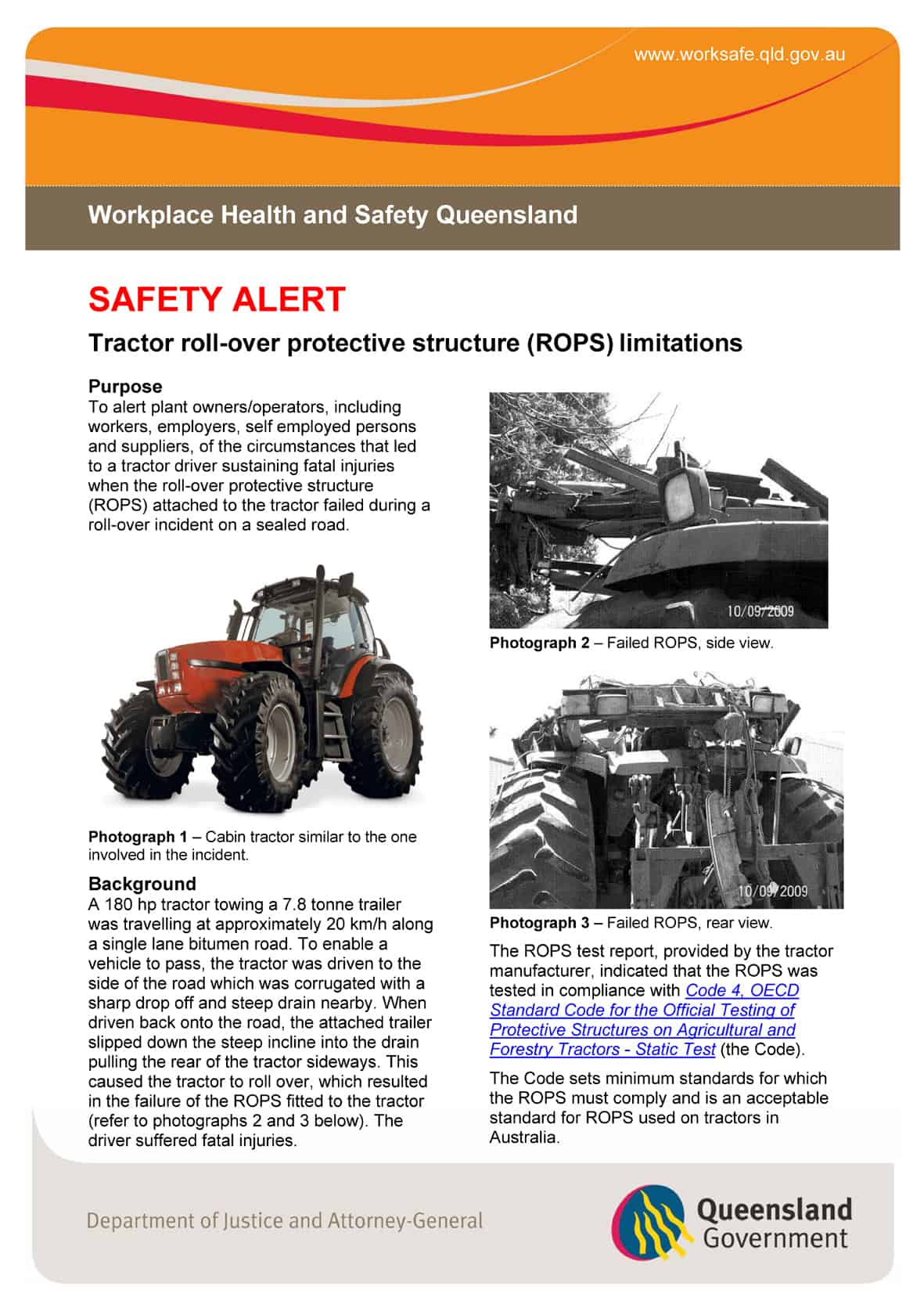
In ROPS we trust

Roll Over Protective Structures (ROPS) are a standard safety design feature on many items of agricultural equipment from tractors to quad bikes.  But ROPS do not prevent a rollover, only minimise the risk of injury from a rollover.

The Workplace Health and Safety Queensland has issued a safety alert over a tractor ROPS that failed.  The background for the safety alert is:

“A 180 hp tractor towing a 7.8 tonne trailer was travelling at approximately 20 km/h along a single lane bitumen road.  To enable a vehicle to pass, the tractor was driven to the side of the road which was corrugated with a sharp drop off and steep drain nearby.  When driven back onto the road, the attached trailer slipped down the steep incline into the drain pulling the rear of the tractor sideways.  This caused the tractor to roll over, which resulted in the failure of the ROPS fitted to the tractor.  The driver suffered fatal injuries.”

Kevin Jones

Economic opportunities in the need to comply

Standards Australia may have been going through difficult financial times but the company that sells the documents created by Standards Australia is doing very well.

The Australian Financial Review on 26 May 2010 (not available online) reported on the continuing growth of SAI Global and the increasingly important role it may play in the United States’s emphasise on compliance.  The AFR reports that the company receives 22% of its revenue from the US and growth in sales is tipped to reach 22% in 2009/10.  So it is a good investment option but its influence may also be important to note for those corporate OHS professionals who operate in a world of compliance, best practice and audits. Continue reading “Economic opportunities in the need to comply”

The risk of being over-policied

The latest OHS podcast from Boardroom Radio reinforces the need to enforce company policies.  The impliacation is that it is very easy to equate legislative compliance with the existence of a policy instead of the implementation of a policy.

The need to keep polices and procedures simple was mentioned but there is the risk that brevity does not necessarily equal clarity.  This links to earlier SafetyAtWorkBlog articles that discuss communication.  It is one thing to have rules, it is another to make sure workers know them and yet another to have faith that they are being implemented.  The emphasis on application and enforcement cannot be stressed enough. Continue reading “The risk of being over-policied”

The politics of the insulation debacle become clearer

The debacle of the Australian Government’s insulation job creation scheme faded when the scheme was cancelled suddenly by the Government earlier in 2010.  Attention was always going to return at various stages as investigations into the deaths of young insulation installers begin but Parliament resumed earlier and the Opposition attacked.  The attack has led to the release of correspondence between the Minister responsible for the debacle, Peter Garrett, and the Prime Minister, Kevin Rudd. (A good example of the role of an effective Opposition in ensuring open government)

The newspapers on 28 May 2010 have focused on the fact that the Prime Minister was aware of the serious occupational health and safety deficiencies of the system months before serious action was taken on the scheme.  However, the correspondence also indicates that Garrett was not inactive on the safety risks in 2009 as many critics allege. Continue reading “The politics of the insulation debacle become clearer”

Is illiteracy a big safety risk?

In a couple of years all Australian States will probably have OHS laws which require active consultation on workplace safety matters.  But how effective will the consultation be if a noticeable part of one’s workforce struggles with literacy?

For many years OHS included a gentle and steady push for OHS information to be provided in Languages Other Than English (LOTE).  Many OHS regulators had Codes of Practice providing guidance on how to communicate safety issues to workers who cannot speak or write English.

The Australian Industry Group (AIGroup) has been running a project on improving workplace literacy for some time.  AIGroup sees literacy as a major impediment to productivity and safety.  The ACTU sees the risks posed to one’s safety predominantly.  On 26 May 2010, AIGroup’s CEO Heather Ridout wrote in The Australian newspaper (not available online) about the project and the workplace risks.  A report from the literacy project has found that “low levels of literacy and numeracy were an issue for”:

Labourers and process worker 45%
Apprentices 25%
Technicians 23%
Administrative staff 17%
IT staff 13%

Continue reading “Is illiteracy a big safety risk?”

EU and Australia improve academic links – again

RMIT University has been active in OHS education for some time and it is hoped that the OHS lecturers might wander down the corridors and knock on the door of Professor Bruce Wilson.

On 28 May 2010, RMIT university launches its European Union Centre (EUC).  According a media notice about the launch, the EUC intends to

“..promote a better understanding of the European Union and EU-Australia relations….”

and, according to Professor Wilson

“…offers a footstep into Asia for Europe, to help address deep-seated challenges.  The Centre will use RMIT’s strong linkages with Asia to enhance European understanding and engagement with the region, tackling vital issues such as the future of cities, people mobility, border security and climate change.” Continue reading “EU and Australia improve academic links – again”

Concatenate Web Development
© Designed and developed by Concatenate Aust Pty Ltd