
“We will trust but we will verify” – upcoming lessons from the Gulf of Mexico

The mass media is full of reports on legal action being taken on behalf of shareholders in BP over the continuing oil spill from the former Deepwater oil rig in the Gulf of Mexico.

An Australian video report was broadcast on 25 May 2010 and a composite article has appeared in The Australian on 26 May 2010 as well as elsewhere. Many outlets are mentioning the law suit (Southeastern Pennsylvania Transportation Authority and Robert Freedman v Anthony B Hayward et al, Court of Chancery for the state of Delaware, No. 5511) but no details of the suit are publicly available at the moment.

Although safety is mentioned as one of the bases for the suit, it is likely that environmental impact will get prominence over occupational safety and that impact on stock value will be of the most concern.   The shareholder outrage mentioned in some of the articles seems to focus mostly on the financial impact on BP share value rather than any moral outrage on environmental impact or dead and injured workers.

BP CEO Anthony Hayward has acknowledged the substantial  “reputational risk” but his comments are almost always reported surrounded by financial bad news.   Continue reading ““We will trust but we will verify” – upcoming lessons from the Gulf of Mexico”
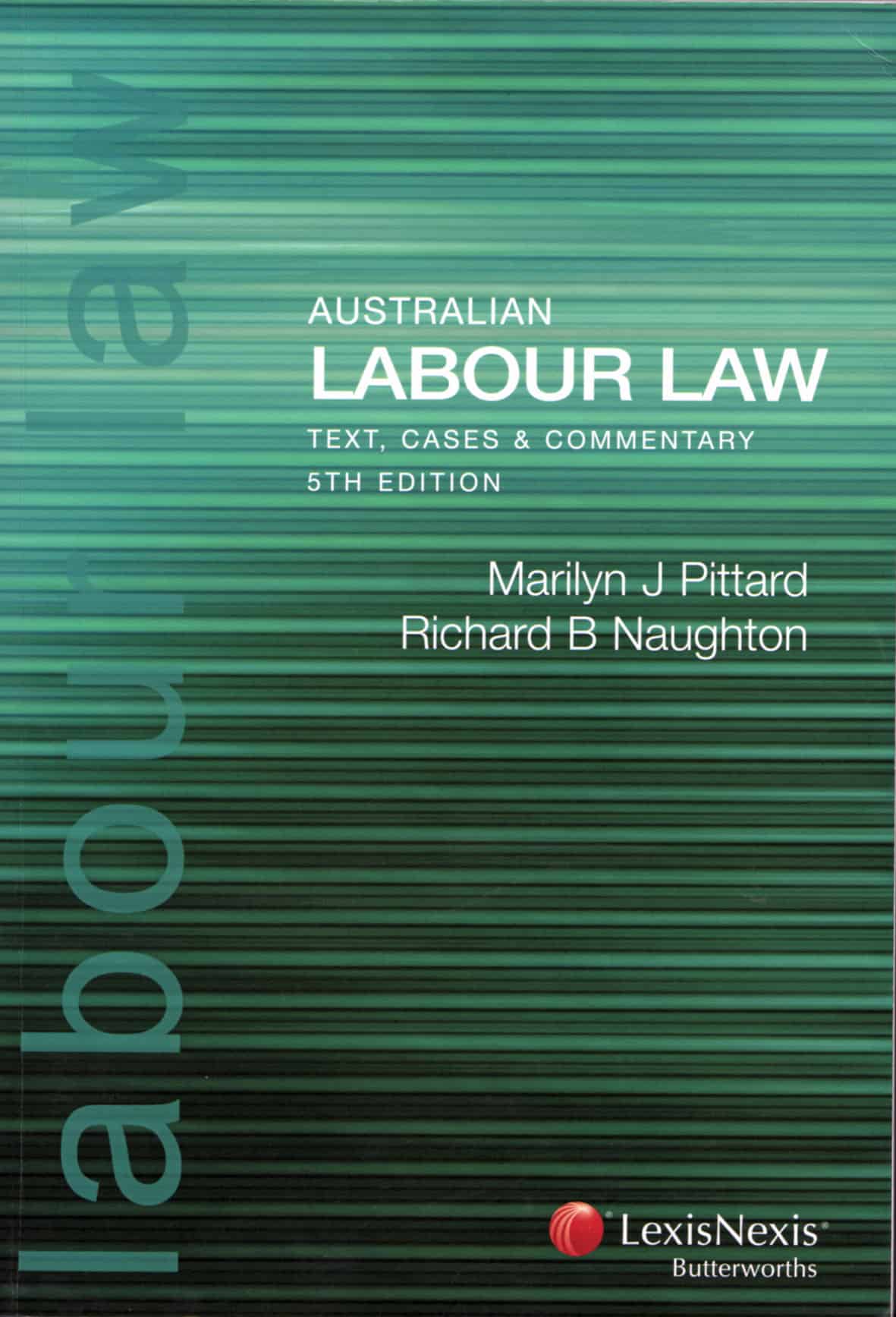
Is OHS part of Labour Law?

The question in the title of this article came about from the release of a fabulous new book by LexisNexis- Butterworths – Australian Labour Law – Text, Cases & Commentary, 5th edition.

Through my introductory look at the book, it seems that occupational health and safety gets around half a page in a book of over 1200 pages.  As an OHS reader I was disappointed, as I believe that OHS is an important subset of labour law.  My belief is echoed by some Australian publishers who include, usually, a chapter on OHS in their labour law titles.  LexisNexis has never been a publisher of OHS information with the market leader being CCH but with Federation Press holding the more quality and original sector.

One possible reason for the lack of OHS is that the authors, Marilyn J Pittard and Richard B Naughton are lecturers in labour law at Monash University and OHS does not feature in their program.  Another could be that the book is a monolithic volume already and, perhaps, OHS could not be given adequate attention without adding a couple of pounds to the book and generating a manual handling risk.

It is hoped that LexisNexis realises there is a market opening for authoritative and fresh writing on OHS in Australia, particularly in this period of change due to harmonisation.  The morphing of OHS in the areas of due diligence and risk management are particularly interesting to watch. Continue reading “Is OHS part of Labour Law?”

Integrating safety in Lean/Six Sigma

At the recent Safety In Action Conference in Melbourne, Sia Evans was scheduled to speak about integrating safety into Lean/Six Sigma.   The management processes were known to me but I had not associated them with OHS management so her blending of the two was intriguing.

I arranged an interview with Sia a couple of weeks prior to her presentation having met her briefly some time before.  As we were having coffee on a balcony in sunny Melbourne we discussed a broad range of issues including the cultural impacts that Sia’s approach had achieved for her employer, Computershare.

She also showed how occupational health and safety can be improved in a workplace by not talking about occupational health and safety.  Sia’s training programs instilled the importance of safety in employees without some of the baggage that OHS training feels obliged to include.

The interview has been edited into a podcast that can be accessed below.

Please let us know of any issues or thoughts the interview may have raised and I will ask Sia to respond.

Kevin Jones

OHS needs plain language, consultation and corporate engagement

An earlier article today provided a reminder of a County Court judge’s criticism of OHS management-speak in a 2004 decision concerning the death of Robert Sergi on a rail bridge construction project near Geelong.

In response to some of the safety initiatives outlined to the Court by the lawyer for Leighton Contractors Ross Ray SC, Judge Gebhardt said:

“Mr Ray pointed to an array of safety initiatives introduced by his client and a welter of documentation was tendered.

I gained the impression from the documents tendered that some form of managerial “hocus pocus” bewitched the company which sought to satisfy the needs and interests of workers with hierarchical and self-serving layers of bureaucratic “bubble-squeak/’ what Mr Ray described as “complex speak”. When the language is destroyed, reality fades and there is no basis for sound and sensible communication.  Workers are not instruments, but participants and conversation with them should occur on that basis.”

It is fair to expect that a judge would have come across a large amount of legal jargon through their career and that this could be an advantage in trying to translate management-speak but clearly, in the above situation, this is not the case. Continue reading “OHS needs plain language, consultation and corporate engagement”

Important OHS court decisions go unreported

On 20 May 2010 a Victorian magistrate fined an employer over $A500,000 following a workplace prosecution.  Almost all of it went to charity, according to WorkSafe Victoria.

There are several issues raised by Magistrate Vandersteen’s decision:

  • Why to charity?
  • Why the particular charities?
  • Why not allocate the funds to OHS-related organisations or initiatives?
  • Why does the Magistrates’ Court not make court decisions publicly available?

The workplace incident that started this case was that in August 2008, a 40-year-old man had his arm ripped out of the socket when it became tangled in an unguarded post peeler.   He was taken to hospital by an emergency ambulance helicopter where his life was saved. Continue reading “Important OHS court decisions go unreported”

Australian roundtable podcast on workplace bullying

On 21 May 2010, Boardroom Radio (BRR) released a podcast on workplace bullying that includes opinions from some worthy speakers.

Andrew Douglas, Managing Director at Douglas LPT;

Wayne Blair, Fair Work Australia Commissioner;

Gail Hubble, Barrister; and

Anna Palmer, HR Consultant, at Provenio Consulting

Some of the questions are a little peculiar such as whether current generations are more “vulnerable” to bullying.  Speakers responded that there are more opportunities for bullying now due to new technologies Continue reading “Australian roundtable podcast on workplace bullying”

Looking for the causes of workplace harm can change one’s world view

The New York Times reported on 17 May 2010 that psychologists have started considering the causes of workplace stress.  About time!

The report says that

“Employees are unhappy about the design of their jobs, the health of their organizations and the quality of their managers..”

and that unhappy workers have a high risk of heart attacks and depression.

The article is principally an interview with the author of a new personnel management book that identifies that performance reviews are a generator of unhappiness and stress.  This concept has been circulating for some time and goes part way to making workplaces safer.

Job design, mentioned above, can be broadened to include how people are managed.  Personnel management and human resources (HR) are a crucial element of any business but the NYT article indicates a growing realisation that the foundations of this management, how jobs are designed, have generated some of the hazards that HR is now tasked to control. Continue reading “Looking for the causes of workplace harm can change one’s world view”

Concatenate Web Development
© Designed and developed by Concatenate Aust Pty Ltd