
Could a prisoner’s death in a prison van be a breach of OHS laws?

ABC television program Lateline broadcast on 2 March 2010 an article (video available) about the death of 59-year-old Mark Holcroft in the back of a prison van in 2009.

Holcroft was a low risk inmate serving 7 months for a drink-driving offence.  He was several weeks into his sentence when he was being transported with six other prisoners to a low-security farm.  From the information made available by ABC, as Holcroft was dying in the van, the other inmates banged on the walls of the van and yelled to attract the drivers’ attention.  The van was equipped with a camera in each of the four corners of the van’s security compartment.  One inmate repeatedly signed at the cameras to attract the attention of the drivers. Continue reading “Could a prisoner’s death in a prison van be a breach of OHS laws?”

OHS due diligence and safety management

In the February 2010 newsletter for Australian law firm, DLAPhillips Fox, Andrew Ball and Donna Trembath wrote about one of the important elements of the model Work, Health & Safety Act – due diligence.   We look at how SafetyAtWorkBlog and other OHS information services can support due diligence on OHS matters.

Ball and Trembath list 6 elements in the definition of due diligence (in bold):

Acquire and have up to date knowledge of work OHS matters.

This first element is where business and OHS information sources are going to be crucial supporters.  OHS law in Australia has always supported the need for companies and safety professionals to maintain a current state of knowledge.  There have always been newsletters on OHS issues but it is very easy to fall into a habit of reading only the information that will assist one in their job rather than getting information that relates to safety throughout a workplace.  The use of Health & Safety representatives or OHS Committees can be important in maintaining a “corporate” state of knowledge.  Delegation of reading information can be very useful and HSRs and OHS Committees are probably the most neglected preventative tools in the safety professionals toolbox. Continue reading “OHS due diligence and safety management”

Workplace bullying data from Denmark

In occupational health and safety (OHS) and other workplace research, Scandinavia is often quoted.   The application of research findings to other nations is of dubious value but often Scandinavian research provides clues to potential OHS hazards or control options.

In February 2010, the European Working Conditions Observatory published online a research report into workplace bullying.  The report says

“Investigating the impact of bullying on psychological stress reactions according to the Impact of Event Scale, the NFA study finds that negative acts which potentially isolate the individual at the workplace, acts directed towards the person and unreasonable workloads induce most psychological stress.” Continue reading “Workplace bullying data from Denmark”

Aussie politician risks head injury in photo op

The issue of quad-bike safety continues to be controversial in Australia.  This debate is not helped by inconsistent safety messages on television.  Many of the news bulletins in Australia on 2 March 2010 showed the Leader of the Opposition, Tony Abbott, riding, seemingly for the first time, a quad bike on his trip to central Australia.  Sometimes he is wearing a helmet and at other times, not.
Video available on the ABC website shows parts of an apparent induction on how to operate the quad bike.   Continue reading “Aussie politician risks head injury in photo op”

A discussion on ethics and OHS decision making

In 2004, I was asked to make an OHS-themed presentation to a group of paramedic students on ethics and from a small business perspective.  Some of the information may have dated slightly but I post this to stimulate discussion.  Below is an edited version of that 2004 oral presentation:

Quite often, when we have an ethical dilemma, “should I do this or should I do that?” we often go away somewhere to think.  In the short term, you “sleep on it” and when you wake you may have a solution or, at least, a different perspective on the problem.  Often we try to clarify our perspective.  I don’t know many people whose job it is to develop ethical statements or programs who sit at a table and talk about ethics.  More often, we go away and think about the issue and then come back and discuss, compare and refine our problem.  We frequently do this with our colleagues and by using our social network.

For an example, recently a colleague asked for me to sign off on a safety manual for some Australian contractors who are installing equipment for an American company in Australia.  It is one thing to deal with companies in your native country but dealing with overseas companies is very different.  With local companies you can solve problems by meeting with the Manager or CEO but when it is an American company, from such a litigious society, how should a small business proceed?  Should I accept the contract?  Is the risk worth the money?  I am not sure. Continue reading “A discussion on ethics and OHS decision making”

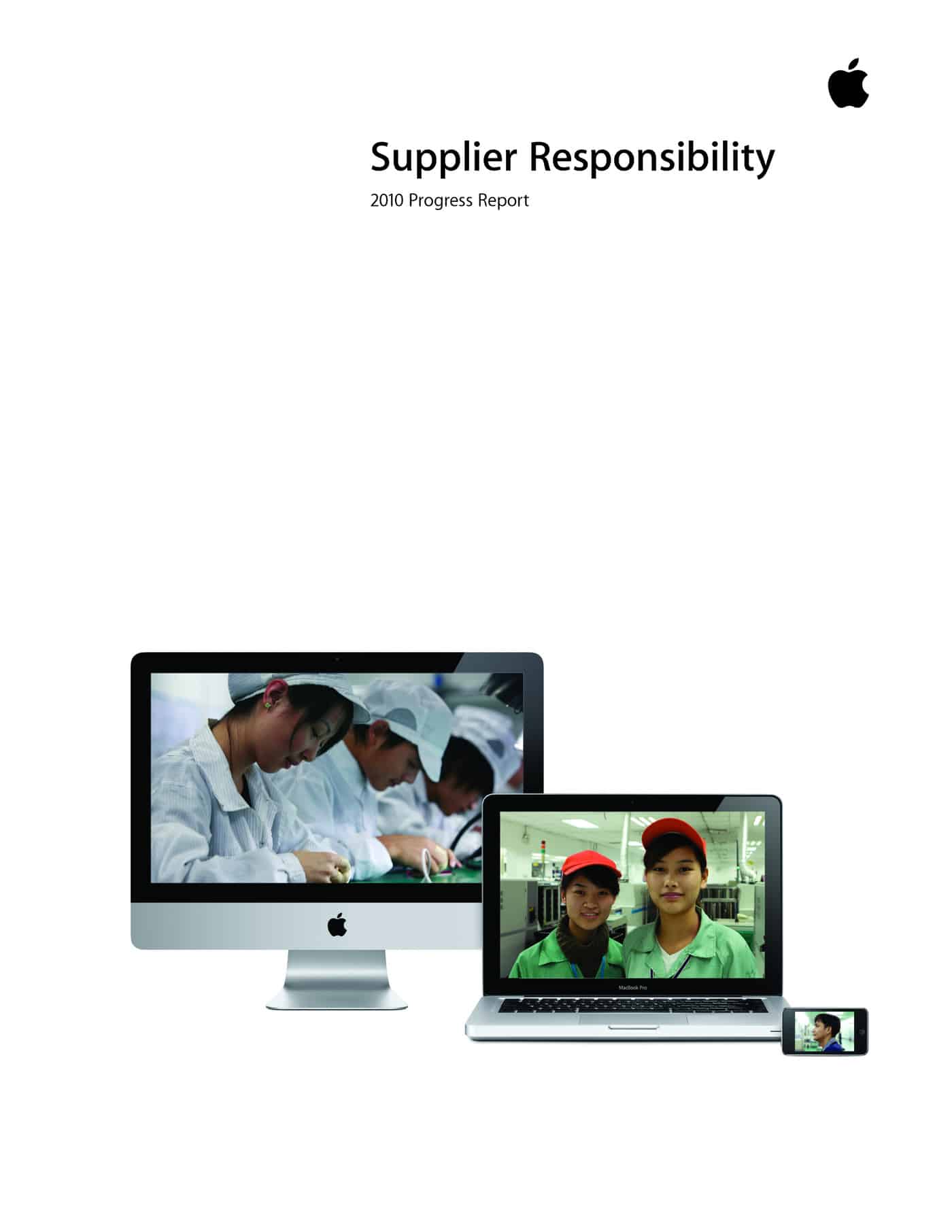
iPods, child labour and excessive working hours

A media report in The First Post on 1 March 2010 includes some good news and some bad news.

Apple has addressed some child labour concerns in several Chinese factories that manufacturer its products – the good news.  The bad news is that children were allowed to work in these factories in the first place.

This illustrates not only the importance of  policies on contractor management, supply chain responsibility and corporate social responsibility but the vital significance of auditing and enforcement.

Apple’s Supplier Responsibility 2010 Progress Report is available online.

A curiosity in the media report is the mention of maximum working hours.  Apple sets a maximum working week at 60 hours.  The Chinese Government applies a 49 hour week.  To which “law” does a company comply?  Should a supply company be in a position of choosing?  Should Apple even consider setting a working hour for its workers that exceeds the limit set by a country’s government?

Kevin Jones

Tractor death – ROPS but no seatbelt

WorkSafe Victoria reported investigations into a tractor-related death near Yackandandah that occurred on 28 February 2010.  The media release (not yet available online) says:

“WorkSafe Victoria is investigating the death of a man who died when a tractor he was driving tipped over in north-east Victoria yesterday.  The man, aged in his 20s, had been moving bee hives….. He was the second Victorian to die at work since Friday and the second in two weeks to die in a tractor-related incident.”

WorkSafe advised SafetyAtWorkBlog that the tractor had a roll-over protective structure but no seatbelt.

Kevin Jones

Concatenate Web Development
© Designed and developed by Concatenate Aust Pty Ltd