
Prediction on accountability and a political kick in the balls

Responsibility highlighted in greenThere will be two areas of occupational health and safety attention in the early months of 2014 in Australia – workplace bullying laws and the Royal Commission into Home Insulation Program.  The labour law firms are gearing up for a “bumper year” as one said prior to Christmas and the business groups are already lobbying/complaining/whingeing about the workplace bullying laws administered by the Fair Work Commission.  However the Royal Commission has the potential for the biggest social and ideological impact so, as the new year begins, I will attempt some predictions of the Royal Commission’s findings based around some of the terms of reference.

Substantial Change

‘the processes by which the Australian Government made decisions about the establishment and implementation of the Program, and the bases of those decisions, including how workplace health and safety and other risks relating to the Program were identified, assessed and managed;’

This paragraph is the one that could have the most long-term effect on governance, due diligence and procurement.  There are many suggestions on these issues in the sphere of project management but trying to keep the discussion in OHS, there are some useful comments on the Government procurement of services.  Australia’s Federal Safety Commission acknowledges that procurement is an important stage in project design.  WorkSafe Victoria’s “handbook for the public sector – health and safety in construction procurement” says

“As procurers, governments can promote better health and safety by requiring projects to include a range of safety measures, such as specifying the safety budget, building layout or the use of certain

Subscribe to SafetyAtWorkBlog to continue reading.
Subscribe Help
Already a member? Log in here

Media coverage on workplace bullying needs more depth and analysis

The Australian media has given workplace bullying the front page, probably because it is a slow news period and there have been no major disasters this Christmas period. However the coverage is of the new rules and opportunities for assistance offered by changes to the Fair Work Act that commence on 1 January 2014, rather than about prevention.

Most of the comments from the business groups in the article by The Age newspaper will be familiar from the last few months. Generally they object to what they see as red tape and increased regulation. Some also believe that workplace bullying should be handled through human resources rather than as an occupational health and safety (OHS) matter.

Red tape and unnecessary bureaucracy is a legitimate concern but one that, in large part, the business sector has allowed to happen. As discussed previously, much of the red tape originates from the risk management strategy of business where, when an issue or hazard cannot be eliminated or it is too difficult to try, insurance or liability protection is obtained. As others have said, too often the risk management of safety is corrupted to become risk management of legal issues. Continue reading “Media coverage on workplace bullying needs more depth and analysis”

Moral conflicts in store for Australian politicians and bureaucrats

iStock_000016528694XSmall2014 is going to present tough challenges to Australia’s politicians and corporate leaders.  The Royal Commission into the Home Insulation Program, in particular, is going to illustrate and perhaps generate ideological conflict.
The Home Insulation Program (HIP) was established quickly to address a looming economic crisis.  Politicians and business leaders wanted Australia to avoid the global recession and they needed creative solutions.  Various importance governance and safety elements appear to have been sacrificed to achieve the economic ends.  In 2014, the politicians of the time and bureaucrats will be grilled over why they made these decisions.  Various inquiries have already identified that these decisions contributed to the deaths of four young workers.  In 2014, these decision- and policy-makers will be held to account for the fatal consequences of their economic decisions.

There has long been a conflict between the pursuit of profit and the pursuit of safe working conditions.  The Royal Commission, and the surrounding debate, is likely to place this conflict squarely in the highest levels of Australia’s government and public service.  Below are some of the issues that the Australian government and business sector are likely to face in 2014. Continue reading “Moral conflicts in store for Australian politicians and bureaucrats”

OHS solutions promoted but not necessarily delivered

All professions need spokespeople or champions who can provide informative and, hopefully, authoritative commentary on topical matters within and beyond the profession.  Australia’s safety profession has never had such a spokesperson but recently the speakers’ bureau ICMI has packaged a selection of speakers who it thinks could be appropriate. The brief for Work Health Solutions focuses almost entirely on the issues of absenteeism, lost productivity, presenteeism and creating “a more enjoyable, friendly and less threatening environment” but will these speakers provide solutions to illnesses, injuries, amputations and diseases? Can these speakers provide the solutions implied in the program?

From the information on the program’s flyer, several of the speakers seem to be able to present stories about safety-gone-wrong. Theo Venter survived electrocution. Ian Johnson was seriously burned and speaks about the risks of confined spaces. Philip Smallman was a tree surgeon who became a paraplegic after a fall. Helen Fitzroy speaks of the impact of her husband’s workplace fatality.  John Tickell has spoken at several OHS conferences and has at least contributed to a book about OHS but others are tenuous. But ICMI is also promoting speakers who are primarily event hosts or Masters of Ceremonies and at least one of them generated complaints during a WorkSafe Victoria event several years ago for inappropriate comments about women. Continue reading “OHS solutions promoted but not necessarily delivered”

Safety leadership and the red tape drag

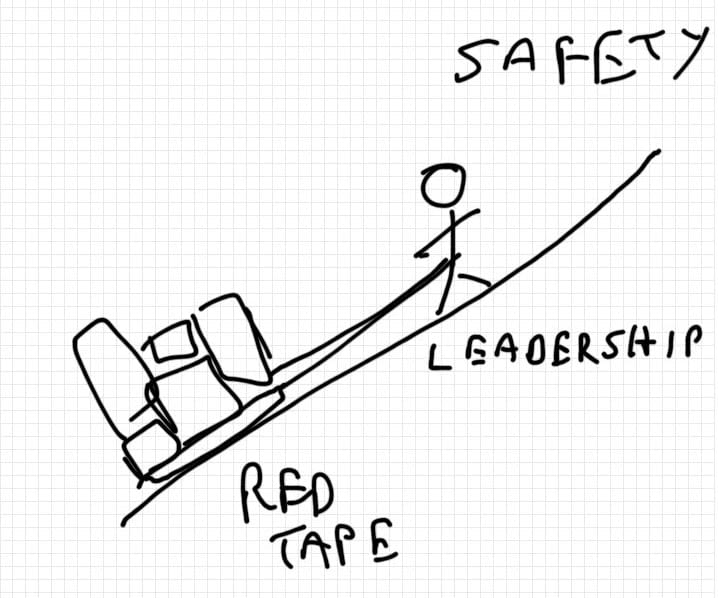
Red Tape scribbleDuring a recent seminar I produced the doodle on the right, which depicts what I think the speaker was talking about.  Safety is a goal that can be best achieved through improving a company’s leadership qualities.  However all companies seem to be restricted by red tape, however one defines that. Can this journey be improved?

Decrease the baggage

It may be possible to reduce or minimise the red tape baggage.  Most Western governments are attempting this through inquiries and reviews but this is assuming that it is government bureaucracy that has created this baggage.  In Australia over the last fifty years Governments have allowed business great flexibility in how it achieves OHS compliance and safe workplaces (definitely not the same thing) by reducing the prescriptive basis of OHS laws.  It may have been reasonable to expect that the loss of prescriptive safety would decrease paperwork but over the same time there has been increasing calls for less red tape from government.   Continue reading “Safety leadership and the red tape drag”

Safety in the C Suite doesn’t always run smoothly

It is rare for workplace safety to gain a half-page in the daily press in Australia but this occurred recently in The Australian.  The newspaper’s industrial editor, Ewin Hannan, built an article, “Tunnel Vision on Safety“, around the following quote from a leaked memo from 2010 then head of human resources, industrial relations and safety for John Holland, Stephen Sasse, in relation to the management of the Airport Link project:

“‘‘In my seven years with John Holland, I have never seen any project or management team that was so cavalier about the company’s OHS (occupational health and safety) system, principles and values and I have grave doubts about the management’s team’s capability in safety.’”

This is a remarkable statement but Sasse has been outspoken on safety issues in the general construction sector before. In 2011 a change in the senior management of Leighton Holdings, the parent company of John Holland, created doubt about Sasse’s future and Sasse left the organisation in October 2011.  The latter articles also indicate Sasse’s relationship with the union movement which may be part of the reason the unions are repeating their calls for an inquiry into John Holland and its licence with Comcare.  SafetyAtWorkBlog has several articles about these industrial relations tensions from 2009. Continue reading “Safety in the C Suite doesn’t always run smoothly”

Politics before safety in South Australia

Occupational health and safety (OHS) eyebrows were raised in Australia recently as a State Government suspended the application of three construction-related codes of practice, principally, on the basis that compliance will cost too much.  The decision by South Australia’s Minister for Industrial Relations, John Rau, following a report by the Small Business Commissioner, Mike Sinkunas, illustrates several issues:

  • the SA government is overly influenced by the Housing Industry Association (HIA),
  • small business is being misinformed on how workplace safety works,
  • the application of “reasonably practicable” has been ignored, and
  • the unions and safety profession do not know how to respond.

Continue reading “Politics before safety in South Australia”

Concatenate Web Development
© Designed and developed by Concatenate Aust Pty Ltd