Law firms are a focus for sexual harassment reforms

This year coverage of The Australian newspaper’s annual Legal Partnership Survey has focused on the number of women partners in law firms. This increase has generated discussion on sexual harassment, which has revealed some of the activities that law firms use to prevent the psychological harm (and brand damage) from sexual harassment; many strategies that are already very familiar to the occupational health and safety profession

Sex Discrimination Commissioner Kate Jenkins has been paraphrased in the article (paywalled), saying

“Non-disclosure agreements should be used to protect people who have been the subject of sexual harassment, rather than to reduce brand damage to organisations…..”

[link added]

Subscribe to SafetyAtWorkBlog to continue reading.
Subscribe Help
Already a member? Log in here

The restricted state of knowledge – NDAs and OHS

A core element of the management of occupational health and safety (OHS) is creating and maintaining a “state of knowledge” on hazards and risks. There is an enormous amount of information already available in various OHS encyclopaedias, wikis and bodies of knowledge, but some of the most important information continues to be locked up in non-disclosure agreements and confidentiality clauses. On the issue of workplace sexual harassment, a recently established inquiry in Victoria, Australia, is set to look at the mechanisms that are principally used to protect the reputation of companies and executives but that could also have broader OHS benefits.

Liberty Sanger and Bronwyn Halfpenny are heading a task force designed by the Victorian Government to

“…develop reforms that will prevent and better respond to sexual harassment in workplaces.”

Subscribe to SafetyAtWorkBlog to continue reading.
Subscribe Help
Already a member? Log in here

Look to the greed behind the corporate culture

Today the Governance Institute of Australia distributed a promotional email for its September national conference. These conferences often provide a useful perspective on broad occupational health and safety (OHS) issues. One gets to see how OHS is seen to fit (if at all!) in the established business and governance structures.

A key theme of this year’s conference is Culture which is a critical issue for most companies, even if they don’t realise it, and one with which the OHS profession is very familiar. However, the Institute, its members and conference delegates should be challenged to analyse Culture more deeply than what is indicated in the promotional email and article.

Subscribe to SafetyAtWorkBlog to continue reading.
Subscribe Help
Already a member? Log in here

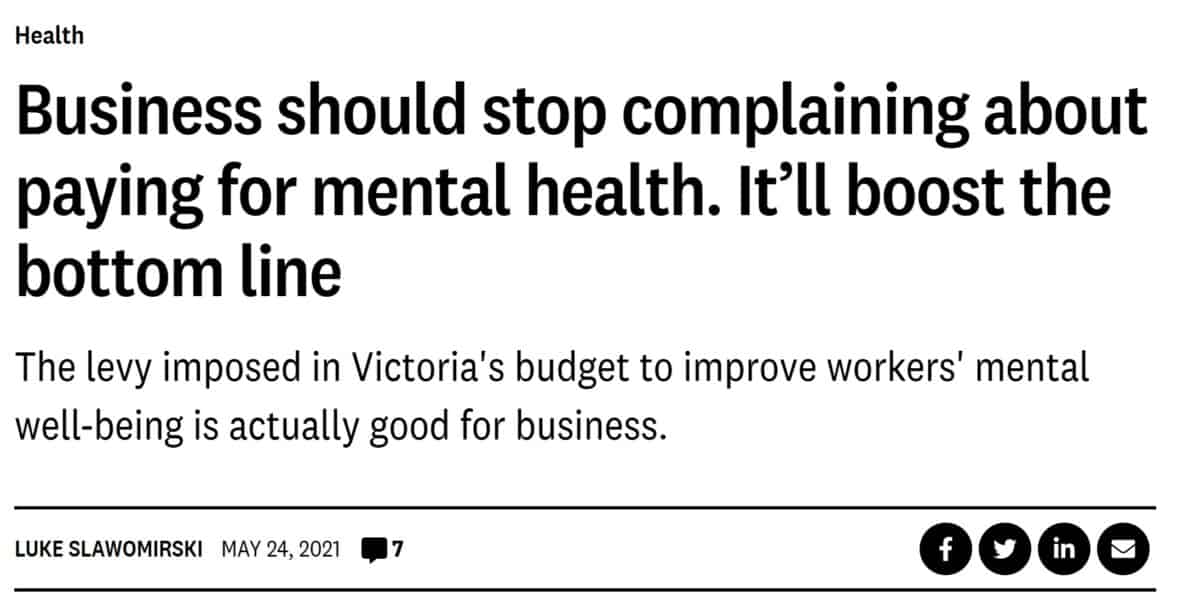
Business should stop complaining about paying for mental health. It’ll boost the bottom line.

[Article reprinted, with permission, from the May 24 edition of Crikey newsletter]

Luke Slawomirski

During the 2020 lockdowns, the business lobby showed a surprising concern for Victorians’ mental health: lockdowns were bad because they’d cause a spike in mental illness and suicides far worse than the COVID-19 cases and deaths they’d prevent.

The suicide spike never happened. What did happen was much-needed additional funding for mental health — $3.8 billion over four years — announced in the 2021-22 state budget on Thursday.

But the way business reacted suggests its interest in mental health has waned.

You see, the measures aimed at better prevention, diagnosis and treatment of mental ill health will be funded by a levy: 0.5% for businesses with payrolls above $10 million and 1% for those above $100 million. Critics, including the federal treasurer, claim this will cruel “job creation and confidence“.

Continue reading “Business should stop complaining about paying for mental health. It’ll boost the bottom line.”

Latest Psych Health Code released

The big occupational health and safety (OHS) news in Australia has been the New South Wales release of its Code of Practice for Managing Psychological Hazards at Work. This Code is not mandatory but is a very good indication of what the OHS regulators (and perhaps eventually the Courts) believe are reasonably practicable measures for employers and business owners to take. These measures are discussed in detail below.

Subscribe to SafetyAtWorkBlog to continue reading.
Subscribe Help
Already a member? Log in here

Industrial Manslaughter or Category 1. Which prevents harm more effectively?

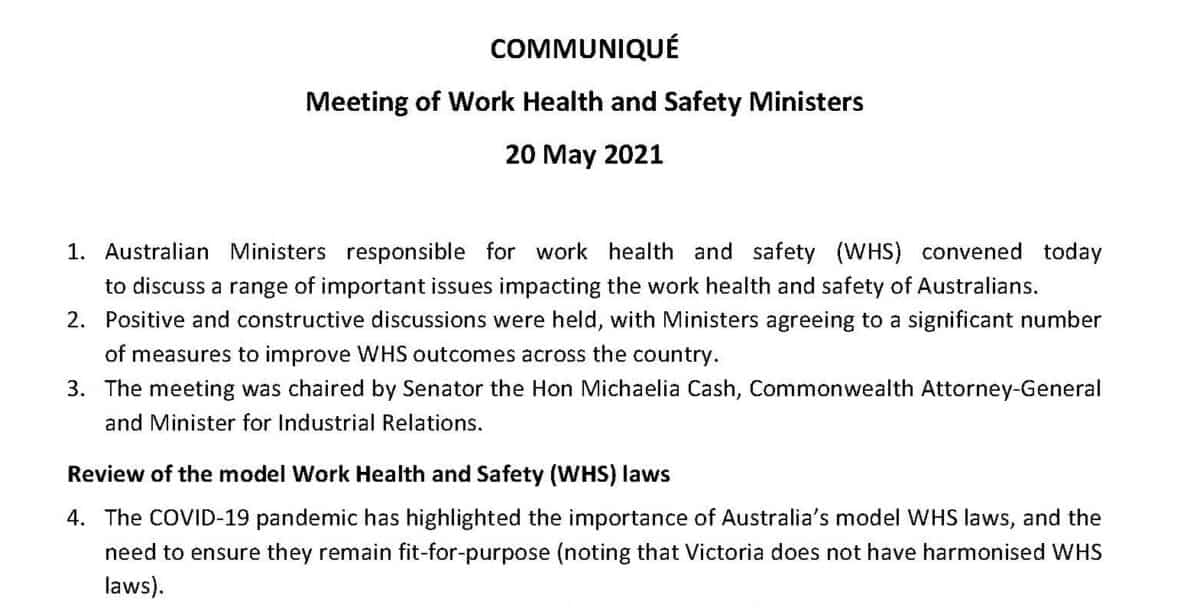
The Communique issued after the May 20, 2021 meeting of the Work Health and Safety (WHS) Ministers says that Australia is not likely to apply an Industrial Manslaughter law nationally:

“While the Northern Territory, Queensland, Western Australia, the Australian Capital Territory and Victoria provided their support for an industrial manslaughter offence, the recommendation did not receive the required majority.”

Some people think that this is no real failure as the Communique also includes “defacto ‘industrial manslaughter’ laws”. Here is the quote that supports that position:

Subscribe to SafetyAtWorkBlog to continue reading.
Subscribe Help
Already a member? Log in here

Psychological harm gets new regulations and funding access

The State of Victoria had a big week on mental health, with the Labor Government allocating billions of dollars to the improvement of the mental health of its citizens. Much of the justification for the spend (and the imposition of a mental health levy on large companies) is in response to the recent Royal Commission into Mental Health Systems. Workplace health and safety was on the agenda in that Royal Commission. Hence, it is worth looking at how, or if, this recent Budget helps employers improve the psychological health of their workers in anticipation of new regulations on this hazard promised by Victoria’s Minister for Workplace Safety, Ingrid Stitt.

Subscribe to SafetyAtWorkBlog to continue reading.
Subscribe Help
Already a member? Log in here
Concatenate Web Development
© Designed and developed by Concatenate Aust Pty Ltd