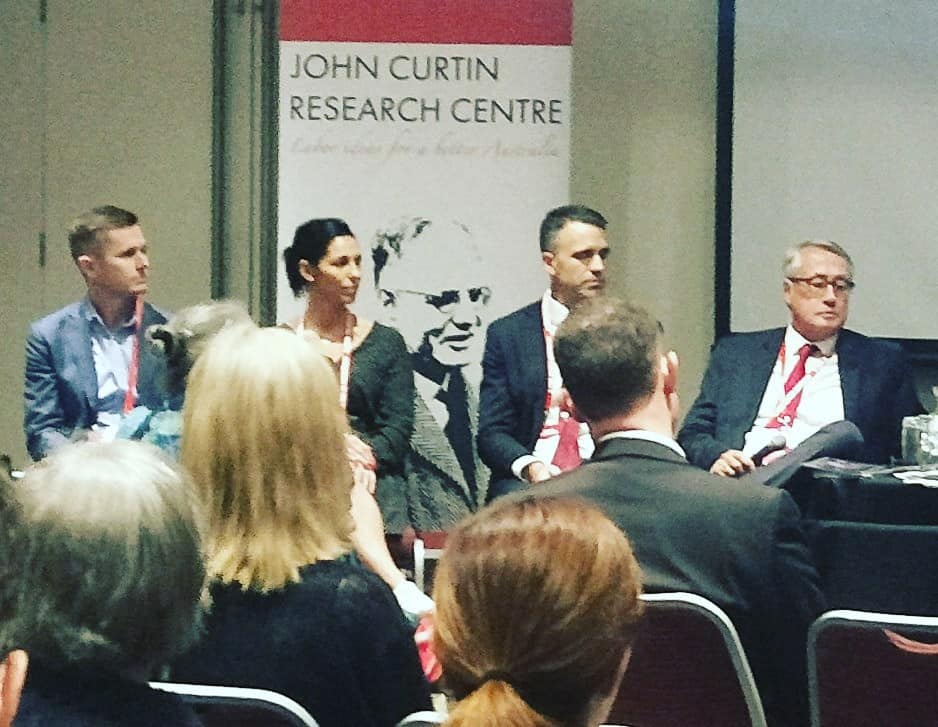
Responses to the Boland Report into Australia’s Work Health and Safety Laws

The mainstream Australian media has almost entirely ignored the release of Marie Boland’s Final Report of the independent Review of Australia’s Work Health and Safety laws. but some of the usual players in the workplace relations sector have responded. Below is a longer responsive from the Australian Chamber of Commerce and Industry (ACCI) but first some simpler responses.

The trade union movement has almost entirely focused on the Industrial Manslaughter recommendations in the Boland Report. As well as a couple of media statements, the Australian Council of Trade Unions released a video on February 25 2019 with Assistant Secretary Liam O’Brien accompanied by the parents of two deceased workers. The first to speak were Tony and Robyn Hampton whose son, Jarrod, died while working for Paspaley Pearls. The second couple were Janice and Mark Murray whose son, Luke, died when parts of a crane that was being unpacked fell on him.

Subscribe to SafetyAtWorkBlog to continue reading.
Subscribe Help
Already a member? Log in here

In order to grow, OHS needs economists, philosophers, ethicists and gender specialists

The occupational health and safety (OHS) profession is being affected by demographic changes as much as any other profession. Younger people seem to have a very different expectation on how to interpret and apply OHS, and older people are tired of being lectured to, and this is putting pressure on those who organise events, seminars and conferences and those who mentor and educate in a range of ways.

Some organisations and conferences are responding by reconfiguring the provision of information away from the lecture format of an expert to a mix of communication methods. This blog has written about some of those that occurred in the last two years. These conferences are less academic than in earlier days. Rarely is a conference accompanied by a handbook of research-based conference papers; some provide no papers at all and slideshows delivered a fortnight after the event are devoid of context and next to useless.

Continue reading “In order to grow, OHS needs economists, philosophers, ethicists and gender specialists”

Multidisciplinary analysis of safety culture

Managing occupational health and safety (OHS) is most successful when it considers a range of perspectives or disciplines in identifying practicable solutions.  Books are often successful in a similar multidisciplinary way but it is becoming rarer for books to contain a collection of perspectives.  A new book has been published on Safety Culture which matches this multidisciplinary approach.

Subscribe to SafetyAtWorkBlog to continue reading.
Subscribe Help
Already a member? Log in here

‘Safety Clutter’ and what to do about it

Many companies have bloated workplace procedures.  Many of these seem to involve workplace health and safety.  Some people blame this on a bureaucracy designed in the olden times by someone, that somehow still exists and is maintained by someone or some process that no one sees or knows. Some prominent Australian researchers have looked into this issue and have written about “safety clutter”* which they say is:

“…the accumulation of safety procedures, documents, roles, and activities that are performed in the name of safety, but do not contribute to the safety of operational work.”.”

Subscribe to SafetyAtWorkBlog to continue reading.
Subscribe Help
Already a member? Log in here
Concatenate Web Development
© Designed and developed by Concatenate Aust Pty Ltd