How safe is unsafe?

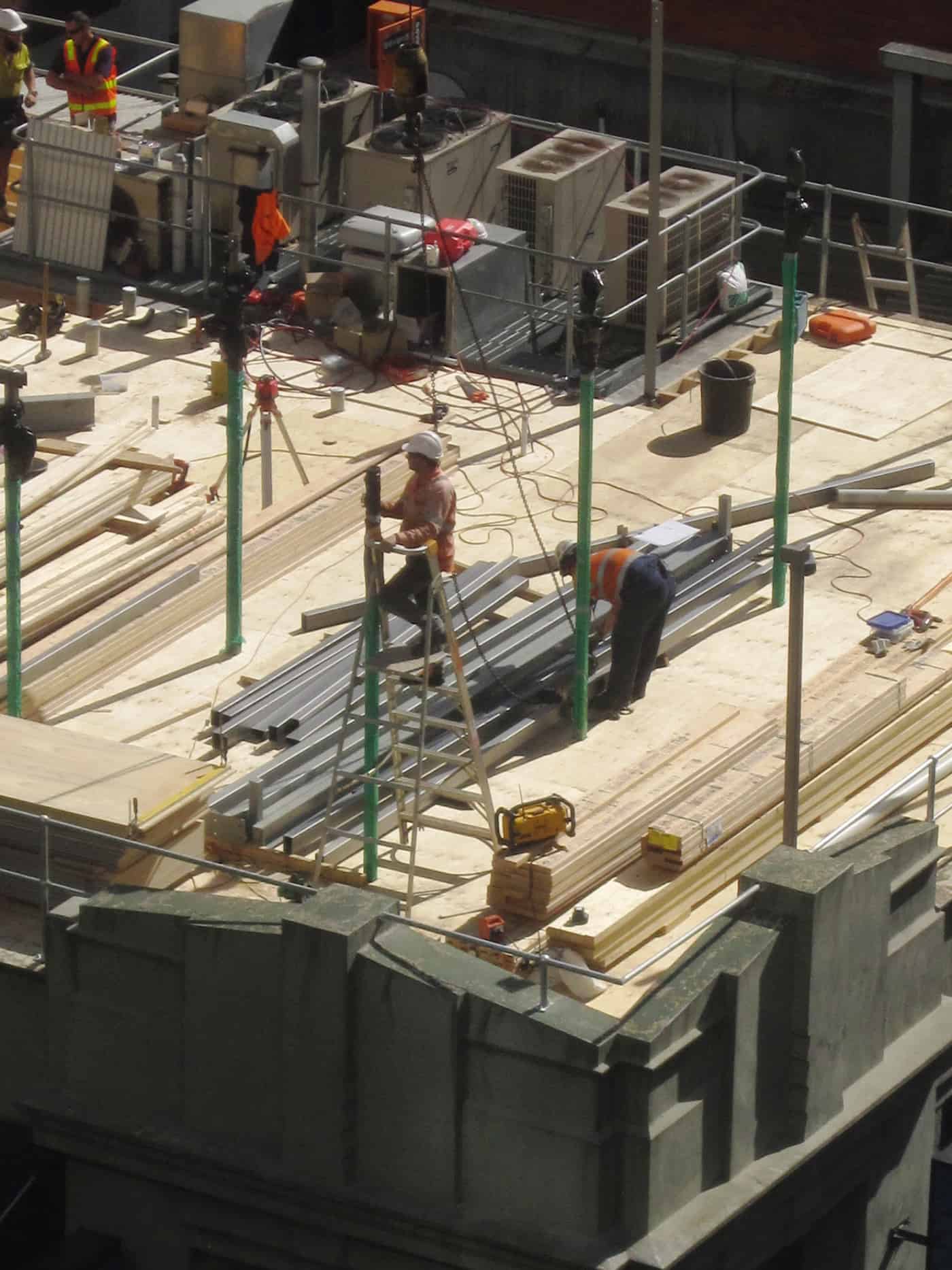
roofwork 01Across the street from an office in Melbourne, a pub is installing a roof area for entertaining.  The work has gone smoothly as far as one can see but the position of the platform ladder in the corner of the roof was curious. If someone was working from the ladder and wobbled, it would be possible to not only fall a couple of metres to the roof but perhaps over the roof’s edge to the pavement two storeys below.

The worker in the front of this picture was moving to erect another platform ladder towards the front of the roof.

roofwork 02The second picture shows the worker on that platform ladder.  Similar risks of wobbling and falling over the roof’s edge.

How safe is unsafe?  There is the potential for the worker to fall from the ladder to the street some distance below but he didn’t.   So was his positioning of the ladder and work undertaken safe?

Kevin Jones

The smell of ‘corruption’

Such are the warning signs

It stopped at 2.32 pm of an ordinary day.   One string of events ended abruptly at the pinch point of a groaning conveyor belt when his arm was ripped off.  Do you think of Swiss cheese models of risk alignment?  Of complexity or failure to learn?  Of the Moura coal mine disaster, the Longford oil and gas plant disaster, the Baker report and the BP Texas City refinery fatalities, of 29 miners killed in the desolate and terrorising Pike River coal mine, NZ, 2010?  Do you think of precariousness lurking at work, of leadership, of productivity?

For me this was the 5th arm I was personally aware of disappearing violently at work, generating years of withdrawal and solitude unrecorded in any OHS statistics.  In that time I had also observed hundreds of missing or useless machine guards.  Such a well known and easy hazard to fix.  What exactly is the problem, what does it indicate about OHS generally, and what may go some way towards practical improvements? Continue reading “The smell of ‘corruption’”

The Salvemini court saga illustrates many problems with prosecutions, justice and care

Sometimes when there is a procedural or organisational blockage, an opportunity or potential solution appears out of the blue. A South Australian Supreme Court decision on 3 October 2012 (not yet available online) may be just such a case.

Almost seven years ago Jack Salvemini was working on a shark fishing boat in the Great Australian Bight when he became entangled in a net being winched and was, according to various reports, either strangled or crushed to death. SafeWorkSA prosecuted the company running the boat, Jean Bryant Fishing and the skipper of the boat, Arthur Markellos.  Both were found guilty of breaching the occupational health and safety laws in effect at that time.

The company was fined $A71,000 from a maximum fine of $A100,000. Markellos was fined $A17,000. Arguments and appeals have continued on over this case since the original prosecution in the Industrial Magistrate’s Court in November 2010. (This judgement also provides the best level of detail of the fatality and its impact on all parties including Arthur Markellos)

Following the Supreme Court decision, Jack’s father, Lee, said he would like to talk with the Attorney-General to discuss what more can be done on his quest for justice. Later in the evening South Australian Premier, Jay Weatherill, commented on the case and offered to meet the family. There is a political element to the Premier’s offer as it makes an important point about the Work Health and Safety Bill currently stalled in the SA Parliament. Continue reading “The Salvemini court saga illustrates many problems with prosecutions, justice and care”

The Australian Government looks to apply “above-the-line” safety to quad bikes

At the end of August 2012, Australia’s Minster for Workplace Relations, Bill Shorten, released a discussion paper on quad bike safety. The intention of the discussion paper is a:

“…calls for submissions on potential improvements to quad bike safety to reduce the alarming rate of quad bike fatalities and injuries….

The comments received will be discussed at a one day forum between all levels of government, farming organisations, unions, industry and community groups to be held in October 2012.”

The paper is fairly thin on details and is certainly not like other discussion papers which present a current state of knowledge or present a set of circumstances that comments are wanted on.  But most of the quad bike safety research is readily available on the internet so, perhaps Minister Shorten is acknowledging this reality and the intelligence of those interested in this issue. The paper poses the following questions: Continue reading “The Australian Government looks to apply “above-the-line” safety to quad bikes”

The need for safety stories

Many companies and organisations take in OHS graduates, often as part of a program of internships, but sometimes because they are “cheap” new starters.  Whatever the process, graduates are hungry to learn but often they believe their profession started when they did.  Increasingly there is an ignorance of history and this puts the graduates at a distinct disadvantage.

Graduates often are strong on theory and poor on the practical.  This is understandable in some ways but graduates can be handicapped by not knowing what their older and more experienced work colleagues know.  On the job training and instruction is often passed down but the stories are not and the history of safety seems passed over. Continue reading “The need for safety stories”

Lessons for everyone in the legal action against France Telecom executives over suicides

In 2009-10, SafetyAtWorkBlog followed the unfolding and tragic story of the spate of suicides at France Telecome that were directly related to the change of work practices and organisational policies instigated after privatisation.  SafetyAtWorkBlog stated that the suicides could be considered to be a case study of poor personnel management and, in more recent parlance, a failure of safety leadership.  This month French authorities have begun investigating France Telecom executives.

According to an AFP report in early July 2012:

“Louis-Pierre Wenes was placed under investigation on Thursday, a day after former France Telecom chief Didier Lombard, for workplace harassment, his lawyer Frederique Beaulieu said.”

At the time of the suicides Wenes was Deputy CEO and Lombard was CEO.

Interestingly and curiously, workplace bullying is not a term used in the France Telecome situation, although it may have met the criteria that Australia applies. Continue reading “Lessons for everyone in the legal action against France Telecom executives over suicides”

FindTheBest seriously misjudges on its data services for workplace deaths and injuries

Many organisations are beginning to assess their performance in occupational health and safety (OHS), mostly through spreadsheet graphics and lead and lag indicators.  These “databases” provide comparisons of activity with the hope of showing positive progress on safety.  FindTheBest.com has been building comparison websites for some time and has applied their mystical Web2.0 algorithms to workplace safety data from the United States in its FindTheData website.  It has several sites that may be of interest to OHS professionals – Work Injuries and Death and Dangerous Jobs.

Dangerous Jobs allows you to select the occupational categories you are interested in and then compare their statistical data.  For instance, comparing Farmers and Ranchers to Structural Steel Workers shows an annual fatality rate of 39.7 to 30.3 based on hours, respectively.  These comparisons are based on data from the United States Department of Labor statistics.  But the question on the comparison is so what?  What benefit can be gained by comparing these two sets of data?  None, as far as I can see.

The glossary for Dangerous Jobs lists the top couple of popular comparisons as

  • Top 7 Most Dangerous Jobs in US
  • Police and sheriff’s patrol officers vs. Electricians

The first has curiosity value but the second is reminiscent of the adolescent (or drunk) speculation on who would win in a fight between Darth Vader and Gigantor?  Pointless speculation that sounds like it could result in some interesting information.  Just maybe.  Perhaps. Continue reading “FindTheBest seriously misjudges on its data services for workplace deaths and injuries”

Concatenate Web Development
© Designed and developed by Concatenate Aust Pty Ltd