Glyphosate – read the label, assess the risk, take precautions

The debate on the risks of using glyphosate products to control weeds continues to ripple around the world largely sparked by the global penetration of media reports from the United States. It is important to look at the risks without the unique litigation climate in the United States. A recent Australian report by SBS television emphasises to the occupational health and safety (OHS) risks of glyphosate.

The report started with mention of reviews into the use of glyphosate products by New South Wales councils and the Victorian Government. It would disappointing if such reviews had not already been conducted given the glyphosate was identified as possible carcinogenic several years ago. That change in the state of knowledge of a hazard should have been sufficient for all glyphosate users to reassess their risks.

This was followed up by information on the residual environmental impacts that was reminiscent of Rachel Carson’s Silent Spring but is not strictly an OHS matter.

Subscribe to SafetyAtWorkBlog to continue reading.
Subscribe Help
Already a member? Log in here

Debate on rollover protection rolls on

The continuing argument over quad bike safety in Australia mirrors many of the other occupational health and safety (OHS) debates over whose evidence is truer, is the argument about politics or safety, the cost of change and whether one size of OHS laws and enforcement fits a splintering employment structure.

The Liberal National Coalition won the recent Federal Election in Australia, retaining power and with a stronger Parliamentary influence. In terms of quad bike safety, action on the Australian Consumer and Competition Commission’s report will follow the schedule set out by the then Assistant Treasurer Stuart Roberts. Several quad bike manufacturers and their industry lobbying arm, the Federal Chamber of Automotive Industries (FCAI), have ramped up the pressure on the Government now that they smell another three years of sympathetic government.

It is important to keep reminding ourselves that OHS, for most Australians, remains regulated at a State level and national positions and recommendations like that of the ACCC are unlikely to be implemented nationally without Federal laws.

Subscribe to SafetyAtWorkBlog to continue reading.
Subscribe Help
Already a member? Log in here

Victims of industrial crime

On May 13 2019 the Australian media published articles based on research (released after embargo) conducted by the RMIT’s Centre for Innovative Justice and about victims of crime which those advocating for Industrial Manslaughter laws should seriously consider.

The Age newspaper reports

“Victims of crime felt let down by the system when offenders pleaded guilty to a less serious charge and did not proceed to trial ‘‘ because they wanted the opportunity to tell their story’’ , …..”

and that

“One victim interviewed during the research said they felt left out of discussions with the OPP when charges in their case were downgraded from murder to manslaughter for a plea of guilt …”

Occupational health and safety (OHS) seems a little ahead of the game here as relatives of deceased workers have been integrated into OHS consultation in both Queensland and Victoria. Relatives had a very strong voice through the Senate Inquiry into Industrial Deaths. Victim Impact Statements have been possible in the Courts for many years but Industrial Manslaughter laws add an additional depth to the participation of victims of industrial crime, and an additional risk of false promises.

Subscribe to SafetyAtWorkBlog to continue reading.
Subscribe Help
Already a member? Log in here

More voices raised about quad bike safety

According the Weekly Times newspaper on May 8 2019 (paywalled), Mojo Motorcycles remains committed to the Australian quad bike market. Polaris acknowledges that

“…. ATVs will go the way of the dodo.”

The Farmsafe and National Farmers Federation (NFF) Workforce Committee, Charles Armstrong, has, in Farmonline National, described the threats by Honda and Yamaha as

“….. an astonishingly infantile reaction from otherwise respected multinational companies.”

Subscribe to SafetyAtWorkBlog to continue reading.
Subscribe Help
Already a member? Log in here

Honda and Yamaha dig in over quad bike safety

“Just carrying on doing more reviews is not going to take us very far. We now have to make a start and that’s going to require legislation,”

These words were spoken by the head of the UK Competition and Markets Authority, Andrew Tyrie, but could easily have been a quote from the Australian Competition and Consumer Commission (ACCC) in relation to its recent review of the safety of quad bikes.

Improving the safety of quad bikes, or what used to be called All Terrain Vehicles (ATVs) until everyone accepted that they don’t travel safely over all terrains, has been a contentious issue in Australia for well over a decade. The issue appears in the media regularly after each death or near miss involving a quad bike rider.

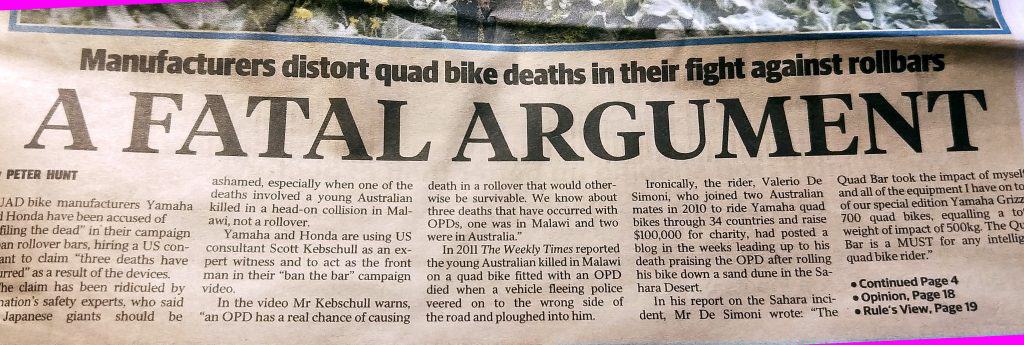
Last week the issue appeared in the media for a different reason. Yamaha and Honda have both advised their dealers that if the ACCC safety recommendations and safety standard become law, they will

“….. be force[d] to cease selling utility ATVs in Australia” (Yamaha)

“… withdraw from the ATV market in Australia.” (Honda)

Subscribe to SafetyAtWorkBlog to continue reading.
Subscribe Help
Already a member? Log in here

Doubts raised over the value of workplace wellness programs

In some Australian workplaces, wellness programs seem to be a dominant interpretation of occupational health and safety (OHS). This is being encouraged through the support of the OHS regulatory agencies. According to one expert, the benefits of workplace wellness programs remain under-researched and what research there is requires validation. Recently Zrui Song of Harvard Medical School said this to the ABC’s Norman Swan:

“There has been a couple of decades of evidence, largely observational in nature, studies that are from single institution or single workplace interventions focused on workplace wellness. And by and large this body of evidence has suggested that the return on investment for workplace wellness programs can be quite large. However, this body of evidence has been limited. They have been limited by the ability to show causal effects of workplace wellness programs…”

Subscribe to SafetyAtWorkBlog to continue reading.
Subscribe Help
Already a member? Log in here

The party politics of safety

The Safety Institute of Australia, commendably, approached the major political parties running in Australia’s current federal election campaign. Only the Australian Labor Party (ALP) responded to the SIA, but the policy documents of the Australian Greens and Liberal and National Parties are available online and their relevance to occupational health and safety (OHS) deserves attention.

The ALP information should be familiar to SafetyAtWorkBlog readers:

• “Show national leadership and meet with work, health and safety ministers from across Australia in the second half of this year to decide on the best course of action of the recommendations to come out of the Boland review.
• Work with state and territory governments to implement a harmonised industrial manslaughter offence.
• Establish a national advisory committee made up of representatives from each state and territory who have been personally impacted by a serious workplace injury or death to develop recommendations for federal, state and territory governments to act upon.”

Subscribe to SafetyAtWorkBlog to continue reading.
Subscribe Help
Already a member? Log in here
Concatenate Web Development
© Designed and developed by Concatenate Aust Pty Ltd