
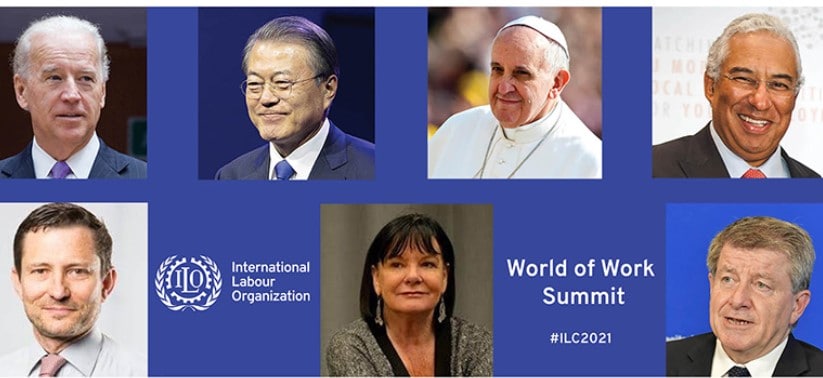
Most of the international reporting in June 2021 was about the G7 meeting, but the International Labour Organisation (ILO) also conducted a World of Work Summit as part of its 109th International Labor Conference. Several world leaders recorded messages for the event, and two are particularly interesting – President Joe Biden and Pope Francis. Such statements do have global influence and can support local occupational health and safety (OHS) initiatives.
Category: government
The OHS agenda of the Australian Labor Party
Given that the protection of worker health and safety will gain more attention and support under progressive parties and governments, the release of the 2021 National Platform for the Australian Labor Party (ALP) is notable. The 2021 document, unsurprisingly, focuses on the role of Health and Safety Representatives, appealing to its financial and political trade union base as major influencers on occupational health and safety (OHS).
This article will focus on the chapters in both the 2021 and 2018 platform documents related to safe and healthy workplaces, although there are OHS-related issues dotted throughout both documents.
The restricted state of knowledge – NDAs and OHS
A core element of the management of occupational health and safety (OHS) is creating and maintaining a “state of knowledge” on hazards and risks. There is an enormous amount of information already available in various OHS encyclopaedias, wikis and bodies of knowledge, but some of the most important information continues to be locked up in non-disclosure agreements and confidentiality clauses. On the issue of workplace sexual harassment, a recently established inquiry in Victoria, Australia, is set to look at the mechanisms that are principally used to protect the reputation of companies and executives but that could also have broader OHS benefits.
Liberty Sanger and Bronwyn Halfpenny are heading a task force designed by the Victorian Government to
“…develop reforms that will prevent and better respond to sexual harassment in workplaces.”
What is behind the fluctuation of mental health claims?
If you are contemplating running a survey about workplace health and safety, make it longitudinal. That is, structure your survey so that data can be compared over a long period of time by clearly defining your questions to the general rather than the topical. Topical questions can be included occasionally (they can freshen up a survey), but the core of the survey needs to be robust.
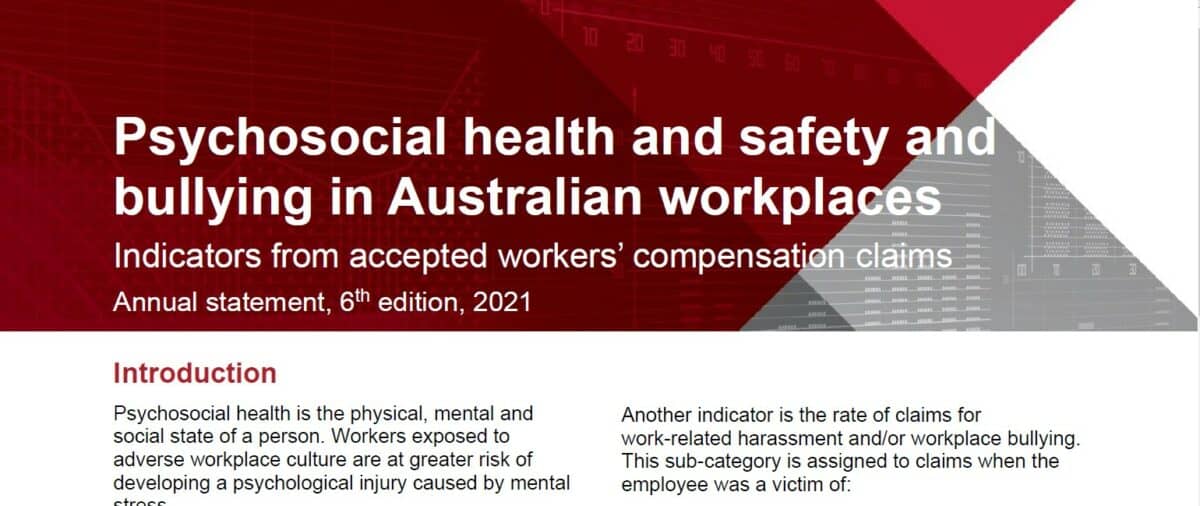
Recently Safe Work Australia (SWA) released the 6th edition of workers compensation claim data for psychosocial health and safety and bullying in Australia. It is a short statement of data that offers some interesting trends and continues the survey’s limitations.
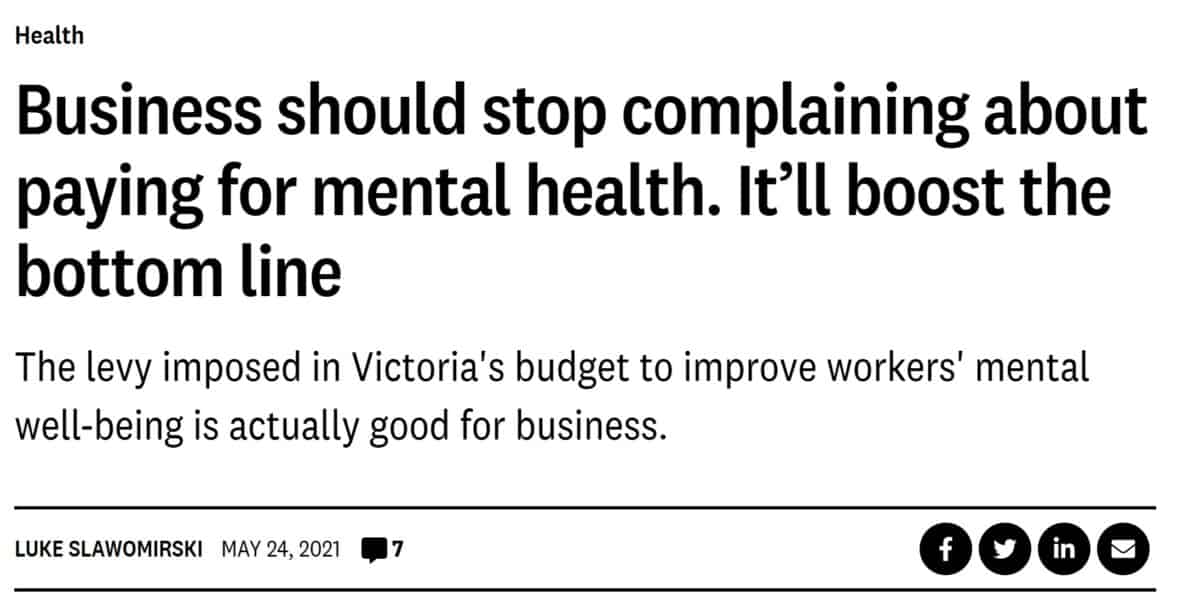
Business should stop complaining about paying for mental health. It’ll boost the bottom line.
[Article reprinted, with permission, from the May 24 edition of Crikey newsletter]
Luke Slawomirski
During the 2020 lockdowns, the business lobby showed a surprising concern for Victorians’ mental health: lockdowns were bad because they’d cause a spike in mental illness and suicides far worse than the COVID-19 cases and deaths they’d prevent.
The suicide spike never happened. What did happen was much-needed additional funding for mental health — $3.8 billion over four years — announced in the 2021-22 state budget on Thursday.
But the way business reacted suggests its interest in mental health has waned.
You see, the measures aimed at better prevention, diagnosis and treatment of mental ill health will be funded by a levy: 0.5% for businesses with payrolls above $10 million and 1% for those above $100 million. Critics, including the federal treasurer, claim this will cruel “job creation and confidence“.
Continue reading “Business should stop complaining about paying for mental health. It’ll boost the bottom line.”
OHS subtext in Industrial Manslaughter discussions
Senator Deborah O’Neill continued her attack on Australia’s Liberal/National party government in Senate Estimates hearing last week.
With the Work Health and Safety (WHS) ministers split on the introduction of an Industrial Manslaughter (IM) offence in the Model WHS laws, Senator Michaelia Cash, Attorney-General, Minister for Industrial Relations and chair of that WHS meeting, could have voted in favour of these IM changes but declined. O’Neill saw this as a political weakness and challenged Senator Cash to justify her decision. The justifications, with a hint of arse-covering, were morally weak but legally sufficient. At one point, Senator Cash said:
“… a fundamental principle of work health and safety regulation in Australia, as you would be aware, is that liability should focus on risk, not outcome, because the evidence shows that when you focus on risk, as opposed to outcome—and the outcome that you are referring to here is a terrible outcome: a death in a workplace—it’s been proven to actually improve health and safety in workplaces.”
Hansard, June 2, 2021, page 8
Industrial Manslaughter laws are not quite dead
The Hansard of June 1, 2021, Senate Estimates Hearings provided some nice background to the May 20 meeting of the Work Health and Safety (WHS) Ministers at which a national Industrial Manslaughter law was dismissed. Again, the politics of occupational health and safety (OHS) were on clear display.