
Wellness programs need to fit business management

Recently Corporate Bodies International circulated an annual membership offer (no costs listed in this link) to its Australian market.  It said:

“Employees and their families have access over to over 300 live webinars and exercise classes, monthly health videos, posters, online GP, Dietitian and Exercise Physiologist appointments – from anywhere in the world, just to name a few of the inclusions. All of this for little more than the cost of a cup of coffee.”

It is the last line that requires a bit more consideration as no program only costs just what marketers claim.

Business cartoon about lowering insurance costs by having fit, exercising employees.

The CBI offer included a link to a flyer about its Healthy Bodies Subscription which involves $A1,800 per annum for companies with less than 100 staff to about ten times that for a much larger number of staff. The services extend from webinars, posters for toilet walls and newsletters to “GP2U Online GP Access” which involves:

“Diagnosis, immediate prescriptions, specialist referrals and medical certificates, all from the convenience of the office. Designed for critical workers or the executive team, minimising work disruption”.

For an organisation that has no occupational health and safety (OHS), Human Resources or well-being resources, purchasing a package like this may be financially attractive but it can also lock one into a pool of medical advisors that could generate conflicts later on with, for instance, insurers, legal representatives, project partners and others. The provision of “immediate prescriptions” may also be a benefit that needs some further investigation – prescriptions by who? For any medication?

A company needs to decide whether it wants to be in total control of the medical services it may offer, or may need to offer, to its employees and whether subscriptions are sufficiently responsive to meet the fluctuations that occur with any workforce and with the business’ profitability.

It is also worth considering whether employees can choose to opt-out and continue being diagnosed or treated by their own physician.  How would such a corporate subscription allow for this worker right?  If the worker opts out, would this be seen as being disloyal? Would this reduce the number of workers covered by the subscription and affect the overall cost to the company?

Owning the welfare program for one’s own employees allows a company to shop for the best deal and to tailor the program to match the fluctuations of the company’s needs. Would this cost more than the subscription fees in the table above? Almost certainly, IF the subscription cost was the only cost involved.  It is important to look beyond cost to operating costs like management control, good governance and due diligence – to the broader context to which occupational health and safety law is pushing Australian companies.  These factors are rarely costed and are frequently overlooked, probably as a consequence of not being measured.  It is a shame that such “intangibles” are accepted as part of economic assessments but are dismissed in relation to OHS.
Kevin Jones

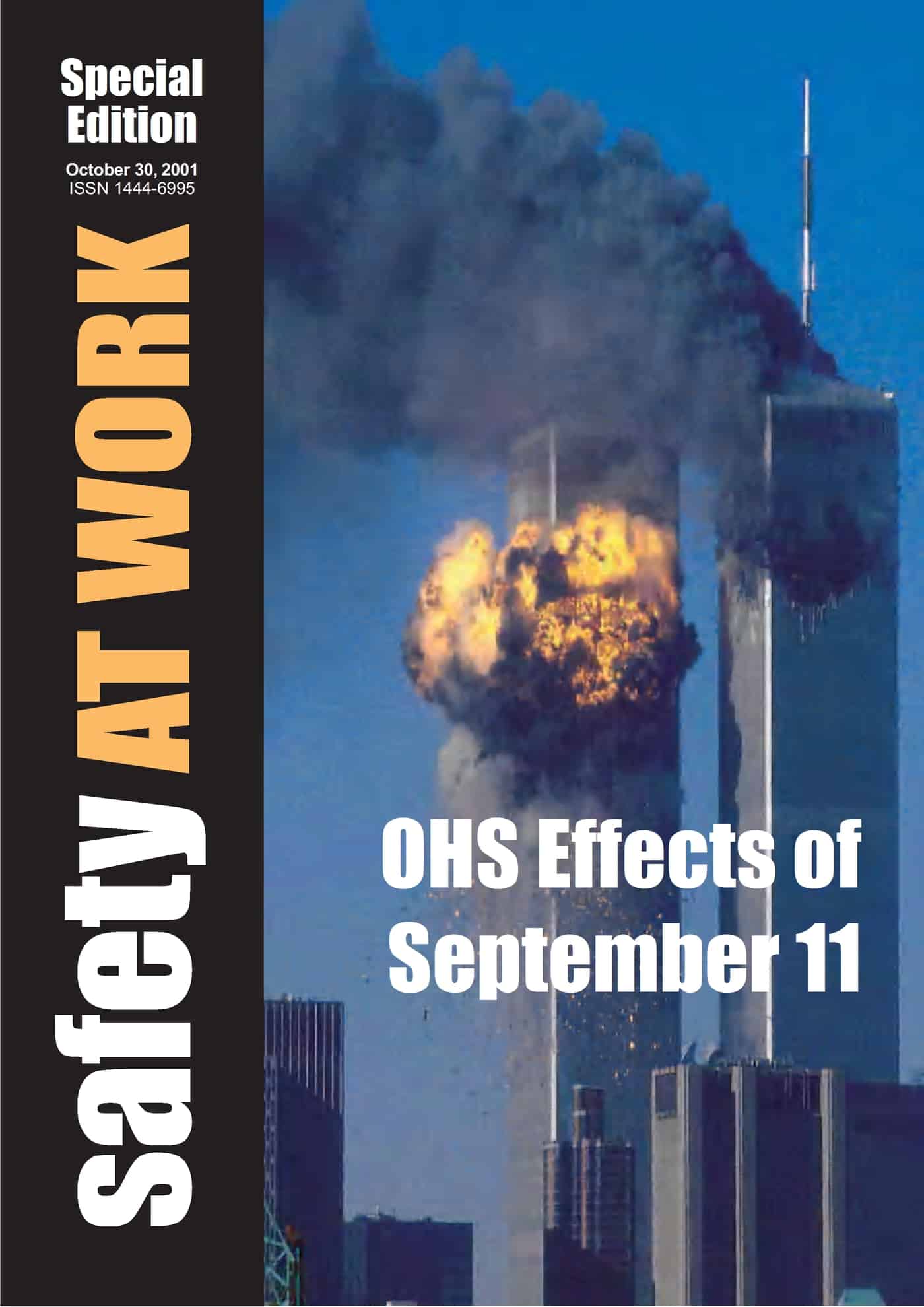
safetyATWORK magazine on 9/11

sept11SafetyAtWorkBlog originated from the SafetyAtWork magazine, a PDF subscription magazine that ran for a few years.  In October 2001 we published a special edition of the magazine focussed on the 9/11 disaster.  It has some exclusive articles and other safety content from a range of authors. We have made it available for the first time through this blog to mark the 15th anniversary of the event.

Kevin Jones


Citi’s 2015 Safety Spotlight shines light on some OHS areas

[This article from 2015 was previously password-protected and is now available to all] Recently a couple of media outlets referred to a report produced by Citi into workplace safety issues related to the top 100 companies on the Australian stock exchange.  The report, “Safety Spotlight: ASX100 Companies & More” (not available online), provides a useful…

Subscribe to SafetyAtWorkBlog to continue reading.
Subscribe Help
Already a member? Log in here

Law firm’s report provides important safety contexts

Law firms have been producing newsletters and case summaries for a long time.  Ostensibly these are for marketing purposes but occupational health and safety (OHS) professionals have benefited from these potted histories and examinations, even though the perspectives are often limited to the legal precedents.  Over the last few years though, law firms have been…

Subscribe to SafetyAtWorkBlog to continue reading.
Subscribe Help
Already a member? Log in here

Evidence to support Stand Up, Sit Less, Move More

Office workers need to exercise more.  This is one of the simplest occupational health and safety (OHS) statements that can be made.  Whether one stands while answering a telephone, walks to a photocopier, have a walking meeting or take the stairs instead of the lift or escalator, you will be healthier by moving.  Too often this simple OHS message is confused by sellers of apps, products, furniture and training courses that promise success from a single intervention.  The way to avoid this is to look at the research and some recent Australian research into sedentary work is a useful reference in determining workplace safety interventions.

The research “A Cluster RCT to Reduce Office Worker’s Sitting Time: Impact on Activity Outcomes” has been written by a swag of researchers from around Australia and found that a:

“workplace-delivered multicomponent intervention was successful at reducing workplace and overall daily sitting time in both the short- and long- term.”

Subscribe to SafetyAtWorkBlog to continue reading.
Subscribe Help
Already a member? Log in here

If worker engagement is lacking, reassess the product

Australian companies continue to introduce workplace wellness programs when the evidence for their effectiveness is still weak.  A major reason for this weakness is that many workers do not see health and wellness as part of the workplace’s role. It is also a problem that the American motivation for workplace wellness is not relevant to Australia.

What’s perhaps more worrying is that wellness programs often get more prominence than occupational health and safety interventions that do work but are less “sexy”.

A March 2016 article in EHS Today illustrates some of these issues.

Continue reading “If worker engagement is lacking, reassess the product”

“Cabbage Salad and Safety” podcast launched

KJ SFH HeadshotIt has been my intention for many years to establish a conversational podcast with a workplace safety lawyer. The opportunity to pitch the idea occurred earlier this year and the first episode of Cabbage Salad and Safety is now available.

Siobhan Flores-Walsh of Corrs Chambers Westgarth (pictured right with the author) was the lucky lawyer and she has been enormously supportive also providing the recording equipment, personnel and opportunity. Continue reading ““Cabbage Salad and Safety” podcast launched”

Concatenate Web Development
© Designed and developed by Concatenate Aust Pty Ltd