A deep look at sleep and mental health in the workplace needed

In September 2018 Australia commenced an inquiry into sleep health awareness.  At the time:

“The Committee Chair, Mr Trent Zimmerman MP, stated that ‘the Committee will examine the causes, economic and social costs, and treatment of inadequate sleep and sleep disorders.” (link added)

Although there is no timetable for the tabling of this Committee’s final report, many of the issues raised in the submissions relate directly to work and work-related mental health risks. Sadly there are hardly any solutions but this is a challenge to all public inquiries and which is particularly relevant to the current spate of Australian inquiries into OHS and mental health.
Subscribe to SafetyAtWorkBlog to continue reading.
Subscribe Help
Already a member? Log in here

A new statistical perspective on work-related injuries and illnesses

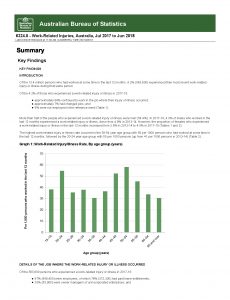
In late October 2018, the Australian Bureau of Statistics (ABS) released a summary of the latest work-related injury and illness data, although it was easy to miss as few, if anyone, reported on it. On first view, that mental health is barely mentioned in the Summary is surprising and the workers compensation data raises interesting policy questions.

Subscribe to SafetyAtWorkBlog to continue reading.
Subscribe Help
Already a member? Log in here

Misunderstanding sleep – Part 2

Most non-transport industries do not look for the lack of sleep or fatigue as a factor in their investigations.  Unless a formal investigation is undertaken, fatigue is rarely mentioned and, if it is, it is categorised as a “contributory factor”, which often means it is given such a low priority that nothing will be done about it.  This is partly a legacy of silo thinking that sleep is a non-work personal activity, which it is, but is still one that can affect work and all the relationships and decisions made at work.  But it is also partly due to the enormous disruption that could result if the lack of sleep and fatigue were taken seriously and effective control measures were introduced.

The most effective control for fatigue may be human-friendly shifts and “reasonable” working hours but that might not fit the shift rosters which are required to satisfy clients.  We know that night shift has higher health and physical risks than day shift so logically, get rid of night shift ….

Subscribe to SafetyAtWorkBlog to continue reading.
Subscribe Help
Already a member? Log in here

The systemic causes of poor mental health may get long-awaited attention

Source: istockphoto

Australia’s national government has announced an inquiry into mental health to be conducted by the Productivity Commission.  The Victorian Government has promised a Royal Commission into Mental Health as part of its election pledge. New South Wales has a five-year Mentally Healthy Workplaces Strategy. All of these initiatives are being applauded by the mental health advocates but two of them have yet to specify their terms of reference or their timelines for delivery, making it difficult to determine what role workplaces, workers and employers will have.

There is also a political risk that community expectations or the evidence base changes during the delivery period.  Workplace mental health seems particularly susceptible to this risk at the moment.

Subscribe to SafetyAtWorkBlog to continue reading.
Subscribe Help
Already a member? Log in here

Bad bosses

Benjamin ArtzAmanda H. Goodall  and Andrew J. Oswald determined that

“There are no published papers — to our knowledge — that assess in an internationally consistent way the rarity or commonness of ‘bad bosses’.”

So they undertook there own research, published under the title “

Subscribe to SafetyAtWorkBlog to continue reading.
Subscribe Help
Already a member? Log in here

The importance of evidence in addressing workplace mental health issues

At the recent Scientific Meeting of the Australia and New Zealand Society of Occupational Medicine (ANZSOM), Allison Milner stepped in for an ill Tony La Montagne and added value to his intended presentation on workplace mental health. This meeting is different from other conferences in one particular way, in relies on evidence and not marketing for its presentations.  This difference made Milner’s presentation very powerful.

Milner set the scene with a broad picture of mental health:

“1 in 5 Australians have a mental illness, which equivalates to about 1.5 million.  And over 3000 people lose their life to suicide every year, and the vast majority of these people being men.  But suicide affects far more people than those people who attempt or sadly lose their life.  It affects their work colleagues, it affects people in our community and it affects our family.”

Continue reading “The importance of evidence in addressing workplace mental health issues”

Start the bullying epidemic without me

Australia has been told for a long time that workplace bullying was an epidemic.  Recent data seems to indicate that workplace bullying is a persistent problem which, to some extent, has blended into the miasma that is work-related mental health.  The Fair Work Commission released its 2017/18 Annual Report on October 18 (not yet online) adding further doubt to the epidemic claims.

Below is a comparison graph (page 19) of FWC activity which shows 721 applications concerning workplace bullying. It is ninth in the list of FWC activities.

Subscribe to SafetyAtWorkBlog to continue reading.
Subscribe Help
Already a member? Log in here
Concatenate Web Development
© Designed and developed by Concatenate Aust Pty Ltd