
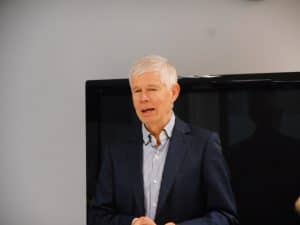
 Recently David Caple gave his annual address to the Central Safety Group in Melbourne. Caple (pictured above) is a prominent ergonomist, an adjunct professor at the Centre for Ergonomics & Human Factors, La Trobe University, a representative on several government OHS-related committees and has an enviable information network.
Fresh from the Singapore OHS conference, Caple speculated on the future of the workplace safety profession at a time when many are indicating an increasing demand for OHS services and advice. He used a graph of the membership of the Safety Institute of Australia to illustrate part of the challenge.
 If occupational health and safety (OHS) is to include the “whole-of-life” for workers, companies, products and projects, OHS professionals need to expand their pool of knowledge to meet the demands for an inclusive organisational culture. One recent research paper supports this approach by looking at the return to work of cancer survivors.
 Innovation in occupational health and safety (OHS) is often encouraged by government but government processes and policy can also discourage and limit this. An obvious example is where government insists on compliance with OHS laws in its tendering criteria but acknowledges that the tender safety criteria remains outdated and, privately, that OHS compliance is not enough to ensure a safe and healthy workplace.

 The most
 There is much general discussion about the
