Paper provides historical context to OHS laws

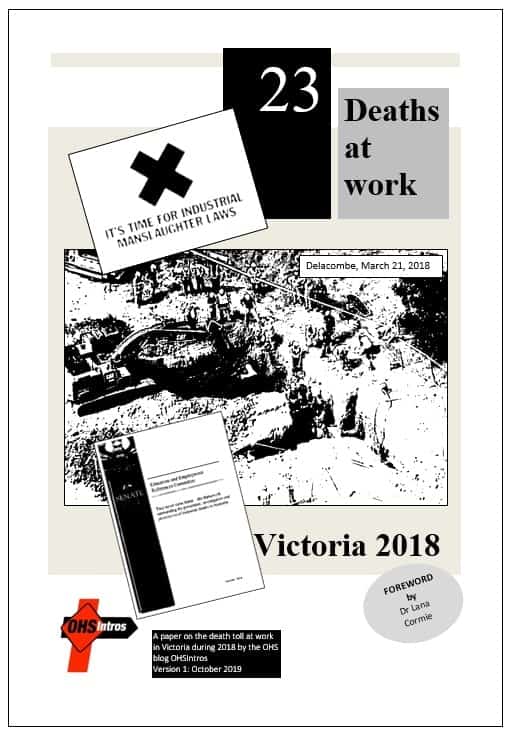
Barry Naismith of OHSIntros has provided excellent independent analysis of Victoria’s occupational health and safety (OHS) data for many years. His latest “Deaths at Work” report (available publicly for a limited time) includes a detailed discussion on the social context of Victoria’s proposed Industrial Manslaughter (IM) laws.

But of more immediate interest is Naismith’s longitudinal analysis. One of his graphs showing death statistics back to the commencement of Victoria’s modern-era OHS laws in 1985 supports the statement popular with politicians that the rate of work-related deaths is declining over that time but Naismith points out that the five-year trend to 2018 is reversed and that this is part of the justification for the IM Laws.

Subscribe to SafetyAtWorkBlog to continue reading.
Subscribe Help
Already a member? Log in here

Farm suicides and prevention

In a submission to the Australian Government’s inquiry into the future of work, the McKell Institute dips into Safe Work Australia’s latest statistical data and reveals a few occupational health and safety (OHS) and workers compensation surprises in the area of agriculture. These surprises are substantiated by other occupational health and safety (OHS) data sources.

Recently, SafetyAtWorkBlog chastised Australian government agencies, and politicians, from relying on workers compensation claims data as measurements of OHS rather than having established supplementary and robust sources of data on work-related injuries and illnesses. Such reliable sources would have helped anticipate some of the hazards from new employment structures and re-emerging occupational hazards. The McKell Institute wrote:

Subscribe to SafetyAtWorkBlog to continue reading.
Subscribe Help
Already a member? Log in here

Political Science (finally) comes to OHS

Improvement in occupational health and safety (OHS) standards has always been the intention of OHS laws. Parallel to this is the intention of the OHS, and allied, professions to continuously improve health and safety through the prevention of harm. However, political leadership on OHS has been scarce over the last few years, especially in the national governments of the United Kingdom, the United States and Australia. So, it is necessary to look beyond the party politics to other sources of change.

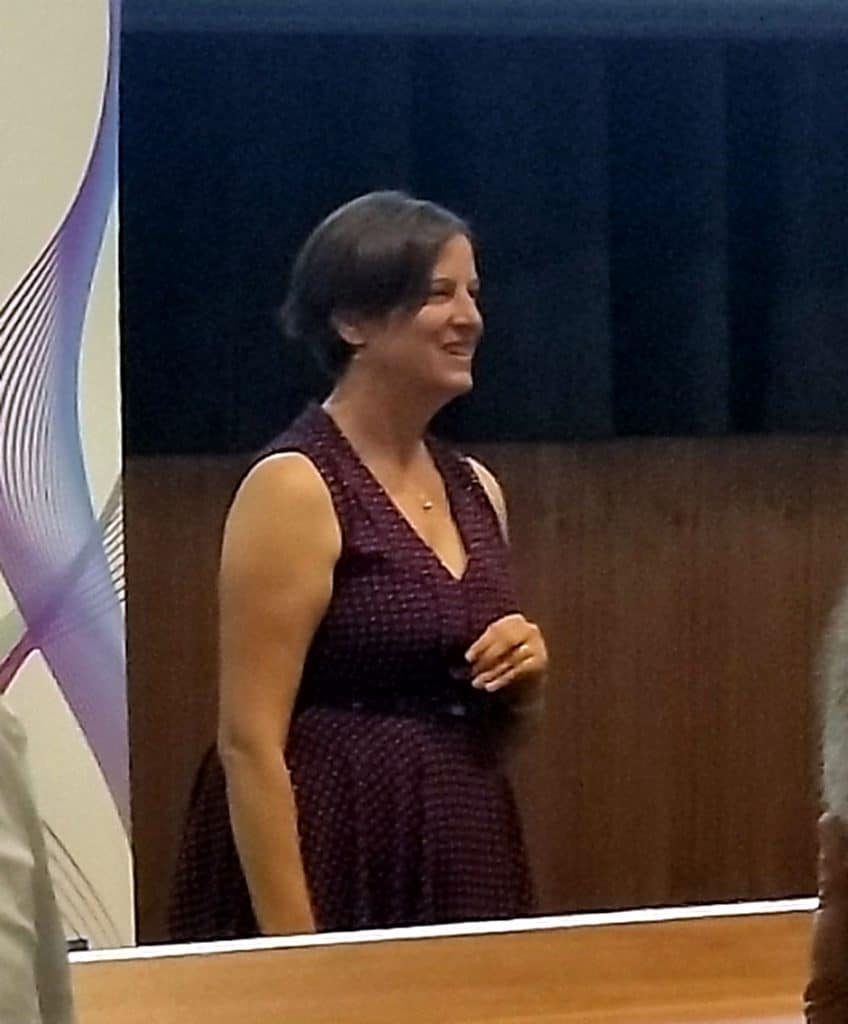
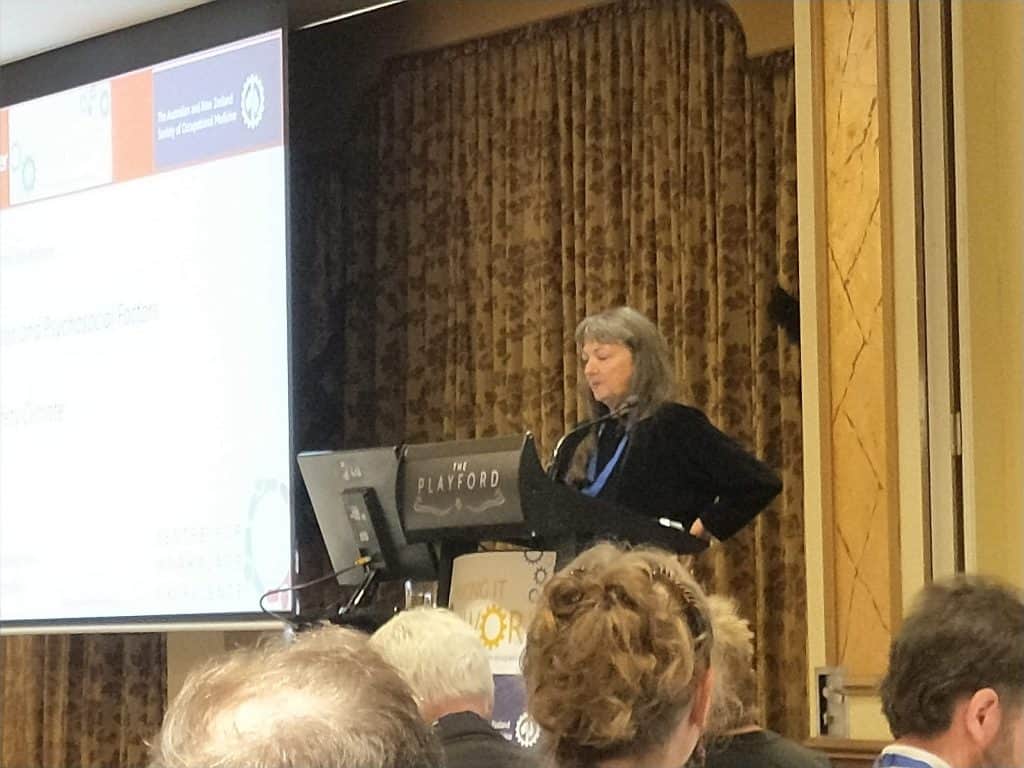
Professor Maureen Dollard speaking at the 2019 ANZSOM Scientific Meeting in Adelaide

At the recent scientific meeting of the Australia and New Zealand Society of Occupational Medicine in Adelaide, prominent academic, Professor Maureen Dollard, introduced a much- needed element of political science into her presentation which was titled “Work Organisation and Psychosocial Factors”. SafetyAtWorkBlog was able to ask Dollard, and fellow presenter Professor Sally Ferguson, about this political context.

Subscribe to SafetyAtWorkBlog to continue reading.
Subscribe Help
Already a member? Log in here

New Zealand leads on wellbeing

A couple of months ago, SafetyAtWorkBlog mentioned New Zealand’s Wellbeing Budget. Last week a representative of the NZ Treasury, Ruth Shinoda, spoke about it from direct experience in Melbourne at the 7th Global Healthy Workplace Summit. The Wellbeing Budget and a complimentary Living Standard Framework provide important contrasts to how Australia is valuing the healthy and safety of its citizens and workers.

Subscribe to SafetyAtWorkBlog to continue reading.
Subscribe Help
Already a member? Log in here

“We need to act together to help me get my act together”

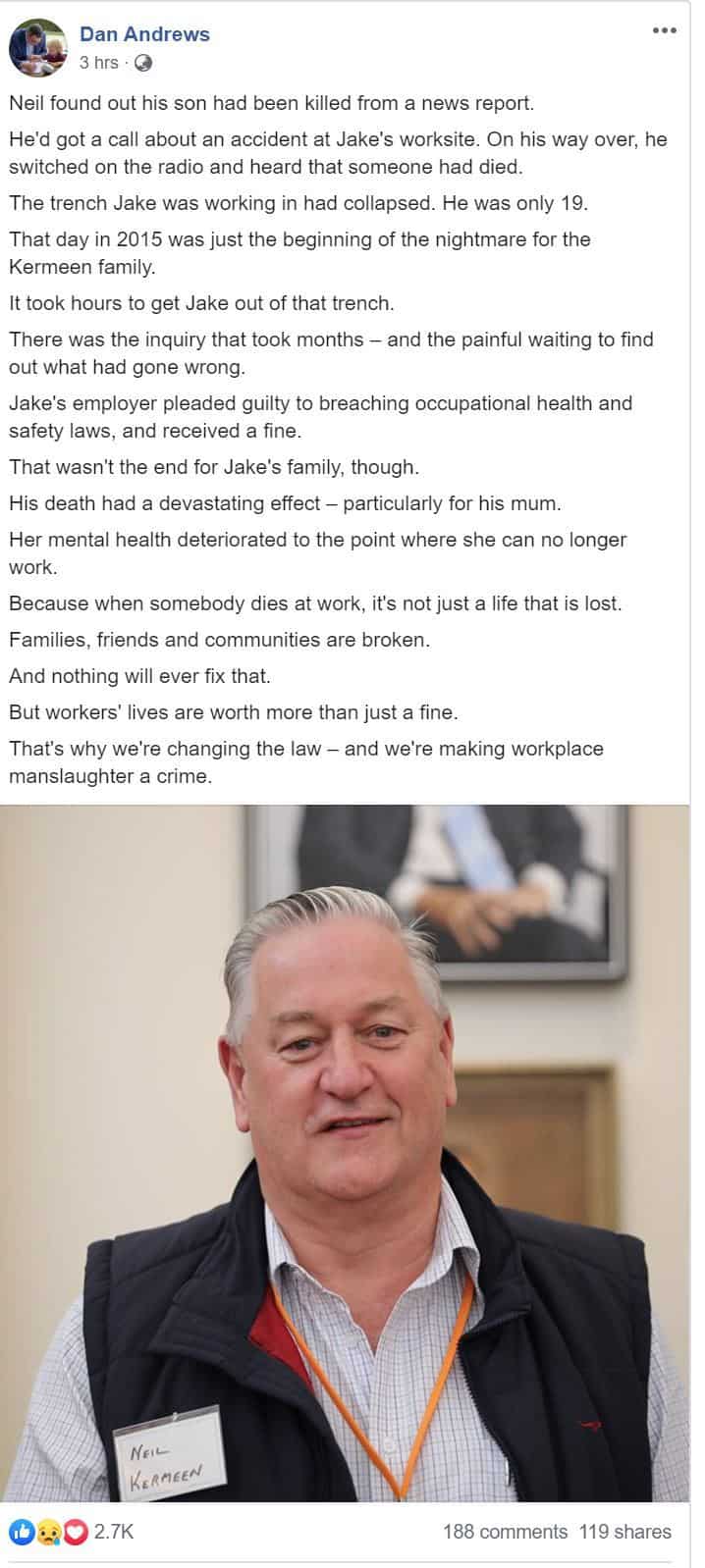
On October 21 2019, Victorian Premier Daniel Andrews posted on Facebook in support of his government’s move to introduce Industrial Manslaughter (IM) laws. He chose the death of Jacob Kermeen and its effect on the family in support of the need for these laws.

It is surely a coincidence that a fatality from a trench collapse was chosen for this exercise. Some of the leading advocates for IM laws are the relatives of two workers who died from a trench collapse in Ballarat in March 2018, a case being prosecuted by WorkSafe Victoria.

Subscribe to SafetyAtWorkBlog to continue reading.
Subscribe Help
Already a member? Log in here

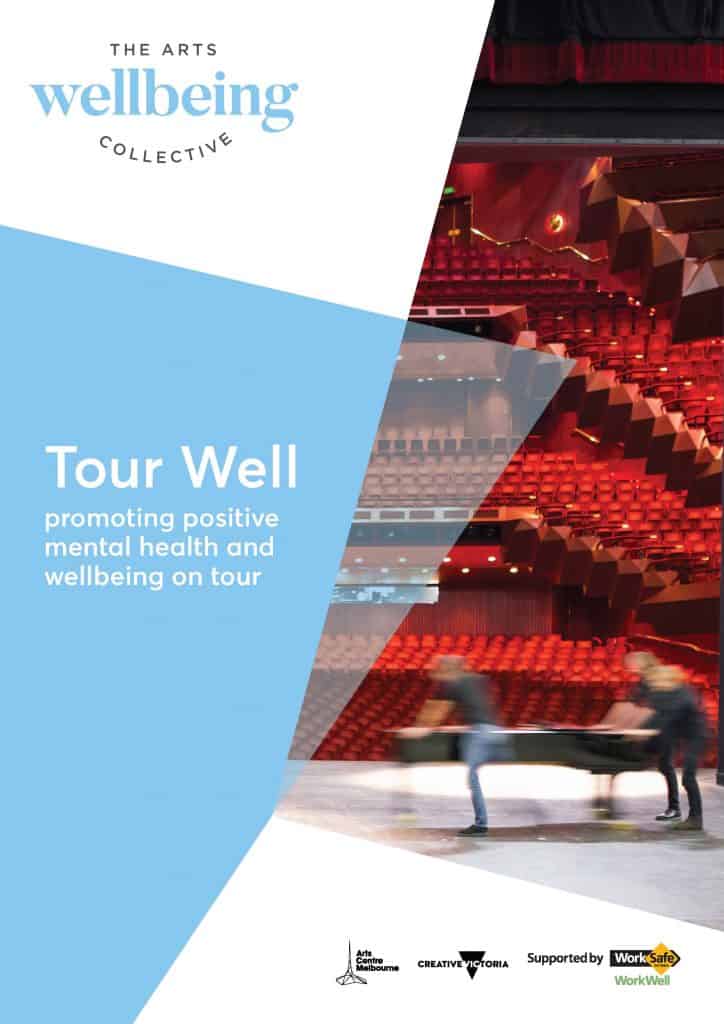
Arts Wellbeing Collective shows how it’s done

From an occupational health and safety (OHS) perspective, part of the reason that the Arts Wellbeing Collective (AWC) is being so successful and admired is that it originated outside of the traditional OHS and Health funding models. Existing in the performing arts meant the Collective drew firstly on their modern version of patronage by approaching their sponsors.

Recently the CEO of the AWC, Claire Spencer, spoke at the launch of Victoria’s Health and Safety Month and reminded the audience of the dire straits the performance arts were in with relation to mental health. She referenced the research commissioned by Entertainment Assist and conducted by Victoria University

Subscribe to SafetyAtWorkBlog to continue reading.
Subscribe Help
Already a member? Log in here
Concatenate Web Development
© Designed and developed by Concatenate Aust Pty Ltd