
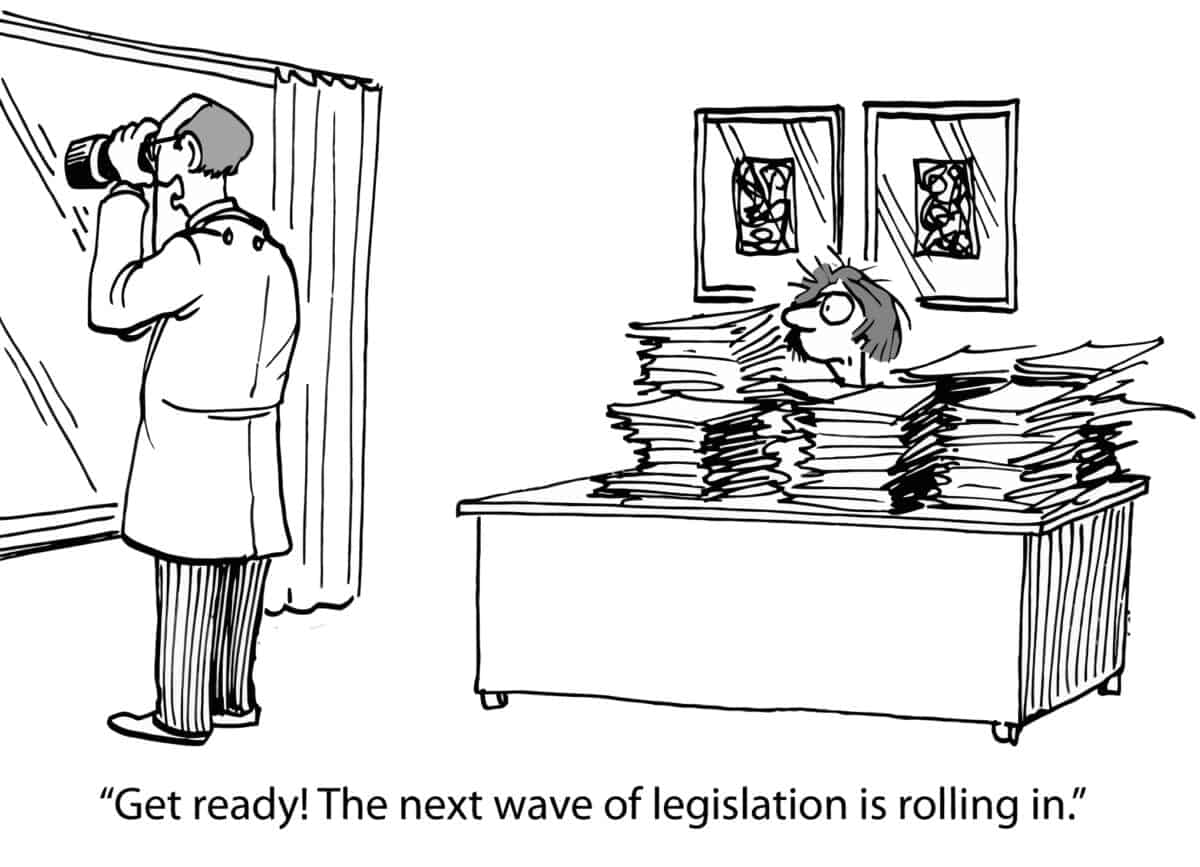
The big occupational health and safety (OHS) news in Australia has been the release of the federal government’s response to the Respect@Work report on sexual harassment in Australian workplaces. And the biggest issue in that response seems to be the government’s lack of enthusiasm for a major recommendation of Sex Discrimination Commissioner Kate Jenkins, the inclusion of a positive duty in the sexual discrimination legislation. Many lawyers have been asked for their opinions on the government’s response, but very few OHS professionals.
Category: politics
OHS is “… more what you’d call ‘guidelines’ than actual rules.”
Occupational health and safety (OHS) may not be a common subject in the mainstream media but there is plenty of political discussion on the topic in Australia’s Parliament.
The current (conservative) federal government seems very slow to accept and respond to recommendations from official inquiries that it sees as a secondary political priority, such as sexual harassment and workplace health and safety. The hearings of the Senate’s Education and Employment Legislation Committee on March 24 2021, were, as usual, enlightening.
Change in the air on ventilation
One of Edward O’Donoghue’s recent Motion supporters in Victoria’s Parliament was Georgie Crozier, the Liberal Opposition’s Shadow Health Minister. In her speech in support of the Motion, she mentioned ventilation:
“I have been asking for the audits of what has occurred in hotel quarantine under the new structure that the government put in after that catastrophic failure of last year. They said, ‘The system’s fixed; everything is fine. We’ve got processes in place and it’s safe’. Well, it is not safe. I have been wanting to see those ventilation audits, see those safety audits, look at the issues that are arising here, because the other states are not having the same degree of breaches and problems and terrible consequences that we are in Victoria. So something is going wrong; something is going terribly wrong. It is the Andrews government that has to take responsibility for this. It is an absolute outrage that they continue to not take responsibility for this.”
Hansard, Page 24
Until recently, Australia was reluctant to accept the spread of COVID19 by air. The focus was on droplets and the cleanliness of surfaces. An aerosolised coronavirus’s risk was, until very late last year, a fringe risk – one not substantiated by evidence.
Playing the man and not the hazard
People like Ken Phillips continue to pursue Premier Daniel Andrews and others for alleged breaches of occupational health and safety (OHS) laws over COVID19-related deaths stemming from failures in Victoria’s hotel quarantine program. On March 17 2021, the pressure to hold the Premier to account increased in the Victorian Parliament, largely under the guise of OHS duties.
On March 17, 2021, the following motion was put to the Legislative Council by the Liberal Party’s Shadow Attorney General, Edward O’Donoghue:
“… that this House calls on the Minister for Workplace Safety, the Hon Ingrid Stitt MLC, to exercise her power, confirmed in section 7(1)(a) of the Occupational Health and Safety Act 2004, to direct WorkSafe Victoria to —
Hansard, pages 23-24
(1) conduct an urgent investigation into all occupational health and safety risks and corresponding responsibilities for duty holders within the Hotel Quarantine Program managed by COVID-19 Quarantine Victoria and its predecessors with responsibility for hotel quarantine;
(2) ensure the report includes details of the health and safety risks and corresponding responsibilities for duty holders;
(3) complete the inquiry and present a Report to the Minister for Workplace Safety by 31 May 2021; and
(4) cause the Report to be tabled in the Council on the next sitting day after it has been received from WorkSafe Victoria.”
OHS in IR’s shadow
In the world of work, industrial relations (IR) continues to lead discussions with occupational health and safety (OHS) as an additional motivator of change (If we’re lucky) or a consequence of IR negotiations, for which we are supposed to be grateful. This seemed to be on display again in one Australian Senate Committee hearing in March 2021.
The Senate’s Economics Reference Committee sat in Melbourne on March 11, 2021. The inquiry hearing was part of the investigation into the “the causes, extent and effects of unlawful non-payment or underpayment of employees’ remuneration by employers and
measures that can be taken to address the issue…”, more commonly referred to as “wage theft”.
Selective duty of care being applied by the Australian Government – from the archive
Yesterday’s article on Comcare’s recent charging of two organisation over workplace-related harm to others generated so much interest that I have (re)published an article from 2016 that analysed an earlier, similar issue. Please also read the comments below and consider adding your own.
Australia’s work health and safety (WHS) laws confirmed the modern approach to workplace safety legislation and compliance where workers and businesses are responsible for their own safety and the safety of others who may be affected by the work. The obligations to others existed before the latest WHS law reforms, but it was not widely enforced. The Grocon wall collapse in Victoria and the redefinition of a workplace in many Australian jurisdictions through the OHS harmonisation program gave the obligation more prominence but has also caused very uncomfortable challenges for the Australian government – challenges that affect how occupational health and safety is applied in Australian jurisdictions.
Continue reading “Selective duty of care being applied by the Australian Government – from the archive”
What Australia can learn from other Parliaments about sexual harassment and assaults
Brittany Higgins alleges that she was raped in her employer’s office by a work colleague after a night of drinking. Since mid-February 2021, other women have claimed to have been sexually assaulted in Parliament. The Attorney-General, Christian Porter, is taking some leave after revealing himself to be the person behind historical rape allegations. At the moment, Australian politics is wrapped up in itself over these scandals. Still, similar scandals have happened in other Parliaments, and the responses to these may provide guidance for Australia.
A small survey of female parliamentarians and staff in Europe in 2018 found the following
▪ 85.2 per cent of female MPs who took part in the study said that they had suffered psychological violence in the course of their term of office.
▪ 46.9 per cent had received death threats or threats of rape or beating.
▪ 58.2 per cent had been the target of online sexist attacks on social networks.
▪ 67.9 per cent had been the target of comments relating to their physical appearance or based on gender stereotypes.
▪ 24.7 per cent had suffered sexual violence.
▪ 14.8 per cent had suffered physical violence.