Interesting but not representative

The Australian Council of Trade Unions (ACTU) released the results of its latest occupational health and safety (OHS) survey. In past surveys respondents have been trade union members. This survey was opened to non-union members, but to what extent is unclear but this has not stopped the ACTU speaking of the respondents as workers rather than workers who are all union members.

This differentiation is important. In the 1990s when union membership was much larger, the argument that the survey results were representative of Australia’s workforce was stronger although still debatable. Representation is harder to claim now with union membership being well below 20% overall and below 10% in the private sector.

Subscribe to SafetyAtWorkBlog to continue reading.
Subscribe Help
Already a member? Log in here

Big potatoes, small potatoes, trust and transparency

The Australian Council of Superannuation Investors (ACSI) has released a research paper that discusses the reporting of workplace fatalities by major companies in their Environmental, Social and Governance (ESG) reports. There are many informational benefits in this report but perhaps the most important is that the report reinforces occupational health and safety (OHS) in ESG reports. The risk is that OHS is seen only in relation to the ESG criteria in Annual Reports.

Australia has experienced a gentle push for inclusion of OHS performance measurements in company and government department Annual Reports. SafetyAtWorkBlog has reported on this and some peer-reviewed research and recommendations over many years. The ACSI report progresses this but also illustrates the sluggish rate of change.

Subscribe to SafetyAtWorkBlog to continue reading.
Subscribe Help
Already a member? Log in here

What’s the fuss? Stay focused on safety

The debate about quad bike safety has gone global with the United States telling the World Trade Organisation that the imposition of operator protection devices (OPDs) on general quad bikes (those not used for recreation or sport) may be a trade barrier. To some this would appear silly, and the argument has little to do with worker safety, but this action by the US impedes progress on safety.

Recently the Victorian Coroner made findings into the quad bike-related death of 69-year-old farmer Gustaav Walta in September 2017. The finding is not yet publicly available but the story of Walta’s death sounds very familiar.

One evening around 6pm Walta advised his friend that he was putting the sheep away. His friend did not receive the regular phone call the next morning and drove to the property finding a quad bike that had rolled over and Walta’s body in an adjacent paddock. It was determined that Walta had died from severe chest injuries caused by the quad bike incident, that he had been ejected from the bike, the bike rolled over him and he then had tried walking to a neighbour’s property before he collapsed and died.

The chronology in the Findings is not very clear on Walta received his chest injuries but what is clear is that, like so many before, the quad bike had not been fitted with an OPD and that Walta had not been wearing a helmet.

Subscribe to SafetyAtWorkBlog to continue reading.
Subscribe Help
Already a member? Log in here

Grab bag of OHS issues – politics, dust, occupational violence and international HR

Workforce lifecycle framework

Over the last week or so, as the Australian Parliament resumes operating, the Liberal/National Government is trying to reduce the influence of “militant” unions through its “Ensuring Integrity” Bill but opponents say this may affect the management of occupational health and safety (OHS).


The Federal Department of Health has established a National Dust Disease
Taskforce
to develop a national approach to the prevention, early identification, control and management of dust diseases in Australia largely, it seems in response to silicosis but Black Lung had to have some influence.


Subscribe to SafetyAtWorkBlog to continue reading.
Subscribe Help
Already a member? Log in here

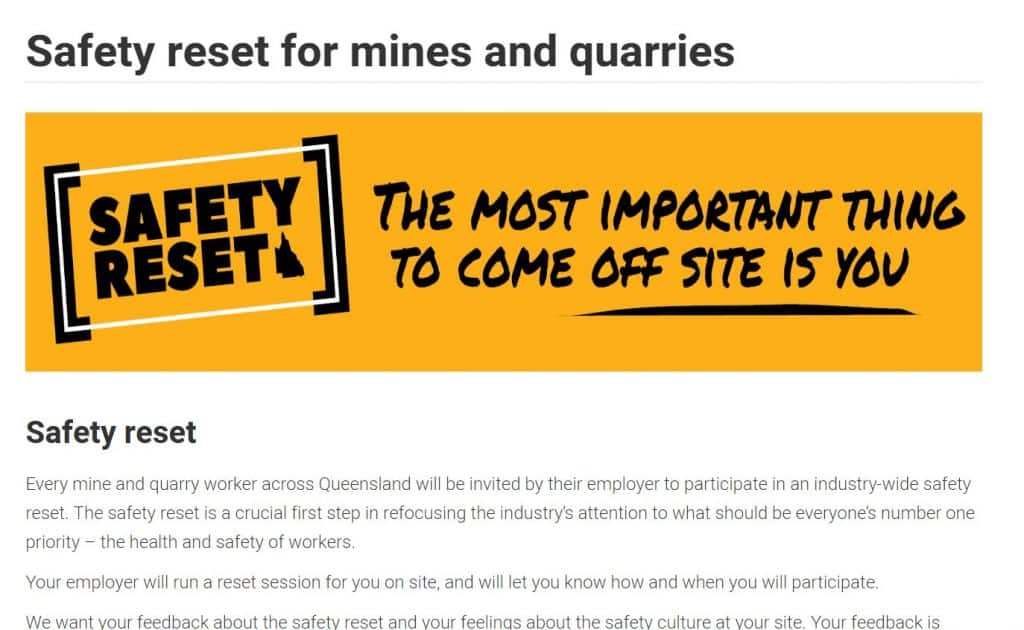
Queensland’s ‘Safety Reset’

Queensland is undertaking a “safety reset” following several recent deaths in the mining and quarry industry. This government initiative has the backing of the resources sector and has collated a good amount of safety resources in support of what is a mandatory exercise.

What is a little different in this initiative is that it reinforces that the primary responsibility for occupational health and safety (OHS) rests with the employers and company owners. In the past, government initiatives have tended to take on the responsibility for the OHS changes or imply that it is the government’s job to fix the situation and the relative safety cultures, as if it was government (in)activity that caused the problem.

Subscribe to SafetyAtWorkBlog to continue reading.
Subscribe Help
Already a member? Log in here

Industrial Manslaughter concerns of the Victorian government taskforce

In April this year the Victorian Government’s Workplace Manslaughter Implementation Taskforce raised the following issues in its Criminal Law Reform Consultation Paper, seen by the SafetyAtWorkBlog:

  • the definition of “person” in the OHS and proposed Industrial Manslaughter laws
  • the establishment of negligence and the standard of care expected by the reasonable person
  • the extension of Industrial Manslaughter offence to the deaths of members of the public
  • whether a decision or act causes the death or only contributes to it
  • exceptions to the laws beyond just volunteers
  • inter-agency cooperation and coordination for effective prosecutions.
If you have any information about safety-related issues or incidents, remember that SafetyAtWorkBlog operates a confidential and anonymous information line at https://safetyatworkblog.whispli.com
Subscribe to SafetyAtWorkBlog to continue reading.
Subscribe Help
Already a member? Log in here

Bereaved families group demands changes

Documents related to the development and implementation of Industrial Manslaughter laws in Victoria and seen by SafetyAtWorkBlog say that the Department of Justice and Community Services will draft a policy paper on the laws prior to the proposed Industrial Manslaughter Bill being presented to Parliament in October or November. October’s Work Health and Safety Month promises to be lively this year.


Participants in the Workplace Fatalities and Serious Incidents Reference Group had expressed concerns about the phoenixing of companies after a workplace fatality and that workplaces where deaths have occurred should be treated as a crime scene that:

“…should not be operational until a full investigation is complete”

Subscribe to SafetyAtWorkBlog to continue reading.
Subscribe Help
Already a member? Log in here
Concatenate Web Development
© Designed and developed by Concatenate Aust Pty Ltd