
 A safety conference in Victoria Australia today heard from Innes Willox of the AIGroup about new challenges in business and occupational health and safety (OHS). As many have mentioned recently big data is a challenge but with important benefits. A major flaw in any of these discussions is an overestimation of data sources and usefulness. Continue reading “Big OHS data needs to digitise the past”
Category: productivity
New OHS management elements in ISO45001
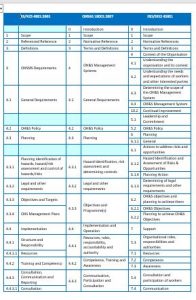 Following yesterday’s article on the impending international occupational health and safety (OHS) management Standard, ISO45001, some readers have asked for more details. David Solomon, the Head of the Australian International Delegation of ISO45001 provided a table that compares the elements of ISO45001 with AS4801 and OHSAS18001.
According to Solomon there are several elements that are new to ISO45001, ie. not included overtly in AS4801:
Me! Me! Me! – OHS needs to grow up for the new world structure
 There is much general discussion about the Fourth Industrial Revolution, The Future of Work and other speculative work-related concepts. Klaus Schwab of the World Economic Forum wrote:
“We stand on the brink of a technological revolution that will fundamentally alter the way we live, work, and relate to one another. In its scale, scope, and complexity, the transformation will be unlike anything humankind has experienced before. We do not yet know just how it will unfold, but one thing is clear: the response to it must be integrated and comprehensive, involving all stakeholders of the global polity, from the public and private sectors to academia and civil society.”
For the purposes of this blog “work” is the focus and health and safety the discussion points. Occupational health and safety (OHS) professionals have a unique opportunity to participate in the early stages of this societal disruption. But there is also a risk that OHS could miss out. Continue reading “Me! Me! Me! – OHS needs to grow up for the new world structure”
Quinlan’s time capsule includes useful OHS perspectives
 Professor Michael Quinlan has been writing about occupational health and safety (OHS) and industrial relations for several decades. His writing has matured over that time as indicated by his most recent book, Ten Pathways to Death and Disaster. In 1980, one of his articles looked at OHS through the prisms of Capitalism and Marxism. It is remarkable how much an article that was written early in Quinlan’s career and at a time when OHS was considered another country remains relevant today. This perspective contrasts strongly with the current dominant thinking on OHS and as a result sounds fresh and may offer some solutions.
In Quinlan’s 1980 article, “The Profits of Death: Workers’ Health and Capitalism”*, he writes that
“contrary to popular belief there is no objective irrefutable definition of illness”.
This could equally be applied to safety. But searching for THE definition of things can lead to everlasting colloquia of academic experts without helping those who need to work within and apply safety concepts.
The challenges of Todd Conklin
 Earlier this month SafetyAtWorkBlog published an article based on an anecdote by Todd Conklin about a glove. There was much more that Conklin shared at the SafeGuard conference in New Zealand. Below are several of his slides/aphorisms/questions that may challenge the way you think about managing occupational health and safety (OHS) in your workplace.
New report provides important data on occupational health
A recent report from the UK Society of Occupational Medicine highlights several issues of note to the occupational health and safety (OHS) professional. But it is also worth looking at the SOM’s media release.
As well as offering financial costs and benefits of good occupational health management the full report also contextualises occupational health:
“The report cites a survey of 1,000 UK employers in which respondents gave their most common reasons to spend on health and wellbeing initiatives as: a motivated and healthy workforce is more productive (41%); to attract and retain staff (25%); to be perceived as a caring employer that takes duty of care requirements seriously (21%). Meanwhile, a survey of 1,000 employees found that they were more likely to choose an employer who took employee health and wellbeing seriously (66%) and would feel they have a duty to work harder for such an employer (43%). The survey results are reflective of the intangible as well as tangible benefits of occupational health.”
Continue reading “New report provides important data on occupational health”
Do open plan offices and sit/stand desks create as many problems as they solve?
 The mainstream media regularly includes articles and, increasingly, advertorials, about the modern workplace, usually office buildings, that are designed to foster creativity, communication, productivity and improve physical health. In many of these workplaces, it quickly becomes apparent that there are never enough meeting rooms for confidential discussions, making the coffee shop in the foyer or a nearby building, essential venues for conversations that would, in the past, be conducted in an office.
It also does not take long for a lot of the workers to be at their desks wearing earbuds or headphones in order to negate the noise that the modern workplace allows and creates. This need for isolation and concentration is contrary to the intentions of the office designers. It is not simply a reflection of the modern ipod technology but a human desire for privacy, focus, diligence and productivity. New research seems to indicate that the situation is not helped by sit/stand desks.