Actions speak louder than words

A short debate in South Australia’s Parliament about the upcoming World Suicide Prevention Day was illustrative of some of the politics and barriers to reducing suicide.

Independent politician, Geoff Brock moved the following in support of World Suicide Prevention Day.

That this house –
(a) acknowledges that 9 September 2020 is World Suicide Prevention Day;
(b) acknowledges that world prevention day started in 2003;
(c) acknowledges that in excess of 3,000 people die from suicide every year;
(d) acknowledges that suicide is one of the largest causes of death each year;
(e) encourages people of all ages to openly discuss and acknowledge deaths by suicide;
(f) encourages people of all ages to openly discuss their mental health and wellbeing issues with family and friends;
(g) acknowledges the everlasting impact and effect of any death on family members and others; and
(h) encourages the state government to provide sufficient support, both financial and other support, as necessary.

Subscribe to SafetyAtWorkBlog to continue reading.
Subscribe Help
Already a member? Log in here

Liability, COVID19, Manslaughter and Working from Home – Welcome to the new OHS

Last week WorkSafe Victoria followed some of the other Australian States by requiring employers to report positive COVID19 cases as “notifiable incidents”. (If they can do this fro COVID19, shouldn’t it be possible to do the same for mental health disorders?) Expanding the pool of notifiable incidents is of little practical consequence but it is indicative of how occupational health and safety (OHS) management is changing, and how Industrial Manslaughter is becoming a pervasive threat.

Managing Liability

In the Australian Financial Review (AFR) on August 4 2020, employer liability for COVID19 incidents was discussed. Liberty Sanger of union-associated law firm, Maurice Blackburn, spoke of the importance of genomic testing to better identify the origin of the infection, ie. was it caught at work or at home.

Subscribe to SafetyAtWorkBlog to continue reading.
Subscribe Help
Already a member? Log in here

More data means a stronger case for change in workplace health and safety

SafetyAtWorkBlog tries to include links to original data and reports wherever possible. Last week the Australian Institute of Health and Welfare (AIHW) released its 2020 data insights report. There is a lot in it, and some relates to workplace risks. Perhaps the most useful section is the chapter of Social Determinants of Health (SDH). For those readers for whom this is a new concept, this chapter is obligatory reading.

SDH is crucial to understanding how occupational health and safety (OHS) risks fit with non-work, or social, activities, government policy decisions and economic pressures. The beauty of the AIHW take on SDH is that it based on Australian data.

Subscribe to SafetyAtWorkBlog to continue reading.
Subscribe Help
Already a member? Log in here

Building an honest state of knowledge about suicide

Bizarre dark painting

The apparent suicide of former Australian Football player, Shane Tuck, last week has again sparked discussion in the media and the community about suicide. The Victorian Coroner, John Cain, believes that how we talk about suicide needs a review. As workplace and work-related suicides also occur, the discussion is relevant to occupational health and safety (OHS).

Subscribe to SafetyAtWorkBlog to continue reading.
Subscribe Help
Already a member? Log in here

Important gig economy report unlikely to affect change

Then current coronavirus pandemic has disrupted workplaces around the world with those most effected being low socioeconomic sectors, including those working on a casual basis or in precarious, gig occupations. Last week the Victorian Government received the final report from its Inquiry into the Victorian On-Demand Workforce. This report is likely to be crucial in assisting the government to develop a safe and healthy strategy for the post-pandemic world of work.


Subscribe to SafetyAtWorkBlog to continue reading.
Subscribe Help
Already a member? Log in here

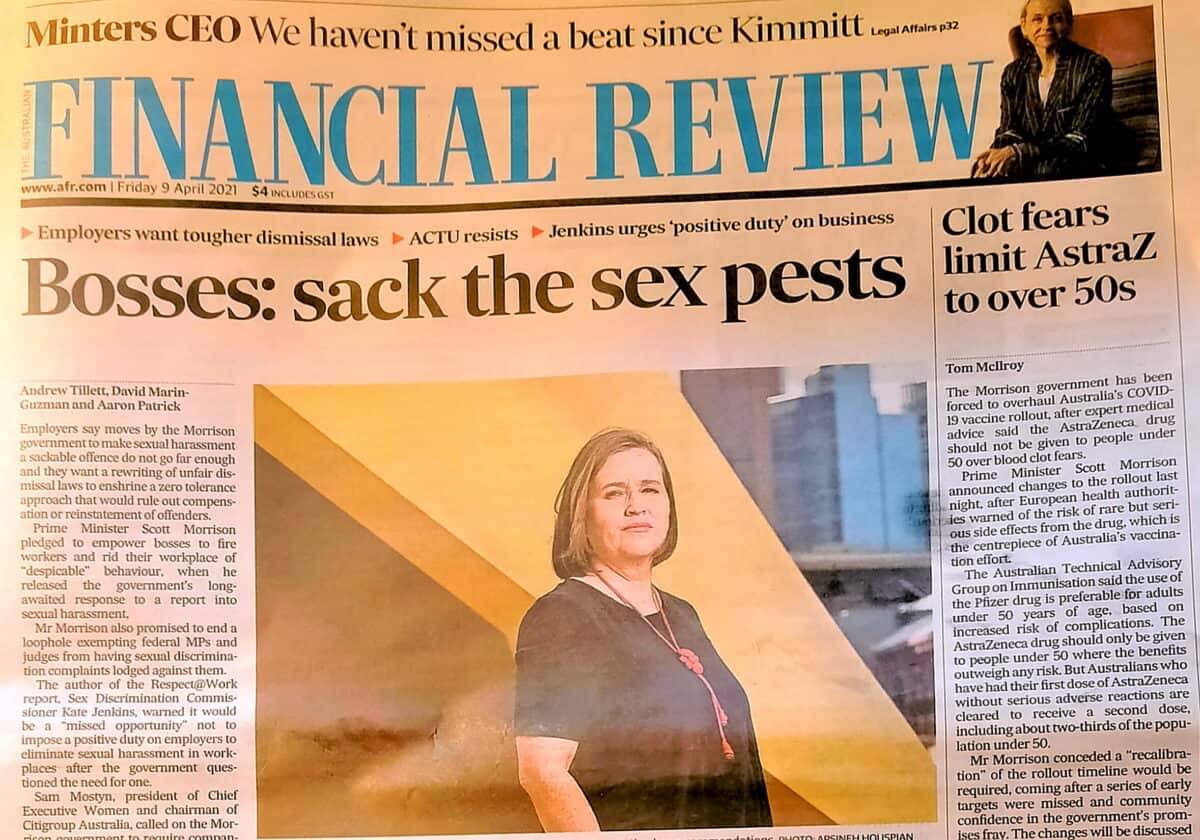
Australians become impatient for change on sexual harassment

Victoria, perhaps, has the best chance of applying occupational health and safety (OHS) principles to the prevention of sexual harassment and the psychological harm that harassment can generate. In the wake of the sexual harassment allegations against former Justice Dyson Heydon, several reviews into the legal profession have been announced.

Sexual harassment at work remains on the national agenda with the Federal Government yet to respond to the Australian Human Rights Commission’s (AHRC) Respect@Work Report which has been sitting with the government since March 2020.

Subscribe to SafetyAtWorkBlog to continue reading.
Subscribe Help
Already a member? Log in here

“Justice Tempered” – ethics and abuse

Recently the Finance Sector Union (FSU) released a small study on ethics and capitalism. The report illustrates how poor corporate ethics and greed created a disregard for the mental health of the finance industry’s workers as well as the financial and mental health of its customers.

The report – “Justice Tempered – How the finance sector’s captivity to capitalist ethics violates workers’ ethical integrity and silences their claims for justice” – was written by John Bottomley, Brendan Byrne and John Flett. Although it is based on detailed interviews with only eight finance sector workers, the authors use these conversations as a catalyst for broader discussions of ethics with extensive cross referencing of relevant, books, publications and, especially, the findings and report of the Royal Commission into Misconduct in the Banking, Superannuation and Financial Services Industry.

Subscribe to SafetyAtWorkBlog to continue reading.
Subscribe Help
Already a member? Log in here
Concatenate Web Development
© Designed and developed by Concatenate Aust Pty Ltd