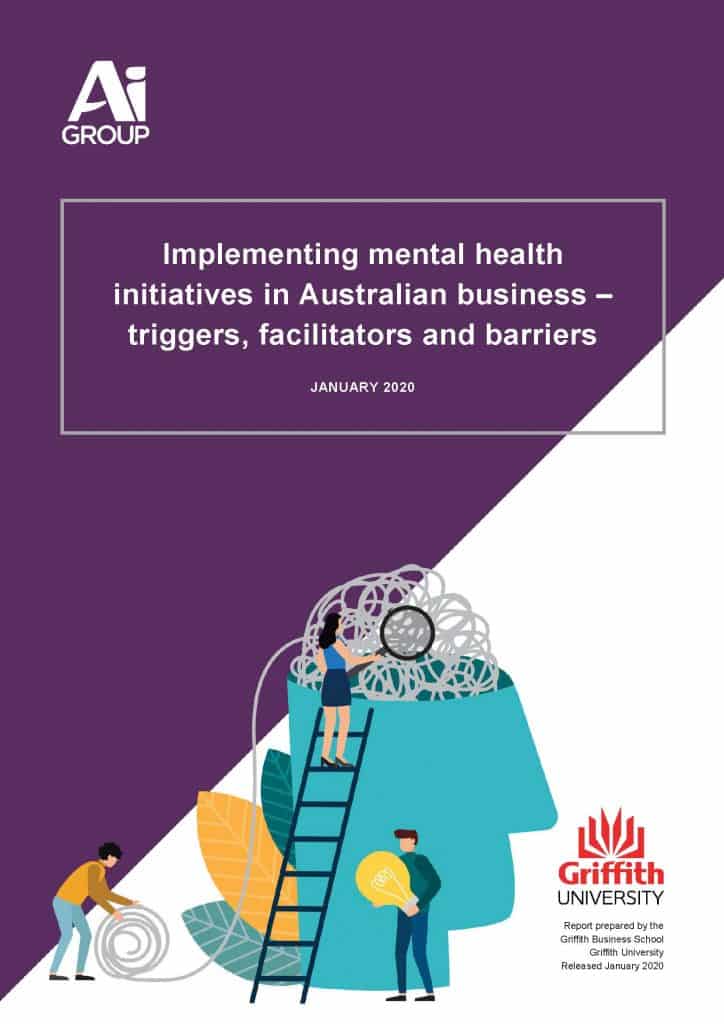
Harm prevention gets short shrift from Aigroup report

The Australian Industry Group has released research into workplace mental health conducted by Griffith University. The AiGroup claims it is a

“… a landmark study into mental health initiatives taken in local workplaces”.

It is far from it. Workplace mental health will only become more important in 2020 with reports due from the Productivity Commission and the Australian Human Rights Commission. Sadly the AiGroup report gives inadequate attention to the prevention of work-related psychological harm even though this has been identified by some Australian mental health experts as the most cost-effective and sustainable business strategy.

The most obvious problem with the report is with this statement:

Subscribe to SafetyAtWorkBlog to continue reading.
Subscribe Help
Already a member? Log in here

Good article ……. And?

There is an article doing the rounds of some of the American newspapers called “Shaping culture to be psychologically healthy” by Bill Howatt. It is a solid article but illustrates some of the limited thinking common to advocates of psychological health in workplaces.

Howatt writes about establishing and managing a suitable culture through leadership, education, awareness and other activities. But organisational cultures operate within a larger pool of cultural contexts and, most importantly, business structures.

Subscribe to SafetyAtWorkBlog to continue reading.
Subscribe Help
Already a member? Log in here

Mental health prevention is still glossed over

The latest edition of CEO Magazine contains a brief report of a workplace mental health breakfast seminar. It is written by John Karagounis, the CEO of the CEO Circle, the host of the seminar. Prominent speakers included Julia Gillard, Paul Howes and Georgie Harman, all associated with beyondblue. The prevention of mental ill-health at work is only inferred in this article, which reflects the dominant, and limited, perspective of most of the mental health sector. A deeper and broader analysis of workplace mental health is deserved.

However, the article included two statements of note. Clarification is being sought on this Karagounis statement:

Subscribe to SafetyAtWorkBlog to continue reading.
Subscribe Help
Already a member? Log in here

Australian research into corporate culture and mental health

In December 2019, it was announced that Professor Maureen Dollard had received funding to investigate “the impact of toxic workplaces on mental health”. The significance of this research is evident in the University of South Australia media release which describes this research as the “first of its kind in the world.

Subscribe to SafetyAtWorkBlog to continue reading.
Subscribe Help
Already a member? Log in here

Recognition for hard work and inspiration

There seems to be a spate of intelligent and knowledgeable people talking about the structural changes required by businesses to reduce and prevent psychological harm. Two Australian voices are Lucinda Brogden and Dr Rebecca Michalak. New Zealand has Dr Hillary Bennett who recently received a Lifetime Achievement Award at the New Zealand Workplace Health and Safety Awards. Bennett’s interview with SafeGuard magazine should be obligatory reading.

Bennett is asked about the Human Resource (HR) profession and nails a critical difference in the HR approach to the occupational health and safety (OHS) one:

Subscribe to SafetyAtWorkBlog to continue reading.
Subscribe Help
Already a member? Log in here

Mining comments are revealing

The reader’s comments on online articles can be very revealing. Below is a discussion of some of the comments posted on The Australian website in response to an article about the accuracy of workplace fatality data in the mining industry. Given that this is one of the few mainstream media articles about occupational health and safety (OHS), they are telling.

One commenter asked the newspaper:

“… if one of your accountants based in the Sydney office were to have a car accident in Parramatta while driving to work in the morning, would you include that in your OHS statistics as a workplace fatality?”

Subscribe to SafetyAtWorkBlog to continue reading.
Subscribe Help
Already a member? Log in here

Even neuroscience needs sociology

Summer in Australia means a lot of time traveling in a car, often to the extent of completing an abridged audiobook and/or several podcasts.  One episode of BBC’s The World This Week caught my ear, not because it is titled “Australia Burning” but for the opinion piece by Martin Bashir (17 minute mark). Bashir discusses mid-life crises, risk aversion and neuroplasticity. I look at the relevance to occupational health and safety.

Bashir spoke about the importance of challenging oneself, especially at “an age of comfort” (my term) an achievement. This may not seem related to OHS, the raison d’être of this blog, but the age of comfort can be defined as an age of safety or risk aversion, or as Bashir says “a mechanism for self-protection”, and this period in our lives may bleed into the way we see the world, the type of OHS advice we may provide our clients and, perhaps, the way that our OHS legislation is constructed.

Subscribe to SafetyAtWorkBlog to continue reading.
Subscribe Help
Already a member? Log in here
Concatenate Web Development
© Designed and developed by Concatenate Aust Pty Ltd