Business continuity planning by another name

Occupational health and safety (OHS) gets a mention in a full-page advertorial in the Australian Financial Review (AFR) (February 3 2021, page 33) revolving around the legal and business services of Clyde & Co. The advertorial contains a good example of the contemporary business jargon such as “organisational resilience” – a concept that has come to the fore during the COVID-19 pandemic.

“Organisational resilience” has several definitions but here is one used by the British Standards Institution:

“….the ability of an organization to anticipate, prepare for, respond and adapt to incremental change and sudden disruptions in order to survive and prosper.”

This has very strong similarities to the much longer-established concepts of “business continuity” or sustainability within which OHS has dabbled for decades.

Subscribe to SafetyAtWorkBlog to continue reading.
Subscribe Help
Already a member? Log in here

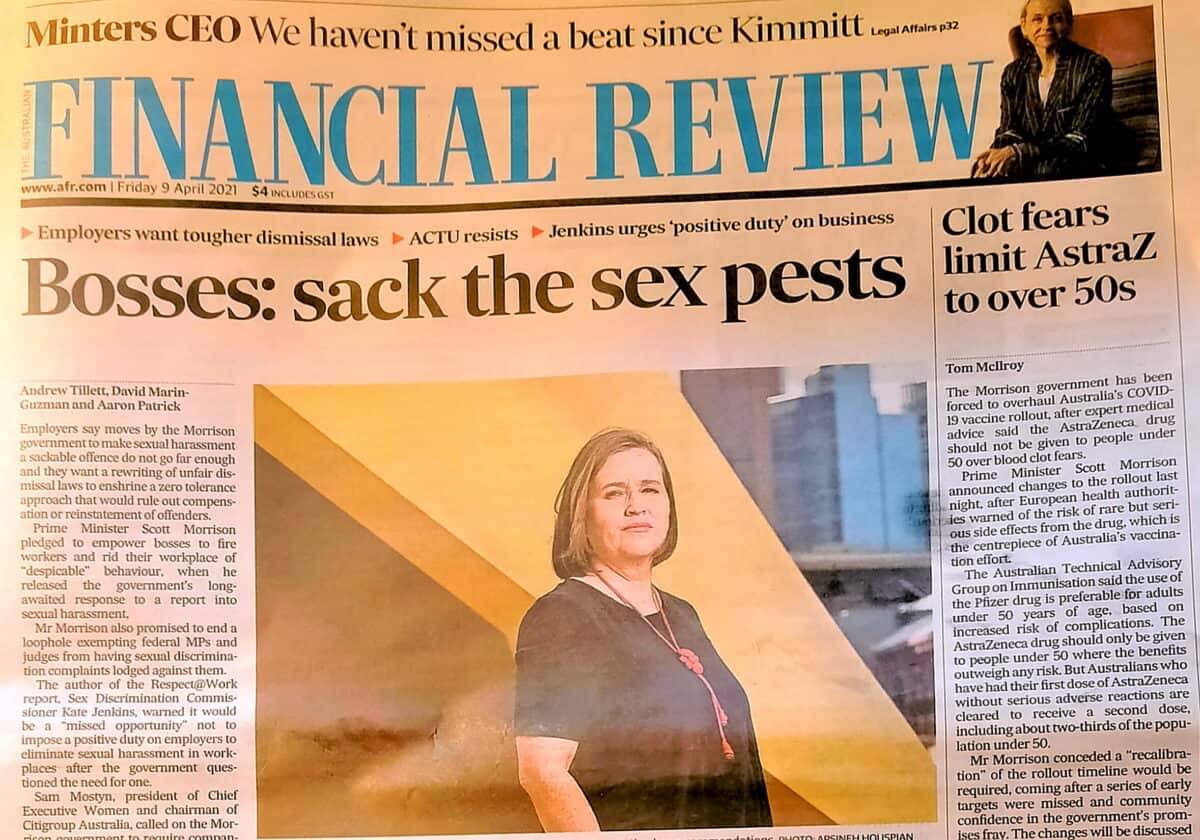
Odd sexual harassment guidance

Safe Work Australia has released an important national occupational health and safety (OHS) guidance called “Preventing workplace sexual harassment.” The advice included is very good, but the presentation is so plain and vanilla as to be unattractive – unattractive in that there is little to encourage anyone from reading what is very important information. No images, no flowcharts, no graphics, no infographics but perhaps most importantly – no case studies.

This is not to suggest that SWA guidance needs to look like a “Dummy’s Guide”, but readability is more than grammar, understanding comes from more than just information.

Subscribe to SafetyAtWorkBlog to continue reading.
Subscribe Help
Already a member? Log in here

Ask not what WorkSafe can do for you, but what you can do to improve safety

One of the most difficult industries in which to achieve occupational health and safety (OHS) improvements is farming, especially in areas where farming continues to be done by small family units. The safety culture of farming is unique as the workplace is embedded in community and rural culture. Some people believe that OHS regulators have given the agricultural industry an easy run for too long, as stated by Mick Debenham in a recent opinion piece in The Weekly Times (paywalled), but farmers should perhaps ask themselves why people continue to die on their farms and what they can do to change this.

Subscribe to SafetyAtWorkBlog to continue reading.
Subscribe Help
Already a member? Log in here

Biden reverses Trump’s position on workplace safety

It is fair to say that the term of office for President Trump was not supportive of occupational health and safety (OHS). Former President Trump did not seem to see the need for OHS regulations and his attitude to the COVID-19 pandemic meant that it would never be considered as an occupational disease. Reports over the last week in the United States media, and the issuing of an Executive Order, indicate that new President Biden values workplace health and safety.

The New York Times (paywalled) is reporting that

“President Biden directed the Occupational Safety and Health Administration [OSHA] on Thursday to release new guidance to employers on protecting workers from Covid-19.
In one of 10 executive orders that he signed Thursday, the president asked the agency to step up enforcement of existing rules to help stop the spread of the coronavirus in the workplace and to explore issuing a new rule requiring employers to take additional precautions.”

Subscribe to SafetyAtWorkBlog to continue reading.
Subscribe Help
Already a member? Log in here

Wilde about Industrial Manslaughter

Many people are sick of the issue of Industrial Manslaughter because it has seemed to dominate the discussion of occupational health and safety (OHS) and taken the focus away from harm prevention reforms on silica, mental health and others. However, Industrial Manslaughter (IM) continues to be raised in Australian Parliaments. In December, Shadow Minister for the National Disability Insurance Scheme & Government Services, Bill Shorten, reminded us of some of the arguments in favour of Industrial Manslaughter laws and penalties.

Subscribe to SafetyAtWorkBlog to continue reading.
Subscribe Help
Already a member? Log in here

Lindstrom, Common Sense and OHS

I found Martin Lindstrom’s latest book, The Ministry of Common Sense, very funny, then anger replaced funny and I had to put down the book and come back to it later. The book is excellent but all the examples of corporate nonsense that Lindstrom provides can be overwhelming. It also contains dozens of examples that are very close to my own experience and, in many cases, nonsense that I have created or supported when advising clients about occupational health and safety (OHS). SafetyAtWorkBlog asked Lindstrom about how Common Sense fits with OHS.

Subscribe to SafetyAtWorkBlog to continue reading.
Subscribe Help
Already a member? Log in here

You cannot have a future of work without a past

It seems like every other day there is an article online or in the press about the “future of work”. One I noted this morning is a two-minute video posted by Human Tech. The odd thing is that the future the speaker, Blake McGowan, discusses is very familiar, but is more about the past and the present than the future and it is very difficult to progress if you don’t acknowledge the history.

Subscribe to SafetyAtWorkBlog to continue reading.
Subscribe Help
Already a member? Log in here
Concatenate Web Development
© Designed and developed by Concatenate Aust Pty Ltd