
The occupational health and safety (OHS) sector has made much noise about workplace safety cultures. So, it is interesting to watch corporate debates on culture, especially with the increased attention to the psychological harm that some cultures create for workers. The Australian Financial Review’s (AFR) BOSS section included a short article about the the possible consequences of an autocratic leadership style, in this case, the conduct of Newcrest’s Sandeep Biswas.
Category: safety culture
Working Hours and Leadership
The workplace issues of excessive hours, unpaid overtime and the negative mental health and social disruption effects are becoming more commonly discussed but not, necessarily, fixed. A persistent example of these workplace hazards is the sitting of Parliament.
Parliamentarians are not always good examples of leadership and nor are they good managers of their workplace responsibilities, as shown by the response to sexual harassment and alleged assaults in the Federal Parliament House. A less controversial example of their management is the flexible hours applied to the passing of, usually contentious, legislation.

OHS must understand business perspectives and vice versa
This week Forbes magazine included a peculiar article about Australian occupational health and safety (OHS) headed “If You Think Managing Worker Health And Safety Is Expensive, Try An Accident“. The article written by Susan Galer includes several curious perspectives and mentions industrial manslaughter (IM).
Is a definition of a “safe system of work” still needed?
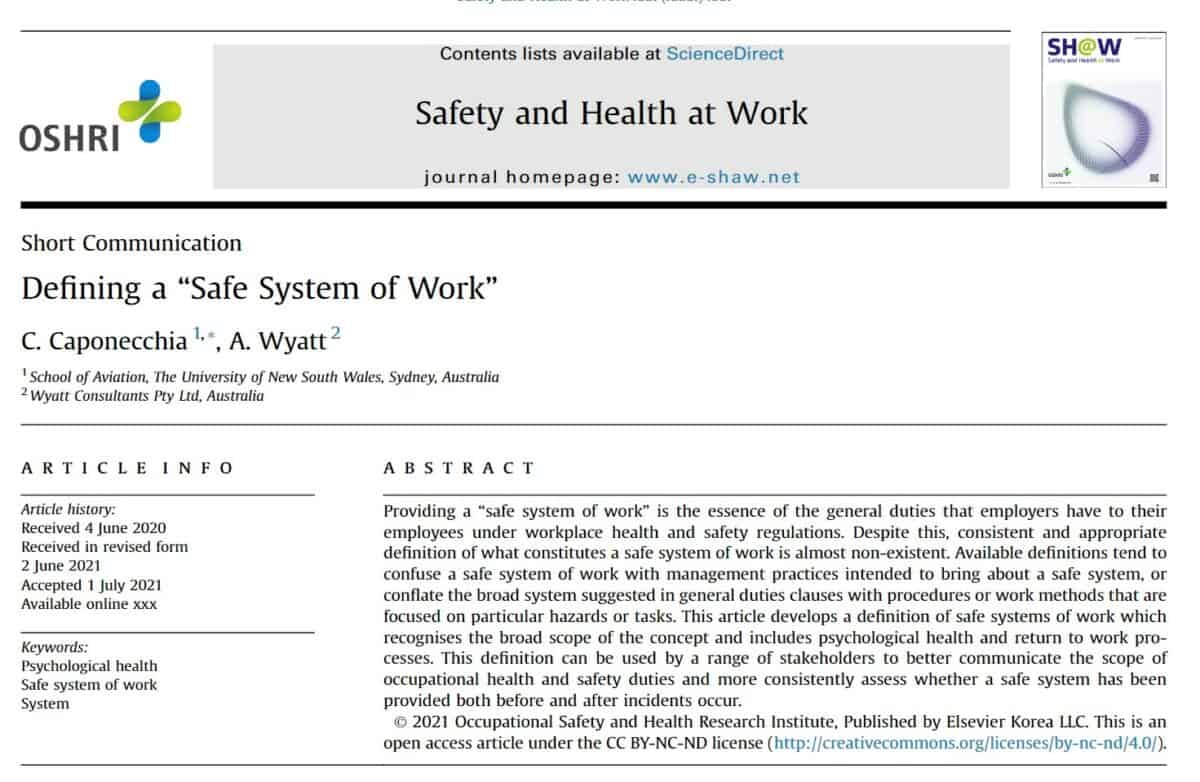
Recently Carlo Caponecchia and Anne Wyatt published a short article about the “safe system of work” (open access for a limited time) – an important concept of occupational health and safety (OHS) and element of OHS laws, but one that is poorly defined; possibly because a sociological definition is more useful, and the sociology of work has always played second fiddle to the legal. This concise article should spark a lively discussion on safety management systems, safety culture and the safe system of business.
NZ research into transport industry OHS is relevant everywhere
In 2019, Victorian Premier Daniel Andrews flagged that incidents involving commercial vehicles would be reflected in workplace health and safety statistics. There has been little visible change on this pledge. Still, recently WorkSafe Victoria reviewed its work-related fatality statistics to include truck fatalities and other causes of work-related deaths for the last couple of years. Guess what, the number of deaths almost doubled for that period from 26 to 49!! What would the rate of serious injuries be if it was also reassessed?
New Zealand undertook a similar exercise a few years ago, which has led to a significant research project into that country’s transport industry and supply chains, a research project with substantial relevance to Australia and elsewhere.

Dehumanising OHS
A recent online article started:
“We all deserve to leave for work each day, knowing that if we say goodbye to our loved ones, it’s not goodbye forever. And when we’re at work, our laws should protect us and keep us safe.”
It contains a heartfelt sentiment but also perpetuates a myth. Occupational Health and Safety (OHS) laws do not protect us or keep us safe. They establish a socio-legal framework that needs to be enforced by a combination of employers, workers, Regulators, Health and Safety Representatives, bystanders, the public, the government, relatives, and others, depending on the work situation at the time.
Just as “mindful” has a different subtext to “careful” so we need to avoid empowering laws beyond their design and dehumanising the OHS process. We need to remember that people are integral to the enforcement of OHS laws, duties and obligations for if we remove people from this activity, OHS becomes a responsibility of everyone and no one.
BTW, the article is a lovely profile of Lana Cormie
More OHS information on Midfield Meats
Recently The Monthly magazine took a close look at the labour practices of Midfield Meats (paywalled), a major Warrnambool company and meat exporter that had been, yet again, successfully prosecuted by WorkSafe Victoria. There are workplace safety elements to The Monthly’s story that were not as prominent as other issues and there were some questions for companies and governments that have supported Midfield in the past.