The 21st World Congress on Safety and Health in Singapore has closed. The next will be in 2020 in Toronto Canada. But before the closing ceremony the range of symposia continued. One discussed best practice in occupational health and safety (OHS) and I had the chance to speak about the downside of Zero Harm. The…
Category: safety
People Centred Prevention should not be a new concept
The World Congress on Safety and Health is physically and mentally exhausting. Physically, simply because of its size. Mentally because there is so much information. Some that confirms your occupational health and safety (OHS) approach and others that conflict with what you know. Some information that seems incredibly dated and anachronistic but you look around and this seems new and wonderful to other delegates.
A major theme of the Congress was “People Centred Prevention” (PCP). This is one of the anachronisms. Wasn’t OHS always about keeping people safe? If this theme had originated in the United Kingdom, it could have been contextualised as redressing the red tape attack on OHS regulation by previous governments – bringing the humanity back to OHS – but it is being proposed in this Congress as a significant change of focus and perspective.
Exclusive interview with Hans-Horst Konkolewsky on Vision Zero
A major theme of the World Congress of Safety and Health 2017 is the extension and strengthening of the Vision Zero concept. One of major advocates of this is Hans-Horst Konkolewsky, of the International Social Security Association. Konkolewsky sees Vision Zero as a “life changer”.
Any safety concept that includes the word “zero” is inflammatory to some sectors of the Australian occupational health and safety (OHS) profession as is evident by some of the tweets received by @SafetyOz over the last few hours. Late on Day One a question from the audience also expressed wariness over the use of the concept. However SafetyAtWorkBlog was able to interview Konkolewsky at the congress over a decade after our first interview, when he was head of EU-OSHA. We outlined the Australian perspective – “Zero Harm” – and his clarification of Vision Zero is important.
Below is audio of the exclusive seven minute interview.
“Shoelaces” – a safety ad that is impossible to ignore
The World Congress on Safety And Health 2017 has awarded some media producers for their occupational health and safety (OHS) themed productions. Below is one of them.
There is some thematic similarity to WorkSafe Victoria’s Homecoming campaign, specifically to the child wait for the Father to return from work and the mother on the phone, but there are different emotional touchpoints.
A major part of the emotional impact comes from the ad not dealing with a workplace fatality. The reaction from the Father in the hospital bed is powerful.
The ad is well worth watching and sharing.
Marnie Williams talks of farm safety, responsibility and a radical future
WorkSafe Victoria’s Executive Director, Health and Safety , Marnie Williams, has had a horrid week. Last Saturday, while being ill with a cold, she stood in for the Victorian Industrial Relations Minister at a Migrant Worker Forum, at which she was asked “what you gonna do about it?”. However she continues to make herself available, a crucial element for any leader of a regulatory agency.
Farm Safety
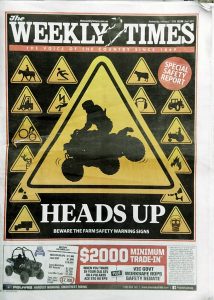
A couple of days later at a safety conference run by the Safety Institute of Australia, SafetyAtWorkBlog accused WorkSafe of not doing enough about the safety of Victorian farmers. Williams rejected the accusation and forecast a new, and surprising, approach for agricultural safety.
Willox talks safety, fluidity, insurance and manslaughter
Innes Willox of the Australian Industry Group is a well-established figure in Australia’s political and industrial landscape. As such he was a good choice to be the first speaker at a small safety conference in Melbourne Australia.
The best speakers about workplace safety are often those who do not speak about safety but those who speak about a world that includes occupational health and safety (OHS).
Broken Windows seems to work
I have written before about the use of Broken Windows theory in an occupational health and safety context. Earlier this year another OHS professional, Bryan McWhorter, wrote about his success in following this approach.
One advantage of talking about this theory is that it applies a concept from outside the OHS field to affect worker and manager behaviours. A safety professional can use the theory’s origin story to show a different approach to safety management. It allows a rationalisation for enforcing safety on those “long hanging” hazards. Continue reading “Broken Windows seems to work”