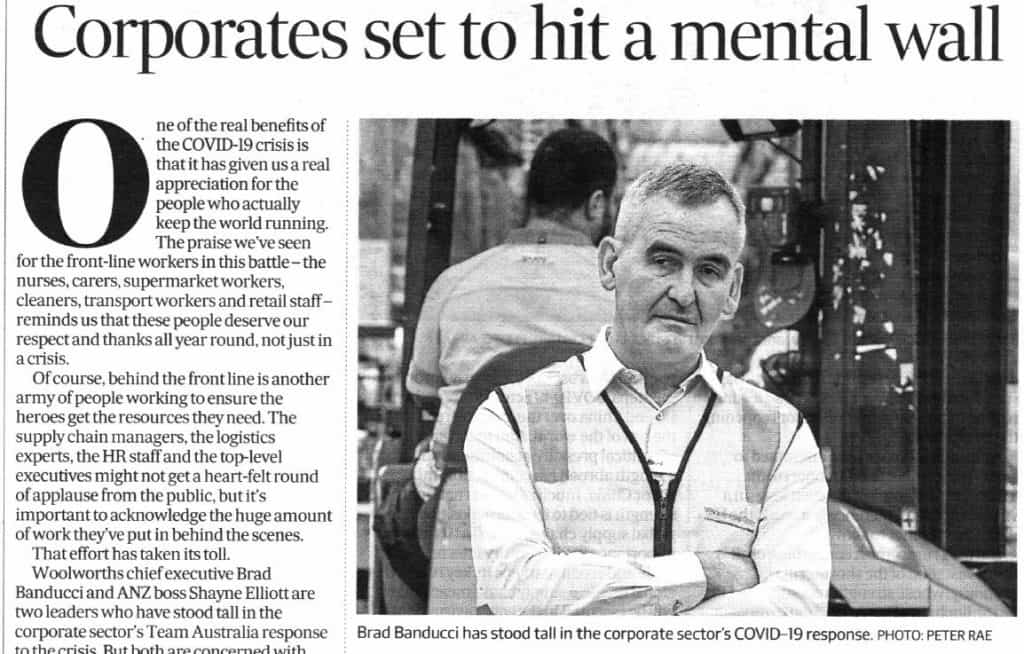
Looks good but could be better

The Australian Financial Review on October 1 2019 contained an exclusive report on consulting firm (paywalled) Deloitte’s approach to mental health at work matters coinciding with National Safe Work Month. The original document is unlikely to be publicly released but Edmund Tadros‘ report provides some quotes and insights. The initiative seems very positive until you consider it in light of organisational changes recommended to control and prevent this psychological hazards from Safe Work Australia (SWA) guidance.

Tadros quotes Deloitte’s Australian CEO Richard Deutsch:

“Mr Deutsch said in the message that individual differences could mean “what I find stressful you may find motivating, and vice versa. I don’t want anyone to feel their health and wellbeing is compromised because of work”.

This broad statement fits with the employer’s duties under occupational health and safety (OHS) laws, so it’s a good start. But doubts about the strategy start to emerged when Deutsch mentions workload, a contentious issue for Deloitte’s junior staff:

Subscribe to SafetyAtWorkBlog to continue reading.
Subscribe Help
Already a member? Log in here

International healthy workplace conference

The wave of workplace wellness cannot be avoided but wellness is only part of achieving safe and healthy workplaces. At the end of October 2019 Melbourne is hosting the 7th Global Healthy Workplace Awards and Summit at Monash University.

Occupational health and safety (OHS) often accuses workplace wellness advocates of providing symptomatic relief instead of addressing issues that cause the un-wellness in the workplace. However the October summit seems to offer deeper analysis on both these perspectives and in the broader context of healthy workplaces.

Continue reading “International healthy workplace conference”

Interesting but not representative

The Australian Council of Trade Unions (ACTU) released the results of its latest occupational health and safety (OHS) survey. In past surveys respondents have been trade union members. This survey was opened to non-union members, but to what extent is unclear but this has not stopped the ACTU speaking of the respondents as workers rather than workers who are all union members.

This differentiation is important. In the 1990s when union membership was much larger, the argument that the survey results were representative of Australia’s workforce was stronger although still debatable. Representation is harder to claim now with union membership being well below 20% overall and below 10% in the private sector.

Subscribe to SafetyAtWorkBlog to continue reading.
Subscribe Help
Already a member? Log in here

Caution. Misery (and Enlightenment) Ahead.

Having been born in the north of England, I enjoy watching movies and TV shows from there, even though I need subtitles sometimes. As a child watching Ken Loach’s film Kes for school, I thought that I could easily have been that kid standing in a cold muddy soccer pitch on an estate not far from our commission house. (I have been told our previous house was demolished because it was in a block of slums) So Loach’s latest film sounded interesting and given that it depicted life in the precarious and “gig” economy, I recently joined the hundreds in the audience at the Melbourne International Film Festival to watch “Sorry We Missed You”.

I really enjoyed the film but found the story very upsetting. It’s taken me almost a week to starting writing this article and the trailer still makes me cry, so I am split on whether to recommend you see the film.

Continue reading “Caution. Misery (and Enlightenment) Ahead.”

Fence or Ambulance?

The other week Lucinda Brogden, one of Australia’s Mental Health Commissioners participated in a three day suicide prevention conference, concluding the week as a keynote speaker at an occupational health and safety (OHS) seminar. Her commitment to keep focusing on the prevention of harm made her a comfortable fit for the largely OHS audience. Hopefully her influence is big on the Australian mental health policy makers.

Brogden reminded the audience of an 1895 poem by Joseph Malins which discusses the prevention of harm through the analogy of putting a fence at the cliff edge to stop people falling rather than having an ambulance at the bottom of the cliff to collect the dead and injured. It is unlikely that Malins was thinking of workplace safety with this poem but, as a temperance activist, it is certain he was thinking about health. Regardless, the imagery is a useful and simple illustration of the advantages in the prevention of harm, and not just in relation to mental health.

Subscribe to SafetyAtWorkBlog to continue reading.
Subscribe Help
Already a member? Log in here

Happy Sad Man – men’s mental health

Last week I mentioned two work-related films at the Melbourne International Film Festival. Tomorrow’s Castlemaine Documentary Film Festival is screening Happy Sad Man a film about the mental health of Australian men. There is an overlap with work-related mental health, especially farmers, so I’ve bought my ticket.

https://vimeo.com/294254156

Kevin Jones

Identifying work-related mental health

Recently the Medical Journal of Australia published new guidelines for general practitioners (GPs) on how to identify work-related mental health conditions (MHC). This is vital information as GPs are often the first opportunity where mental health conditions can be identified or confirmed. It also assists occupational health and safety (OHS) professionals by acknowledging the role of work in the positive and negative mental health of workers.

Subscribe to SafetyAtWorkBlog to continue reading.
Subscribe Help
Already a member? Log in here
Concatenate Web Development
© Designed and developed by Concatenate Aust Pty Ltd