Political tennis on silicosis begins

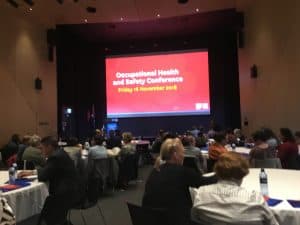
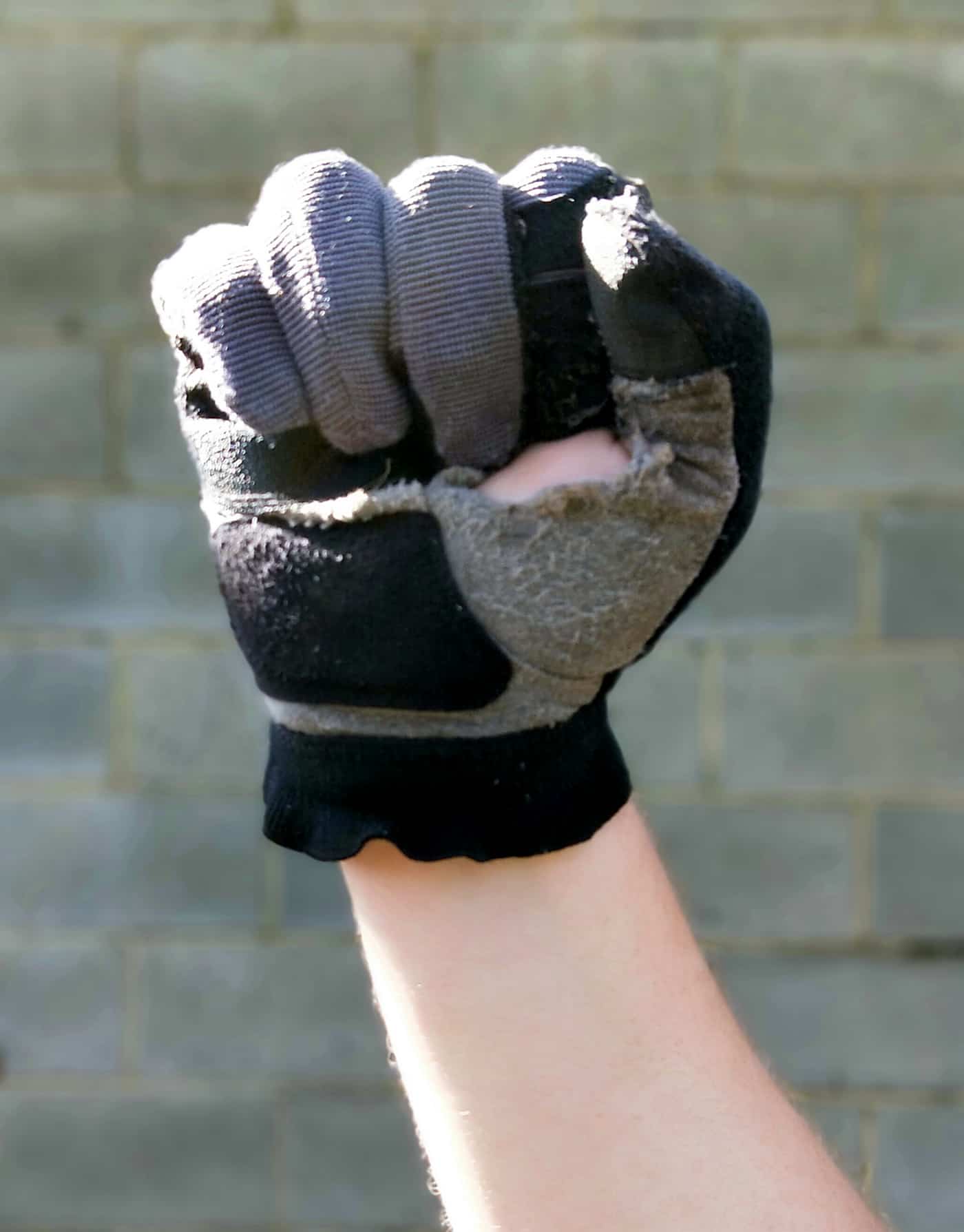
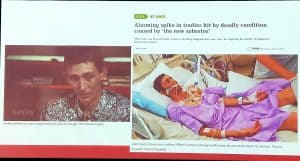
Pictured from Dr Ryan Hoy’s ANZSOM presentation

It was reported on October 11 2018 that Australia’s Health Minister, Greg Hunt, has called for:

“… state workplace regulators to immediately investigate risks to the health of stonemasons, and stop unsafe work practices.”

Some reports have said that a statement was issued:

“Mr Hunt issued a statement saying he and the Chief Medical Officer would raise the issue at a health COAG meeting in Adelaide on Friday. He said the meeting would be asked to consider whether a national dust diseases register should be developed.”

However the Minister’s Office has advised SafetyAtWorkBlog that no formal statement has been made.  This makes it a bit hard to determine what exactly he is asking for on the prevention of silicosis but the States have begun to respond.

The Victorian Minister for Health,

Subscribe to SafetyAtWorkBlog to continue reading.
Subscribe Help
Already a member? Log in here

CFMEU steps up the OHS pressure

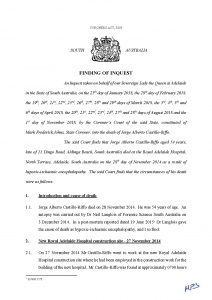
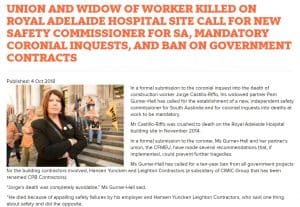
SafetyAtWorkBlog has dipped into the occupational health and safety (OHS) and political issues around the death of Jorge Castillo-Riffo in Adelaide in 2014.  On October 4 2018, the CFMEU issued a media release outlining the recommendations it made to the Coronial inquest into Castillo-Riffo’s death.  They deserve serious consideration:

  • Mandatory coronial inquests should be held into all deaths at work, with a mandatory requirement for the reporting of any action taken, or proposed to be taken, in consequence of any findings and recommendations made;
  • Families should receive funding to be represented;
  • An independent safety commissioner should be established in SA whose duty it is to review, comment and provide recommendations concerning the safety record of companies who tender for government construction contracts work over $5 million;
Subscribe to SafetyAtWorkBlog to continue reading.
Subscribe Help
Already a member? Log in here

Bill Shorten reflects on the Esso Longford disaster

Tonight, SafetyAtWorkBlog will be attending the launch of a new book that includes personal stories about the 1998 Esso Longford explosionWorkers’ Inferno.  The book is being released on the 2oth anniversary of the explosion that killed two workers, injured many others, disrupted gas supplies to the State of Victoria, resulted in a then-record fine for occupational health and safety (OHS) breaches and generated a Royal Commission.  It is also, perhaps, the best example of a company trying to blame the worker for a major incident.

The Federal Opposition leader, Bill Shorten, was an official of the Australian Workers Union at the time and today he published an opinion piece Continue reading “Bill Shorten reflects on the Esso Longford disaster”

Is OHS suffering from policy AND structural capture?

The Grattan Institute has released a report about the political influence of lobbyists.  Understandably the media is giving the report a lot of attention, particularly as it identifies lobby groups that have more access to politicians than other groups and how public interest policies have failed after intense lobbying. But the report also addresses the matter of “policy capture”.  Although the report analyses the activities of lobbyists, perhaps research could be undertaken into the high level of policy influence on workplace health and safety matters from a tripartite consultative structure that no longer reflects the Australian workforce.

In its Overview the Grattan Institute writes:

Subscribe to SafetyAtWorkBlog to continue reading.
Subscribe Help
Already a member? Log in here

Where is the Senate Inquiry into Industrial Deaths heading?

As readers would realise, the transcripts for the Australian Senate inquiry into industrial deaths are fascinating. It is worth looking at the other presentations and questions on the day when the Australian Chamber of Commerce and Industry received a grilling as this provides insight into how to present to a government inquiry addressing occupational health and safety.

The Senate Committee has probably heard more from relatives of deceased workers than has any other similar inquiry, perhaps even the Workplace Bullying inquiry in which this Committee’s member Deborah O’Neill participated.  This is an indication of the shift in OHS over the last few years where the human impacts of workplace safety failures, what some describe as the “lived experience”, gain an influence that used to sit with professionals and acknowledged subject matter experts.

Source: istockphoto, Credit: jotily – https://www.engel.ac/
Subscribe to SafetyAtWorkBlog to continue reading.
Subscribe Help
Already a member? Log in here

Review of West Gate Bridge findings has important lessons for modern infrastructure projects

2020 will be the fiftieth anniversary of the collapse of the West Gate Bridge which resulted in, amongst others, the deaths of 35 workers, changed Victoria’s approach to occupational health and safety (OHS), instigated a Royal Commission into the disaster, strengthened trade union influence and established an industrial antagonism to the John Holland group of businesses that continues today.

Panorama of West Gate Bridge in Melbourne at sunset in summer.

Last week,

Subscribe to SafetyAtWorkBlog to continue reading.
Subscribe Help
Already a member? Log in here

It’s not about doing the least possible but about doing the best

It is almost impossible to underestimate the impact that Australia’s Royal Commission into Misconduct in the Banking, Superannuation
and Financial Services Industry is already having on the corporate cultures of Australian businesses.  The effective management of occupational health and safety (OHS) relies on effective consultation, trust and respect just as does any other element in a company’s organisational culture.

The media on August 13 2018 has been

Subscribe to SafetyAtWorkBlog to continue reading.
Subscribe Help
Already a member? Log in here
Concatenate Web Development
© Designed and developed by Concatenate Aust Pty Ltd